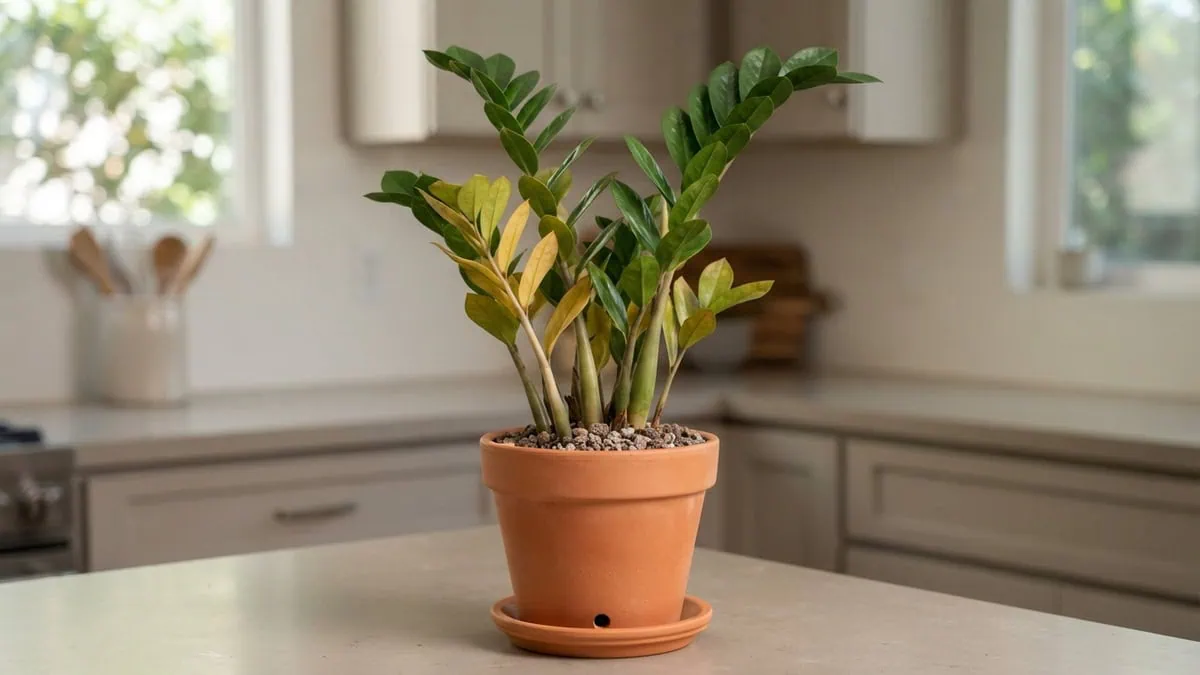
🎯 Quick Answer: Why a ZZ plant turns yellow
A yellow ZZ plant withers when soil stays wet past two weeks, rotting the rhizome of Zamioculcas zamiifolia, an Araceae aroid. If you are wondering why is my ZZ plant turning yellow, read the pattern first. A soft, sour, bottom-up yellow means rot; dry, crispy tips mean thirst or salt.
- Check the stem base first: soft and sour signals rhizome rot — act now
- Lift the pot: heavy weeks after watering means it is still soaking
- Read the position: oldest leaves yellow first with overwatering or low nitrogen
- Crispy dry tips: point to thirst, salt buildup, or a sun scorch
- Remove yellowed leaflets: they never re-green; cut low, no more than a third
I lost ZZ plants before I stopped panicking at the first yellow leaflet and learned to read it. Every time, the yellow crept up from the lowest leaves while the stems leaned and softened, and every time I grabbed the watering can.
Exactly the wrong move. Chlorosis was the plant’s flag; I kept misreading it.
Rather than read every yellow leaf as thirst, I discovered that an overwatered Zamioculcas zamiifolia rots from a rhizome that banks weeks of water underground, so another drink is the last thing it needs. Actually, I take that back… it isn’t always rot (not joking) — the same yellow can be thirst, a scorch, or salt, and only the pattern separates them.
What actually works is a quick three-look check: where the yellow sits, how the leaf feels, what the stem base is doing. Read those three. The fix starts with keeping a ZZ plant healthy from the roots up.
Full stop. Before you change a thing, breathe and run your ZZ past the following table — it points you to the one likely cause.
Why is my ZZ plant turning yellow? A quick symptom check
| What to check | What it tells you |
|---|---|
| Where the yellowing starts | Oldest, bottom leaves first: overwatering-rot or low nitrogen. Newest top leaves: iron or light. |
| How the leaf feels | Soft, limp, mushy: too wet or rot. Dry, papery, crispy: too dry or salt. |
| Stem base | Soft, squishy, darkening: rot, act now. Firm but wrinkled: too dry. |
| Soil state | Wet, sour 2+ weeks after watering: overwatering. Bone-dry, shrinking from the pot edge: underwatering. |
| Fastest cross-check | Lift the pot (heavy means still wet), or push a wooden skewer to the bottom. |
| Does a yellowed ZZ leaf turn green again? | No |
| Soil still wet 2 weeks after watering? | Yes means rot risk |
Tap the button below to get more plant fixes in your Google Search results

Table of Contents
Start by reading the yellowing pattern
Start with three quick signals before you touch a thing: where the yellow sits, how the leaf feels, and whether the stem base has softened. According to the University of Wisconsin-Madison Extension, a yellow leaf can be a normal process or a signal of something more complex, so analyzing the reasons for yellow leaves beats reacting to the color.
The color is a symptom, not the cause, and the following sections take each signal in turn.
Which leaves yellow, and do they curl in?
Position is your first read. When the oldest, lowest leaflets yellow first while the newest growth stays deep green, the trouble usually sits at the roots — overwatering rot, or a plain nitrogen shortfall. In my experience, position alone narrows it fastest.
When the top, newest leaflets pale and yellow between the veins, it points instead to iron the roots cannot pull up, often because a high soil pH has locked it away (stay with me here).
Among the common ZZ plant leaves curling inward causes, leaflets curling under as they yellow is the plant closing up to save water — usually too much direct light, or a scorch it is trying to back away from.
If instead the stalks are splaying and toppling, that is a structural issue covered in a ZZ plant that droops or topples over.
Soft-and-mushy, or dry-and-crispy?
Texture tells you which direction you went. Squeeze a yellowing leaflet and press the stem base: soft, limp, and faintly sour means the pot stayed too wet and the rhizome is rotting, while dry, papery, and crisp means it went too far the other way.
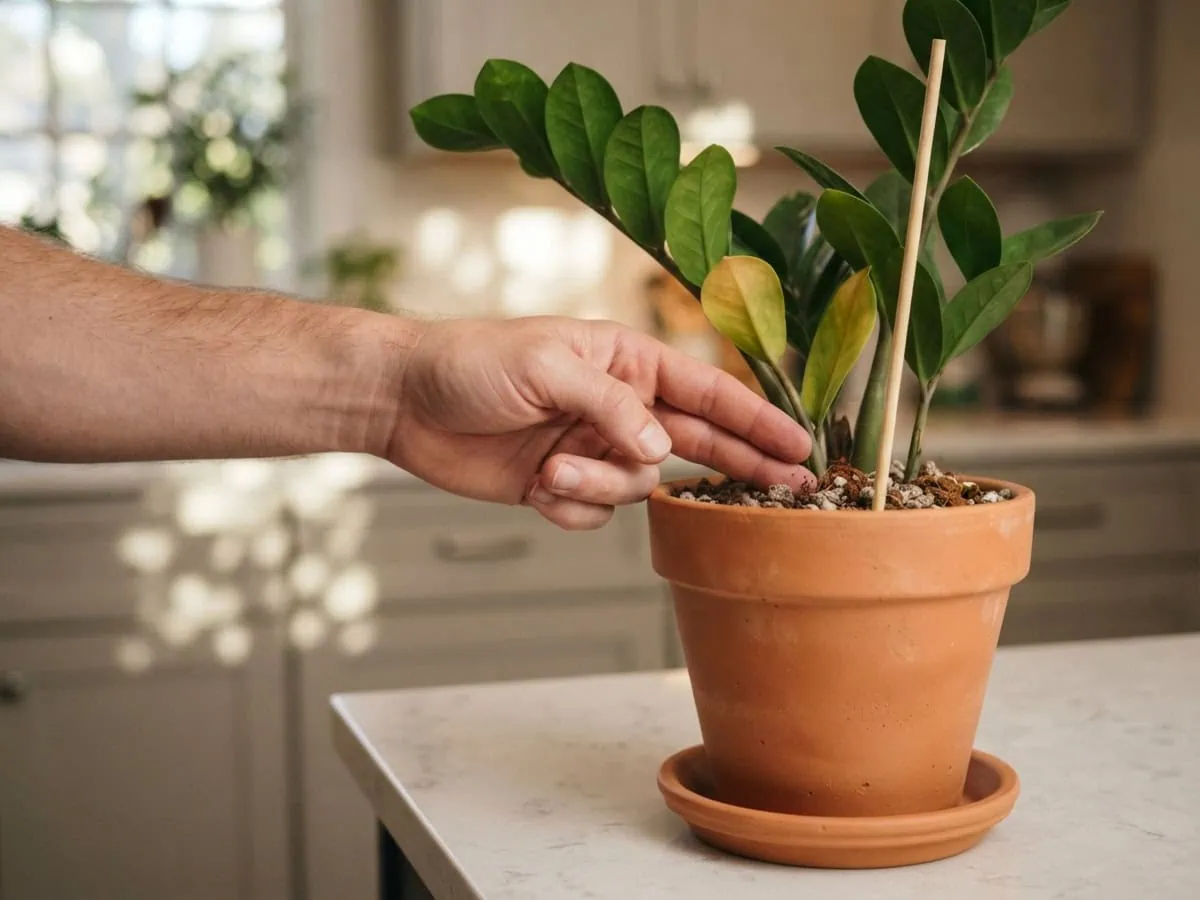
Seeing ZZ plant leaves turning yellow and brown at the same time is the classic overwatering picture — the leaf yellows, then browns and collapses as the rotting roots stop feeding it. Crispy brown that starts at the very tips, though, reads as thirst or salt, not rot.
Sun-scorched or just thirsty?
Both leave a ZZ looking crispy, but the damage sits in different places. Scorch bleaches; thirst dulls. The ZZ plant sunburn vs underwatering leaf damage question comes down to where the marks land and how the whole plant looks.
| Clue | Direct-sun scorch | Underwatering |
|---|---|---|
| Where it starts | Tips and edges facing the window | Whole leaf, oldest first |
| Look | Bleached, whitened, then brown; curling | Even yellowing, dry brown tips |
| Stems | Usually firm | Wrinkled, shriveled |
| Fix | Move back from the glass | One deep soak, then wait |
Verdict: if the bleaching hugs the side facing a bright pane, it is scorch from direct sun — roughly 1,000 foot-candles and up of unfiltered light — so pull the plant a few feet back or hang a sheer curtain.
If the whole plant is dull and the mix has shrunk from the sides, it is thirst; give it one thorough soak. A ZZ wants bright, indirect light around 500 to 2,000 foot-candles, and it will sulk pale below that, but it never wants direct sun on the leaves.
For the full picture, see how much light a ZZ plant actually needs.
Tap the button below to get more plant fixes in your Google Search results

What’s actually turning a ZZ plant yellow
Behind every yellow leaflet is one of a short list of causes, and on a ZZ the odds tilt heavily toward one. Too much water. The plant evolved to bank water in a fat underground rhizome and coast through drought, so a pot that stays wet drowns the very roots it leans on, and chlorosis follows as those roots stop delivering nutrients.
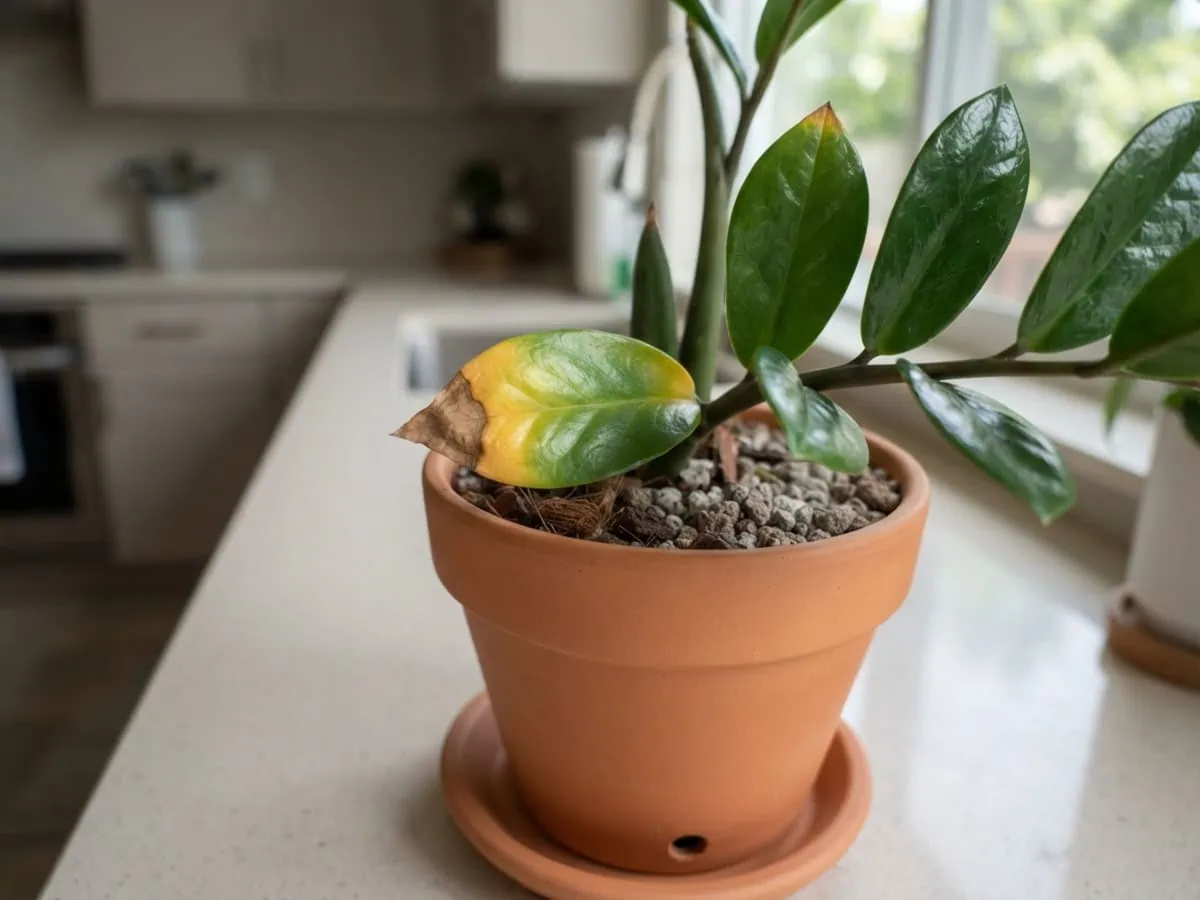
This is anecdotal, so weigh it as one grower’s pattern rather than a rule, but across my own plants the yellowing always tracked the soggy soil, not the light. The following sections rank the real causes, most likely first.
If the soil is still wet and the stem base feels soft, then stop watering and check the rhizome for rot. However, if the soil is bone-dry and the stems have gone wrinkled, then the plant is simply thirsty and needs one deep soak — not a rot rescue.
Overwatering and hidden rhizome rot
This is the big one. An overwatered ZZ yellows from the lowest leaves upward, the stems lean and go soft near the soil, and the mix smells sour when you lean in close.
And here is the trap that catches everyone, myself included: rotted roots can no longer pull up water, so the plant wilts and looks thirsty — and a reflex splash only feeds the rot.
If the stem base is soft and darkening, read it as rot and check rescuing a rotting ZZ rhizome before you do anything else.
Underwatering and wrinkled, shriveled stems
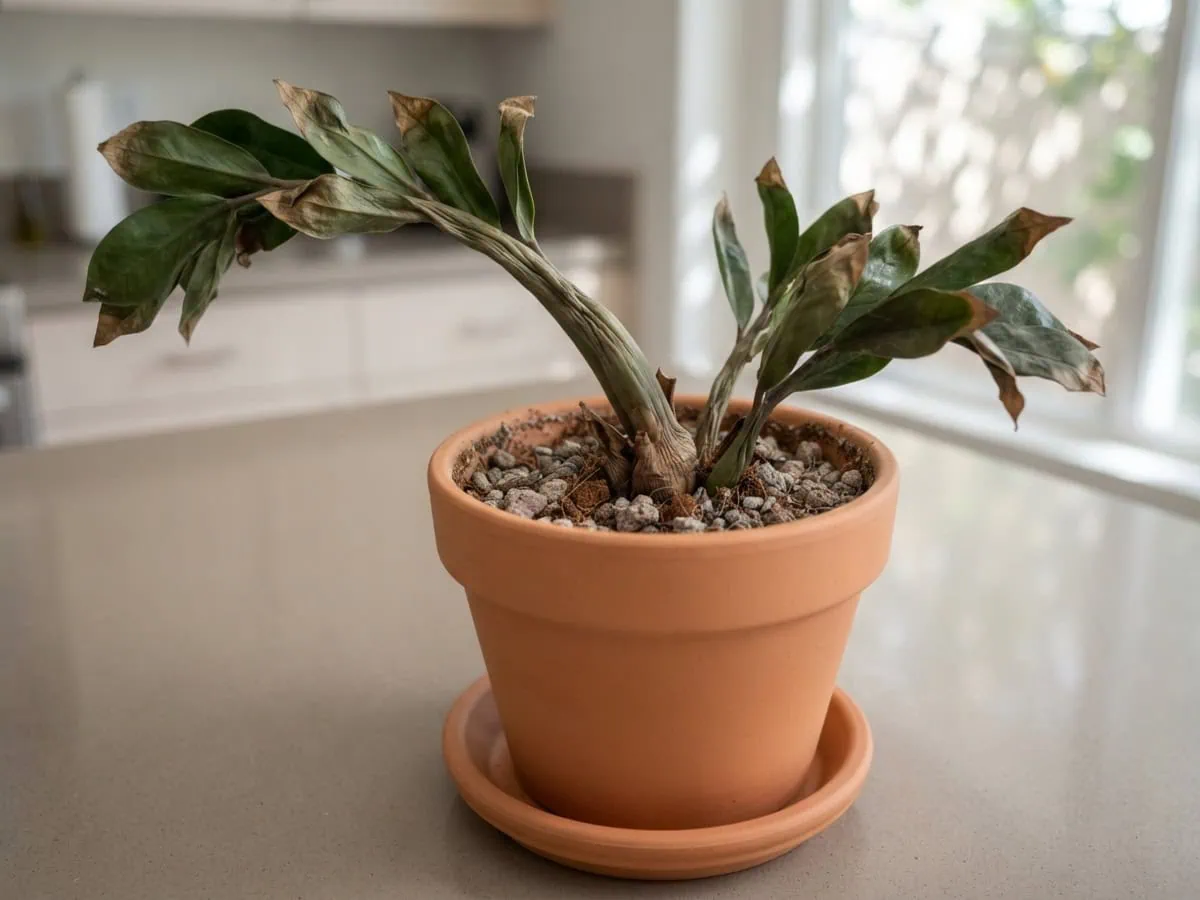
Less often, the same yellow is thirst. When a ZZ finally runs dry, the stems wrinkle and shrivel like a deflating balloon and the oldest leaves yellow and crisp at the edges.
The ZZ plant wrinkled shriveled stems meaning is almost always plain dehydration — the rhizome has spent its water reserve — and the fix is one thorough soak until it drains, then patience while the stalks plump back up. Firm-but-wrinkled re-plumps; soft-and-mushy does not, because that is rot.
Salt, hard water, and brown crispy tips
Brown, crispy leaf tips are a different signal again. So why does my ZZ plant have brown crispy tips? On a ZZ the usual answer is not exotic tap-water chemistry but plain salt — every watering leaves a little fertilizer and mineral behind, and on a slow, rarely-flushed plant those salts build into a crust that scorches the leaf margins.
The fix is to flush the pot: water heavily until it runs freely from the drainage holes, let it drain, and repeat, which leaches the built-up salts back out.
Yellow-leaf mistakes and myths to skip
A few well-meant fixes make yellowing worse, so skip these.
First, do not reach for hydrogen peroxide. Never on living tissue. It circulates as a rot fix, but poured or sprayed onto living roots, crown, or stems it burns the very tissue you are trying to save; keep it for wiping out emptied pots and tools, and dust a cut site with a little ground cinnamon instead.
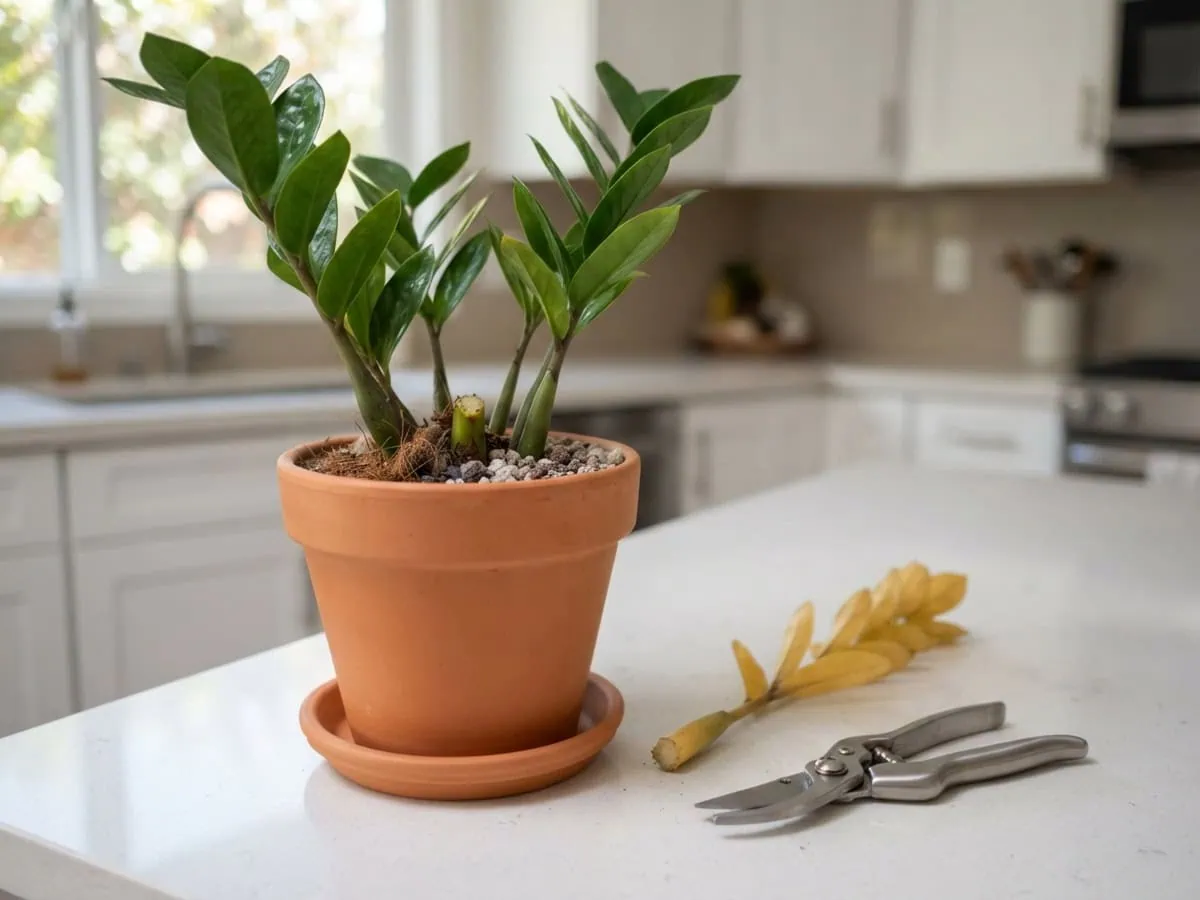
Second, a yellow leaflet will not turn green again — the chlorophyll is gone — so remove it rather than wait, cutting cleanly at the base near the soil line and taking no more than a third of the plant’s leaves at once.
And do not confuse the harmless stuff for damage: the odd dark burn mark or a hairline leaf crack is mechanical, not disease, and a single old bottom leaf yellowing now and then is just the plant retiring it. That is distinct from the black specks and spots on ZZ stems, which have their own causes.
One last myth to drop: a ZZ does not need a humidifier, and no amount of misting will green a leaf that yellowed from a wet pot. The plant recovers by pushing fresh spears from the base, not by re-coloring the leaf you saved, so once you have removed the yellow and fixed the cause, watch the crown for new growth rather than the old leaflet.
Never pour or spray hydrogen peroxide onto a ZZ plant’s living roots, crown, stems, or leaves — it burns the tissue. Save it for emptied pots and tools only, and use a pinch of powdered cinnamon on any cut. Wear gloves whenever you cut yellow leaves, because ZZ sap carries insoluble calcium oxalate raphides that irritate skin and eyes, and wash your hands afterward. This content is for informational purposes only. If you experience a severe reaction, seek medical attention. For suspected ingestion by a child, contact Poison Control (1-800-222-1222 in the US) immediately.
Frequently asked questions about a yellowing ZZ plant
How to fix yellowing ZZ plant?
Fix a yellowing ZZ plant by matching the pattern to the cause, then correcting that one thing. If the soil is wet and the stem base is soft, stop watering and check the rhizome for rot. If the soil is bone-dry and the stems are wrinkled, give one deep soak.
Move a scorched plant back from direct sun, and flush the pot if salt has crisped the tips. Remove the yellow leaves, and let new growth judge your fix: firm spears rising from the rhizome mean the cause is corrected, while more bottom-up chlorosis means it is not.
Should I cut off yellow ZZ plant stem?
Yes, cut off a fully yellowed ZZ stem, because the leaf cannot turn green again once its chlorophyll is gone. Use clean, sharp scissors and cut the whole stalk off low, at the base near the soil line, rather than trimming just the tips.
Take no more than about a third of the plant’s stalks in one session so you do not shock it. A new spear will rise from the underground rhizome in its place, drawing on the water and starch that organ banks, so the plant replaces the stalk rather than repairing it.
Will yellow zz leaves turn green again?
No, yellow ZZ leaves will not turn green again, because the yellowing means the chlorophyll in that leaflet is already gone for good. A yellow leaf is spent tissue, not a recovering one, so no amount of watering, feeding, or light brings its color back.
Remove it, and put your attention on the cause and on the crown, where fresh green spears appear once conditions are right. That new growth, not the old leaf, is your recovery signal, because a fresh spear proves the rhizome is still building chlorophyll where it counts.
Should I cut off yellow leaves?
Yes, remove yellow leaves once they are more than about half discolored, since they no longer photosynthesize and will not green up. Snip them at the base with clean scissors, and if a leaf is only partly yellow you can leave it a little longer to keep feeding the plant.
Never strip more than roughly a third at once. Removing spent leaves also lets you see the stem bases clearly to check for the rhizome rot that drives most yellowing, and it steers the plant’s nitrogen into new growth instead of dying tissue.
Can a plant recover from yellow leaves?
Yes, a ZZ plant recovers from yellow leaves as long as the roots and rhizome are still firm and healthy. The yellow leaves themselves are lost, but the plant regrows from its underground rhizome once you correct the cause — usually by drying out an overwatered pot or soaking an underwatered one. Recovery is slow, because Zamioculcas zamiifolia evolved as a drought-adapted geophyte, so look for firm new spears at the rhizome over the coming weeks rather than any change in the old foliage.
What does an overwatered ZZ plant look like?
An overwatered ZZ plant looks yellow from the bottom up, with soft, mushy stems that lean and a stem base that darkens near the soil. The mix stays wet and smells sour for more than two weeks after watering, and the lower leaves yellow, then brown, and drop.
Underneath, the normally firm, pale rhizome turns brown, soft, and foul-smelling. Because the rotted roots can no longer drink, the plant often wilts and looks thirsty — which tricks owners into watering it even more, deepening the rhizome rot and the chlorosis it drives.
Win your next yellow-leaf battle
Reading a yellow ZZ plant is a skill you build fast. The panic fades. Most yellowing traces back to a pot that stayed too wet, so check the soil and the stem base before you ever reach for the watering can.
Read first, water later. When the next leaf pales, run the three-look check, fix the one cause it points to, and give the plant time to answer from the base.
The natural next step from here is dialing in the right ZZ watering rhythm so the color never starts. Answer why is my ZZ plant turning yellow with the pattern, not a guess, and you win your next yellow-leaf battle without losing a plant to overwatering.
May you learn to read a yellow ZZ leaflet at a glance, catch its cause early, and watch fresh green spears rise firm from the base.
Tap the button below to get more plant fixes in your Google Search results