🎯 Quick Answer: the mix a parlor palm can breathe in
The best soil mix for a parlor palm in a pot triggers drainage: Chamaedorea elegans, an Arecaceae palm, needs 10-15% air-filled porosity. Coarse aggregate carries one third of the finished volume. Water only when the top 1-2 inches read dry, and keep a drainage hole under it.
- Squeeze test: damp mix crumbles open instead of holding a ball
- Water trigger: top 1-2 inches of the mix read dry
- Step up: one container size at a time, never two
- Salt flush: pour until about a tenth of it drains from the holes
- Replace the mix: sour smell, sodden feel, water sheeting off the surface
Nine parlor palms have died in my care, and every one of them went the same way: soggy soil, a sour smell like wet cardboard left in a closed garage, and roots that pulled apart between my fingers. The mix, not the watering can. (Yes, this sounds backward — bear with me.)
Five years of failure forced me to learn that a parlor palm’s roots are not drinking. They are breathing. Correction — what I meant was that Chamaedorea elegans stores no water anywhere in its slender stems, so a compacted mix with no aeration starves the roots of oxygen long before it dries.
One third of the finished volume has to be coarse aggregate. And get that fraction right, and the watering can is no longer the thing that fails the plant. Everything else this palm needs belongs to the complete growing routine behind these decisions.
Truth is — you do not have to memorize any of this; the table below sets each number beside the reason it exists.
Every number behind the best soil mix for a parlor palm in a pot
| Parlor palm specs | Working figure |
|---|---|
| Growing medium | A coarse free-draining palm mix of two parts coir to one part pine bark fines to one part coarse sand, top-dressed with a thin layer of the same coarse sand |
| Aggregate fraction of the finished mix | One third by volume |
| Air and water balance the mix has to hit | 10-15% air-filled porosity with 30-40% water-holding capacity by volume |
| Medium pH | 5.5-6.5, held at 5.5-6.0, with 6.5 as a hard ceiling |
| Container step-up | One container size at a time, so 6-inch to 8-inch or 8-inch to 10-inch |
| Drainage hole required in the growing pot? | Yes, and no vessel without one is the growing pot |
Tap the button below to get more plant fixes in your Google Search results

Table of Contents
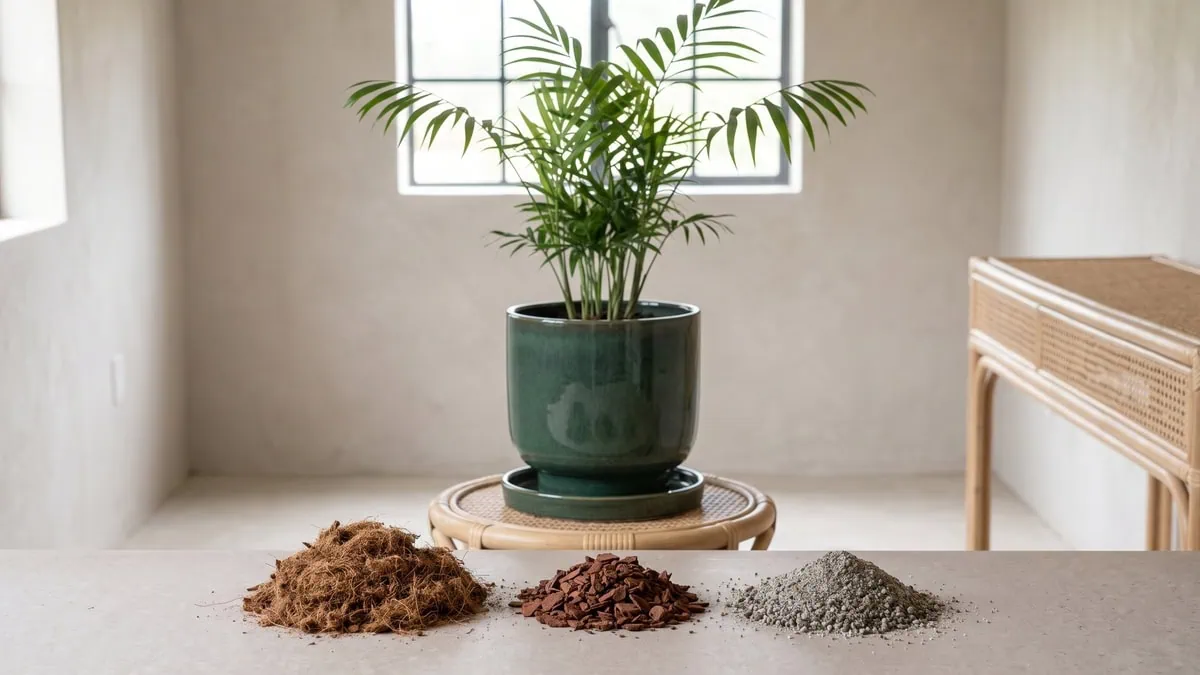
Two parts coir, one part bark, one part sand: the mix by volume
A parlor palm mix is two parts coir to one part pine bark fines to one part coarse sand, top-dressed with a thin layer of that same sand. That third is what holds air once the pot is watered, and the target it meets is 10 to 15 percent air-filled porosity. That ratio comes apart in three parts.
Why one third of the mix has to be aggregate
Type “how much perlite should I add for a parlor palm” into a search bar and the answers scatter between a fifth and a third of the pot. Take the third. Perlite, coarse sand and pine bark fines all count toward it (any of the three works).
Aggregate holds the gaps between particles open, and root oxygen occupies those gaps. According to the International Society for Horticultural Science, the particle-size distribution of a substrate is what governs how fast water drains out of it and how freely gas moves through it.
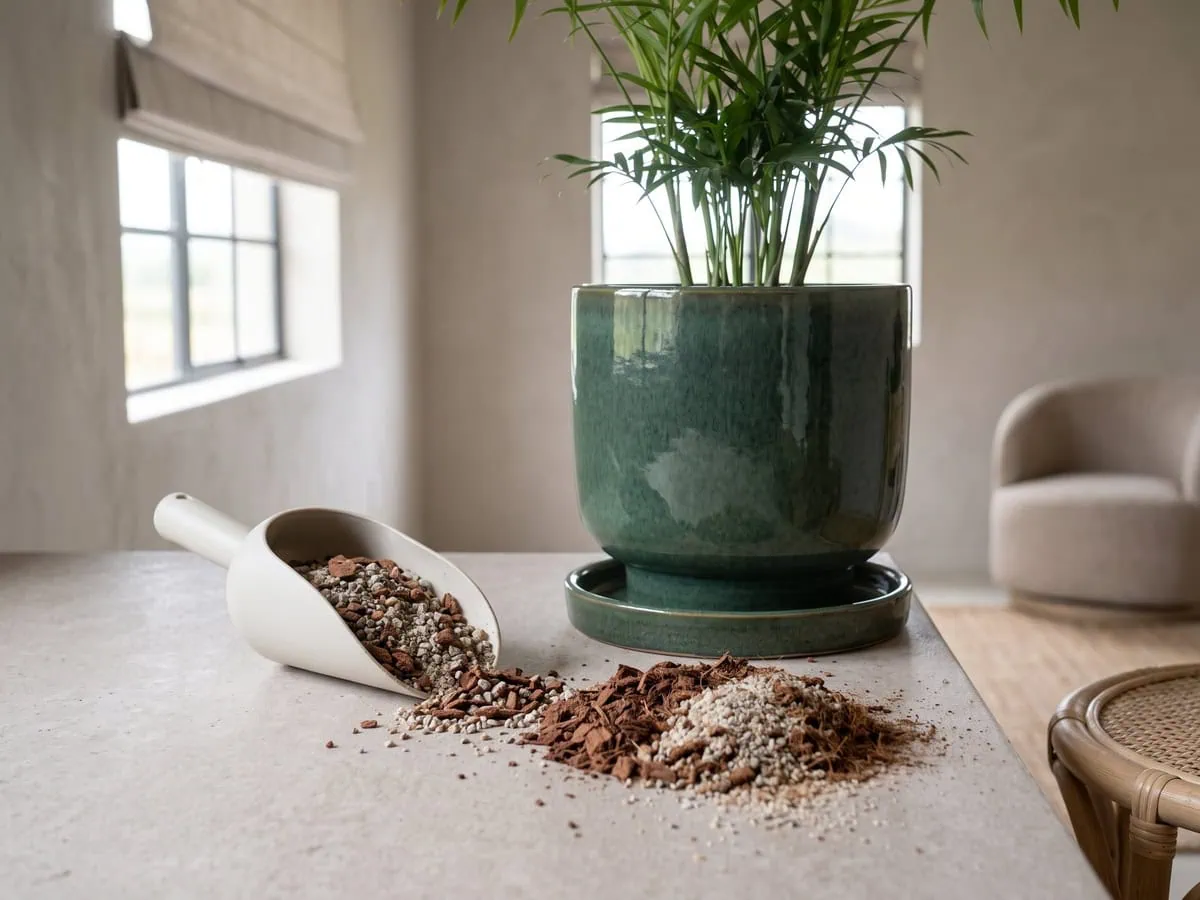
Take a handful of the moistened mix and open your hand. A ball that stays whole when prodded needs more grit; one that falls into crumbs is already at the third (bagged mixes sold with bark already in them start closer than plain ones).
- Air-filled porosity: the share of the pot volume holding air rather than water after drainage stops.
- Particle-size distribution: the mix of coarse and fine grains that decides drainage and air movement.
Peat-based or peat-free: what the split really turns on
Care pages split hard here. Tentatively, the base material matters less than what the finished bag does with water. Coir is the substitute the container-palm literature names for sphagnum peat, and it resists the hard, water-shedding crust a peat-only block forms.
| Behavior in the pot | Peat-based | Peat-free coir base |
|---|---|---|
| Re-wetting after a dry-back | Sheds water once it dries hard | Takes water back readily |
| Structure after a year | Slumps and packs down | Holds its crumb longer |
Verdict: choose the coir base for a pot you water by feel, because it takes water back after a dry-back instead of shedding it, and a bag that beads water on the first pass through will do exactly the same once the palm is standing in it.
The pH band, and the one thing that moves it
Hold the medium between 5.5 and 6.5, and nearer 5.5 to 6.0 if you have the choice. Above 6.5 manganese stops being available and palms feel that shortage before anything else does. Fresh bagged mix arrives inside that band (the bag label often prints it), so the band is not the thing to manage.
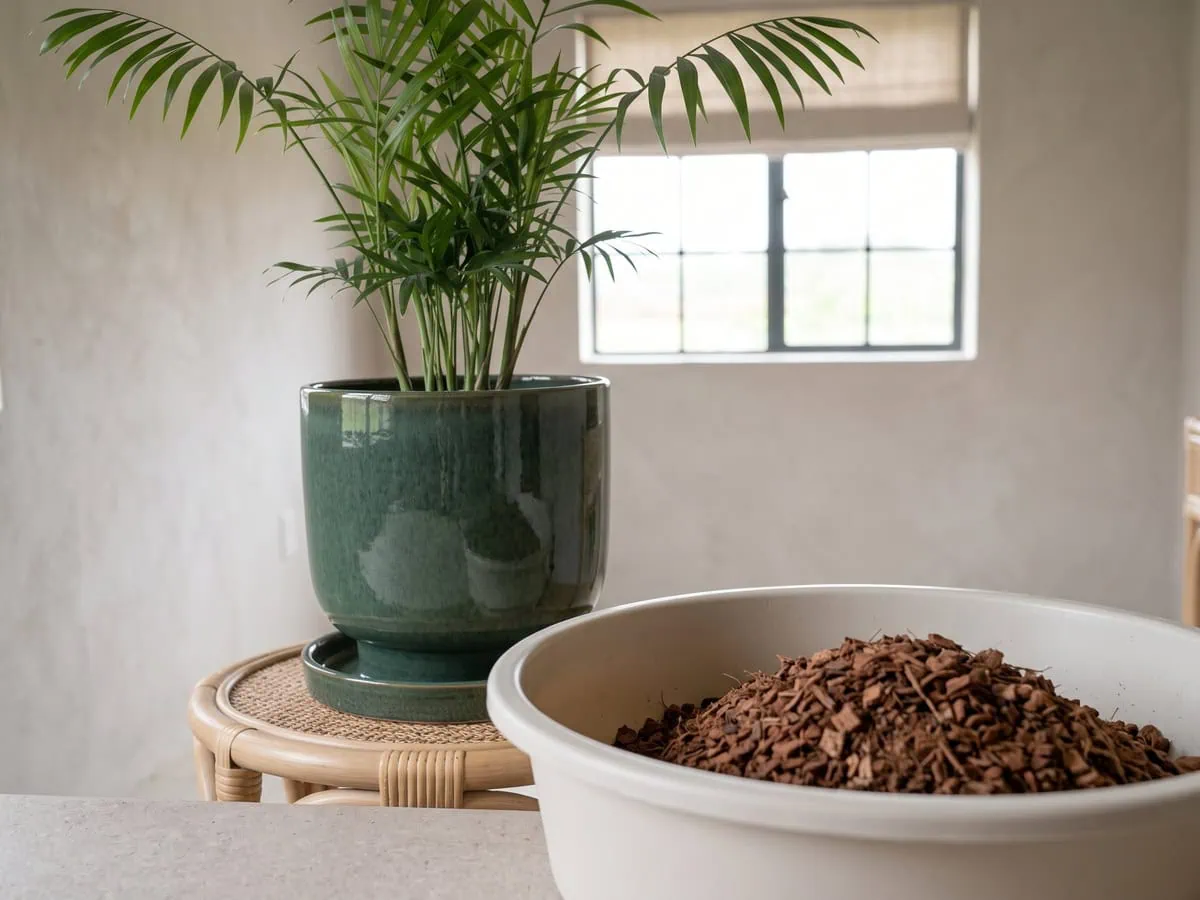
Water is. Months of hard tap water push a pot upward out of the band, which is also how salts build, and keeping mineral salts from building in the pot is the same job. A newly opened bag of pine bark fines smells of resin and rain-wet timber, sharp and clean; that is the smell a healthy pot keeps.
Tap the button below to get more plant fixes in your Google Search results

Choosing the pot: size first, material second
Step this palm up one container size at a time, so 6-inch to 8-inch or 8-inch to 10-inch, and settle the wall material afterwards, once the size is fixed. Size decides how long the mix stays wet; material only nudges that. Three questions follow, in that order.
Measure the pot you have, then add two inches
Readers asking “what size pot does a parlor palm need” get told to double it. Do not. Put a rule across the outside width of the pot the plant is in now, add two inches at most, and buy to that measurement rather than to a size name.
A pot far wider than the root plug holds water the fine roots never reach, and nothing on the surface shows it. And three of the nine palms I lost sat in exactly that, wide pots that stayed heavy for a fortnight. Getting the step right also shortens settling the plant after it has been moved up a size.
Plastic or terracotta: which wall dries faster
The question “is a plastic or terracotta pot better for a parlor palm” has no universal answer, because the wall is a drying lever rather than a quality grade. Unglazed clay pulls water and dissolved salts out through its wall; plastic and glazed ceramic hold both inside (which is why one watering habit gives two different results in two pots).
| Wall behavior | Unglazed terracotta | Plastic or glazed |
|---|---|---|
| Dry-down speed | Faster, through the wall | Slower, only from the surface |
| Salt handling | Wicks salts into the wall | Keeps salts in the mix |
Verdict: take terracotta if you water generously or the plant sits in a dim corner, and plastic or glazed if your palm stands in warmth and bright light and dries out on you.
Drainage holes, saucers and the cachepot trap
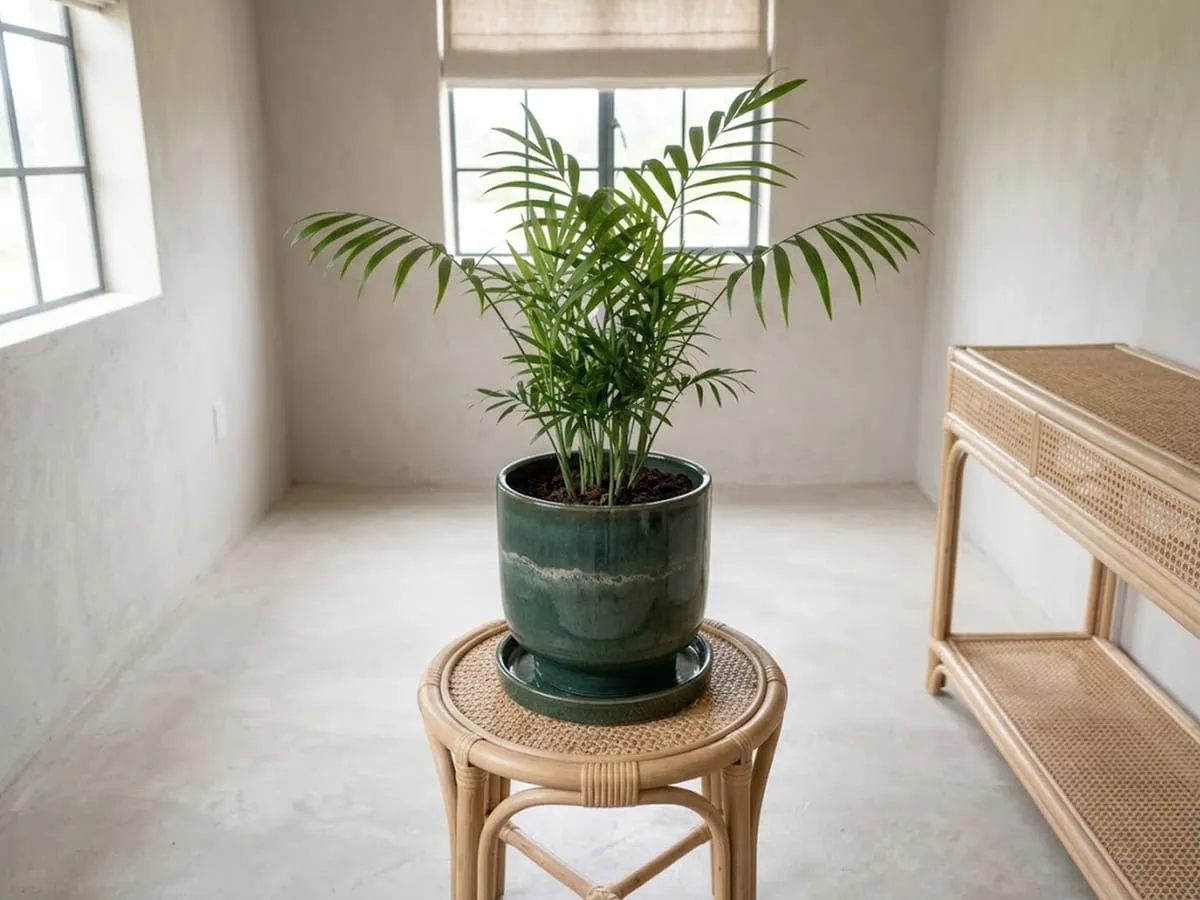
The growing pot has a drainage hole (no exceptions, decorative or otherwise). A handsome outer vessel without one is a saucer you cannot tip, and the water it catches sits around the root plug unseen (you find it only when you lift the pot out).
Keep the palm in a liner pot with holes and drop that liner into the decorative vessel. After watering, lift the liner out, pour off whatever collected below, and put it back. A pot left standing in its own runoff picks up a flat, pond-water smell within a week, and that smell is the root zone telling you it never dried.
When the medium fails, and what it looks like
A failed mix stops behaving like crumbs: it smears, it holds the shape of the pot, or it sheds water off the top instead of taking it in. None of it shows in the pot, and the surface can look unchanged for weeks. The three readings below take it out and look.
Mucky, sponge-like, or shedding water: reading a spent mix
Turn the plant out and hold the root ball in both hands. Then smell it. A spent medium keeps the pot’s outline instead of breaking apart, with the fibrous plug still circling the wall you just lifted it from, and it smells like a damp cellar, flat and faintly sweet.
The second reading is the interval (and this is where it gets easy to miss). But watering has not changed, yet the pot now stays heavy days longer than it used to, which points at the medium rather than at the schedule and at how far back the root zone is allowed to dry.
A gravel layer in the bottom of the pot does not drain it. Water perches above the gravel instead of passing through, so the wet zone moves up into the roots and the usable pot volume shrinks. Fix the mix and keep the drainage hole clear; leave the bottom of the pot empty.
White growth on the surface: what it is telling you
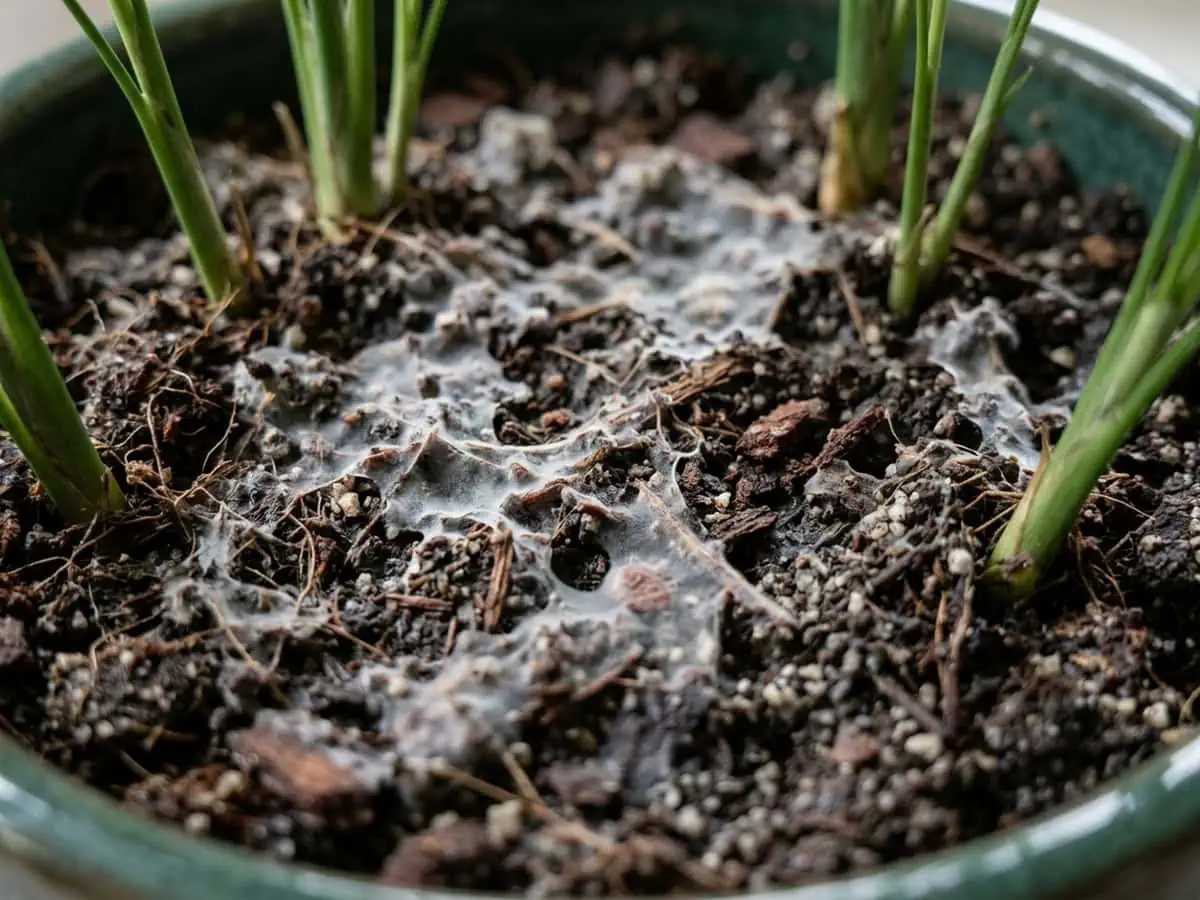
Owners searching “why is white mold growing on my parlor palm soil” are usually looking at a pale film on damp surface medium, most often in the first weeks after a plant comes home. Look where it sits. It sits on the medium, not on the fronds (that detail decides what you do next).
Scrape the top layer off, replace it with fresh mix, move some air across the pot and let that surface dry between waterings. If the film is on the fronds instead, or if it is sticky, that belongs with the sticky residue chain that starts on the fronds.
Soil-free systems: what is actually known
The care pages a reader finds on “can a parlor palm grow in water or leca” are silent on the long haul, and owner reports are the only evidence either way. Roots grown in a mix and roots grown in standing water are not interchangeable (a plant moved across loses the roots it built for the medium it left).
Move one plant at a time and leave the rest in their medium while it establishes. I lost two of my nine that way, swapping a whole shelf over at once on a hunch, and the cuttings route is a different question handled in rooting a separated stem before it goes into a mix.
Frequently asked questions about parlor palm soil
What type of potting mix is best for parlour palms?
Two parts coir, one part pine bark fines, one part coarse sand, finished with a thin layer of that same sand on top. The mix drains within a minute or two of watering and still holds moisture at depth.
Container-palm practice names coir as the peat substitute, the bark fines break down slowly and keep structural air gaps open, and the sand carries most of the drainage share in a slow-growing palm.
What kind of pot is best for Parlor Palm?
Any pot with a drainage hole, one container size up from the one the plant is in now. Material comes second: unglazed terracotta dries fastest because water moves out through the wall, while plastic and glazed ceramic hold it inside.
Match the wall to the room and to your own watering habit. Terracotta suits a generous waterer or a dim corner; plastic or glazed suits a warm bright spot where the pot dries out quickly.
Do Parlor Palms like being root bound?
Yes, within limits: this palm tolerates a snug root ball and can sit in the same container for several years without trouble.
Move it up only when roots circle the ball in a solid mass, push out through the drainage hole, or the pot dries out within a day of watering. The full repotting decision, and the settling period after it, belong to the repotting guide rather than to the mix.
What is the best soil mix for parlor palms?
Aggregate takes one third of the finished volume, and a coir-based base takes the other two thirds. The physical target behind that ratio is 10-15% air-filled porosity with 30-40% water-holding capacity by volume.
Those figures come from container-palm substrate work rather than from houseplant lore, and the squeeze test approximates them at home: a moistened handful that falls open as the hand opens is at the ratio, one that holds a ball is not.
What type of soil is best for Parlor Palm plants?
A bagged houseplant mix opened up with a third aggregate is enough. Garden soil, a peat-only block and anything that packs down hard are the three to avoid, because each of them collapses the air space the roots need.
Keep the medium between 5.5 and 6.5. Fresh mix arrives inside that band, and months of hard tap water are what push a pot above 6.5, where manganese stops being available to a palm.
Stop watering a spent mix, start replacing it
The medium decides this. The pot only sets how fast it dries, and a drainage hole is non-negotiable under either.
Plain version? Watch the mix the way you watch the fronds (it changes slowly, which is why it gets missed). A handful that crumbles open, takes water back and dries down within a few days is still working; one that smears, sheds water, or gives off the flat shut-in smell of a pot that never dries has finished its service.
The next question is watering: this palm stores no water itself, so a fresh mix resets the interval that kept it alive.
Replace it. So the best soil mix for a parlor palm in a pot is the one you can still crumble a year from now. Squeeze a handful of the finished mix: the one that crumbles open is the one your parlor palm can breathe in.
Tap the button below to get more plant fixes in your Google Search results