🚨 Emergency 30-Second Answer: why is my new parlor palm dying after bringing it home
Pour off the trapped water now — a new Chamaedorea elegans, of the Arecaceae family, wants its top 1-2 inches dry before rewatering. Most of what you are seeing arrived with the plant. Check the fronds for spider mites in the same hour.
Then judge each stem on its own, because every stem carries one growing point. A stem whose growing point has gone soft will not regrow. Green tissue stays; only fully brown fronds come off.
Change one thing at a time, and give the plant a fortnight before repotting.
- First hour: turn the fronds over and look for spider mites
- Isolate it: keep the new plant away from your other plants
- Read frond age: damage present on arrival is not new damage
- One change at a time: move it once, then leave it alone for two weeks
- Watch the newest frond: the first one opened indoors tells you most
The lowest fronds on a newly purchased parlor palm go pale and dry at the tips within a fortnight, and the mix has not dried three days after a soaking. Lift the sleeve off and the smell is sour, like a wrung-out dishcloth left folded overnight.
The mistake I kept making was reading that as damage I had caused, when the plant had come from a shaded greenhouse and was grown on from liners to marketable sizes under conditions no room repeats. What fixed it was reading the pot stem by stem: each stem carries one growing point and cannot grow another.
Most of it arrived with the plant. Sort out what is still going on before you judge what is already done, and keep the wider routine in keeping a parlor palm alive indoors.
None of this needs a decision today. The table below sets out what a first-week parlor palm actually asks for, one line at a time.
Why is my new parlor palm dying after bringing it home: the first-week table
| What to check | The first-week answer |
|---|---|
| Water caught in the outer pot or saucer | Pour it off now; this plant never stands in water |
| Take the sleeve or wrap off on arrival? | Yes, anything trapping water or pressing fronds comes off |
| Moisture between waterings | Moist but not saturated; water when the top 1-2 inches are dry |
| First container change after purchase | Wait until a frond has opened indoors |
| A stem whose growing point has gone soft | That stem will not regrow; judge each stem on its own |
Tap the button below to get more plant fixes in your Google Search results

Table of Contents
Stop the damage that is still happening
Two things can still be doing damage while you read this: water standing at the roots, and something small feeding on the undersides of the fronds. The following two checks come first, and the third one keeps you from spoiling the test. Neither is how much water a struggling plant should get, which belongs to the settled routine.
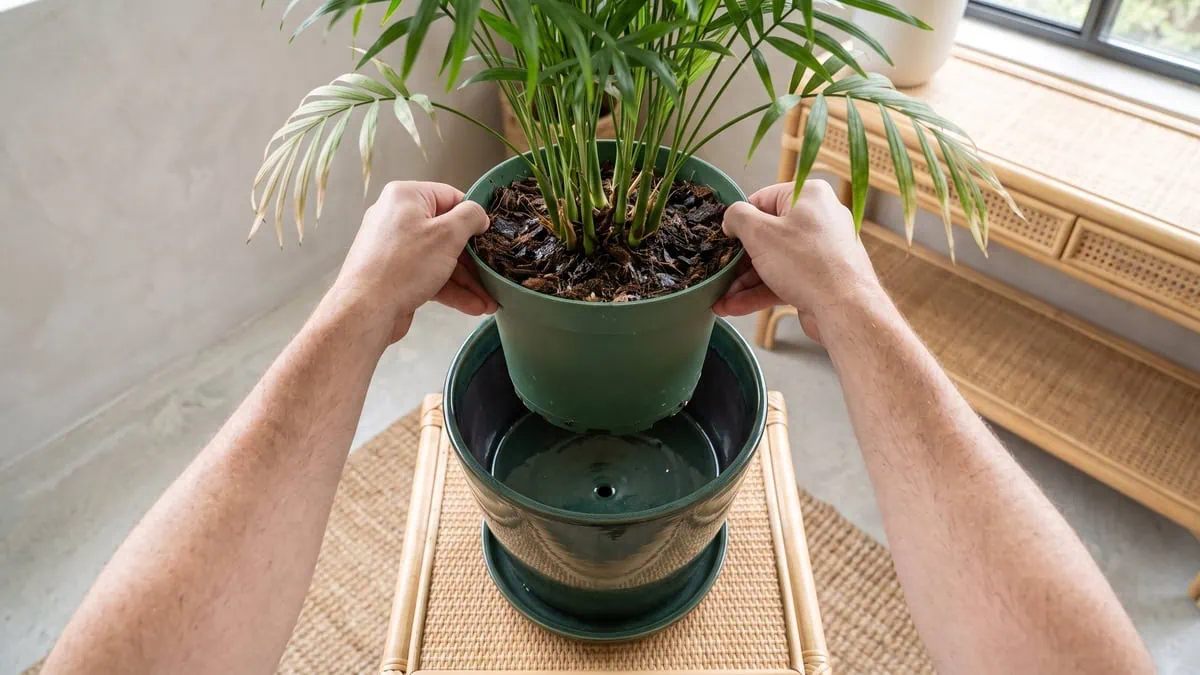
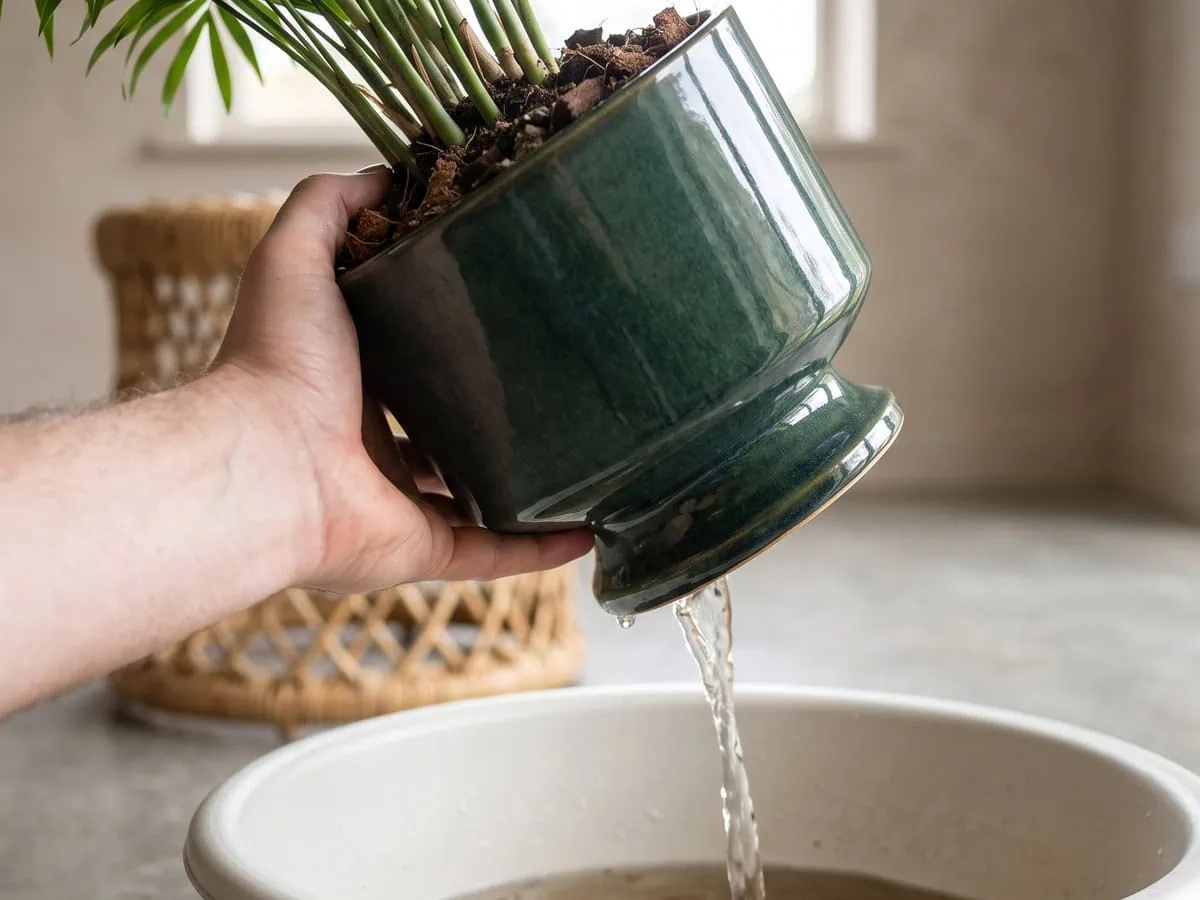
Anything standing in the outer pot or saucer gets tipped out first. A parlor palm must never stand in water, and the fibrous root plug loses oxygen while you decide.
Standing water in the pot and in the outer sleeve
Lift the nursery liner out and look into the sleeve. Water drains out of the liner, collects unseen in the decorative outer pot, and holds the fibrous root plug submerged until you tip it out. Pour it off after every watering (note to self: the sleeve is a container too, and it keeps whatever the liner sheds).
The smell tells you how long it has been standing. Sour, with the flat mineral edge of a cellar wall after rain, means the medium has been airless for days rather than hours, and gravel there perches water above itself instead of letting it leave. Never add gravel to the bottom.
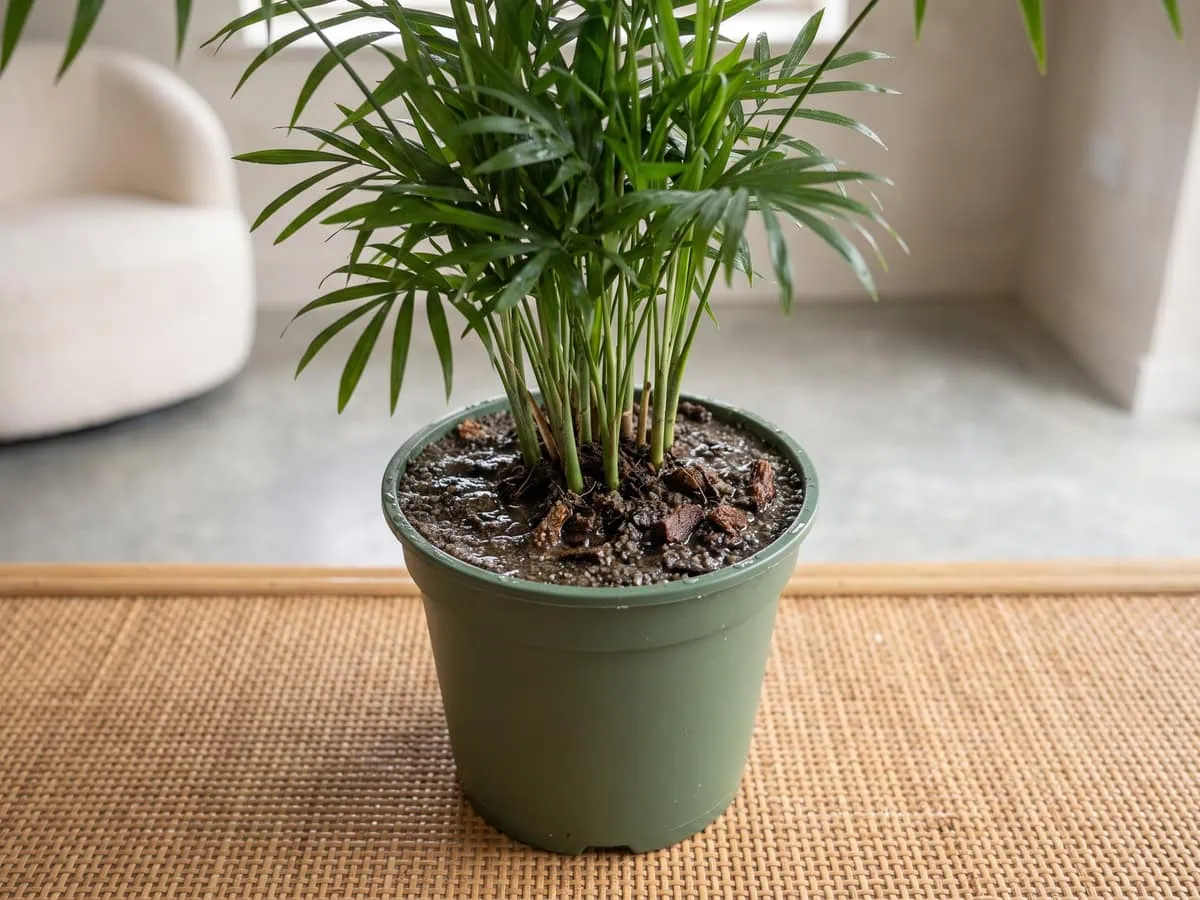
- Lift the liner out and pour off whatever the sleeve caught.
- Water again only when the top 1-2 inches are dry to the touch.
- Let the liner finish draining before it goes back inside.
Something feeding on the fronds right now
Turn the leaflets over before you look anywhere else. A sap-feeding organism is the most commonly reported cause of failure on this palm, spider mites first, then mealybugs, thrips, scale and aphids. Nursery stock is reported arriving with one already aboard, so isolation comes before anything else you do.
I hold new plants apart for the first two to three weeks now. Insecticidal soap at a 1-2% solution, sprayed to cover the undersides, is repeated every 4-7 days until the population is gone.
Keep it shaded while wet. Soap goes on away from direct sun and never on a plant that is dry, so the leaflets dry before the plant goes back to its usual spot. What the feeding leaves behind is a color change or a speckle pattern on the leaflets.
- Check the underside of every frond, not the top surface.
- Isolate the new plant for two to three weeks before it joins the others.
- Test a small area and wait 24 hours before spraying the whole plant.
Change one thing at a time, with one exception
Make four changes in one afternoon and you learn nothing from any of them. Published rescue routines disagree here: some tell you to adjust a single care area at a time while others list four actions with no order at all, and neither was written for a plant bought this month.
The exception is water standing at the roots. Tip it out. That damage carries on while you wait for a clean test, and no amount of patience makes the reading you get afterwards any cleaner.
Tap the button below to get more plant fixes in your Google Search results

Work out which damage came home with the plant
Damage that arrived with the plant sits on tissue the plant already had; damage you caused sits on tissue it has grown since it came home. The following four checks sort one from the other, and none of them needs a tool.
Fronds that were already open when it arrived
A frond fully open on the day it came home cannot record your conditions. Whatever marks it, whether tan tips with a narrow darker boundary, an even pale cast or fine stippling, was built somewhere else. That is the honest answer to “why does a brand new parlor palm start browning within weeks”: the browning is older than the weeks.
Reading the pattern itself belongs elsewhere. Not here. If the marks are spreading, reading a browning pattern on a frond takes it further than these checks do.
Fronds that opened under your roof
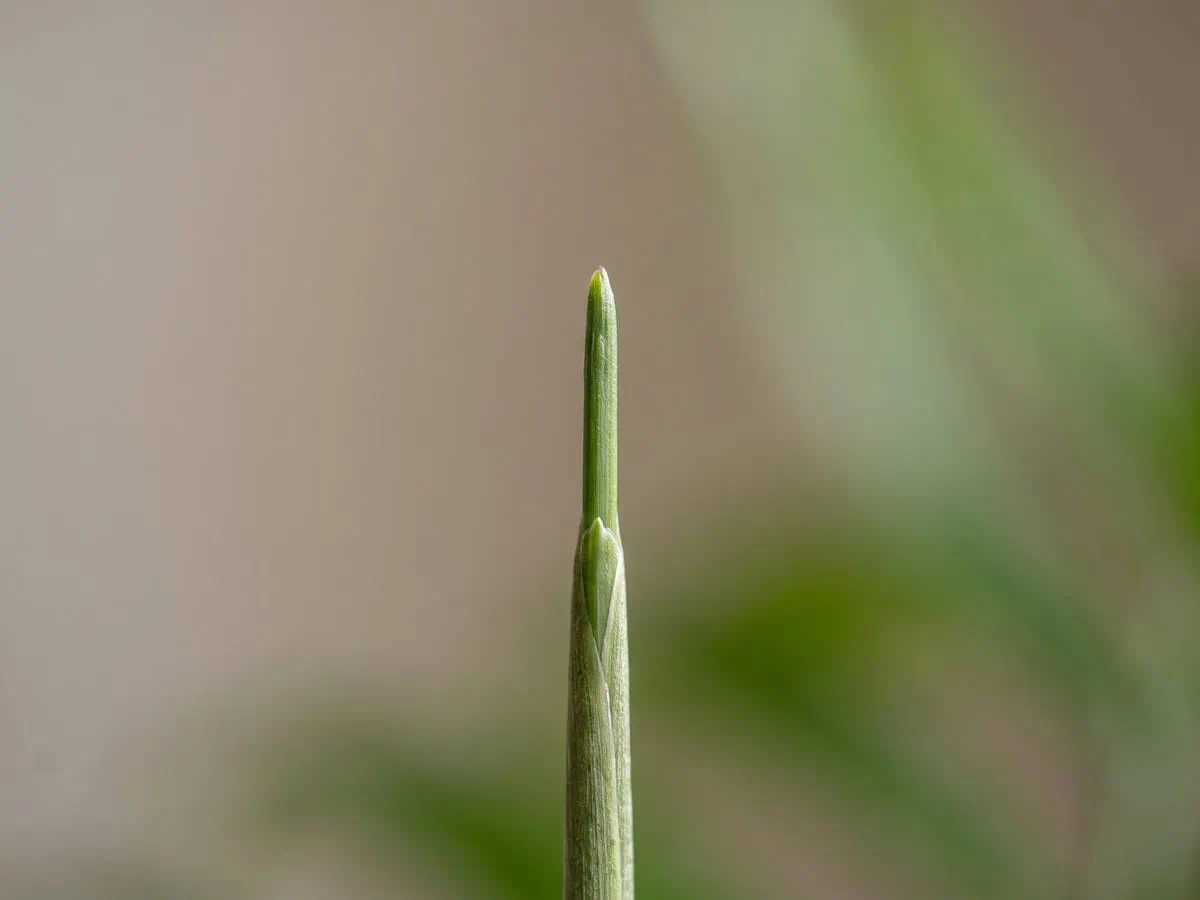
The spear that unrolled after you got it home is the only tissue built entirely in your room. Marks there are current, and they are the ones worth acting on. With a single bud per stem, and only one or two fronds a year indoors, that evidence arrives at a crawl.
Count the fronds today. Note that figure somewhere you will find it again. Loss that stops while the central spear keeps coming is the plant shedding what it cannot carry in a new position; loss that keeps running is not.
- Note the frond count on the day you read this.
- Check it again a week later, not an hour later.
- Watch whether the newest spear is still lengthening.
The sleeve, the wrap and the outer pot
Yes, it comes off. “Should I take a new parlor palm out of its plastic sleeve” has one answer: anything that traps water, blocks air at the medium surface, or presses fronds against each other comes off on arrival.
The dry cardboard smell of a box that has traveled clings to the wrap, and it is the last thing the plant needs held against its leaflets.
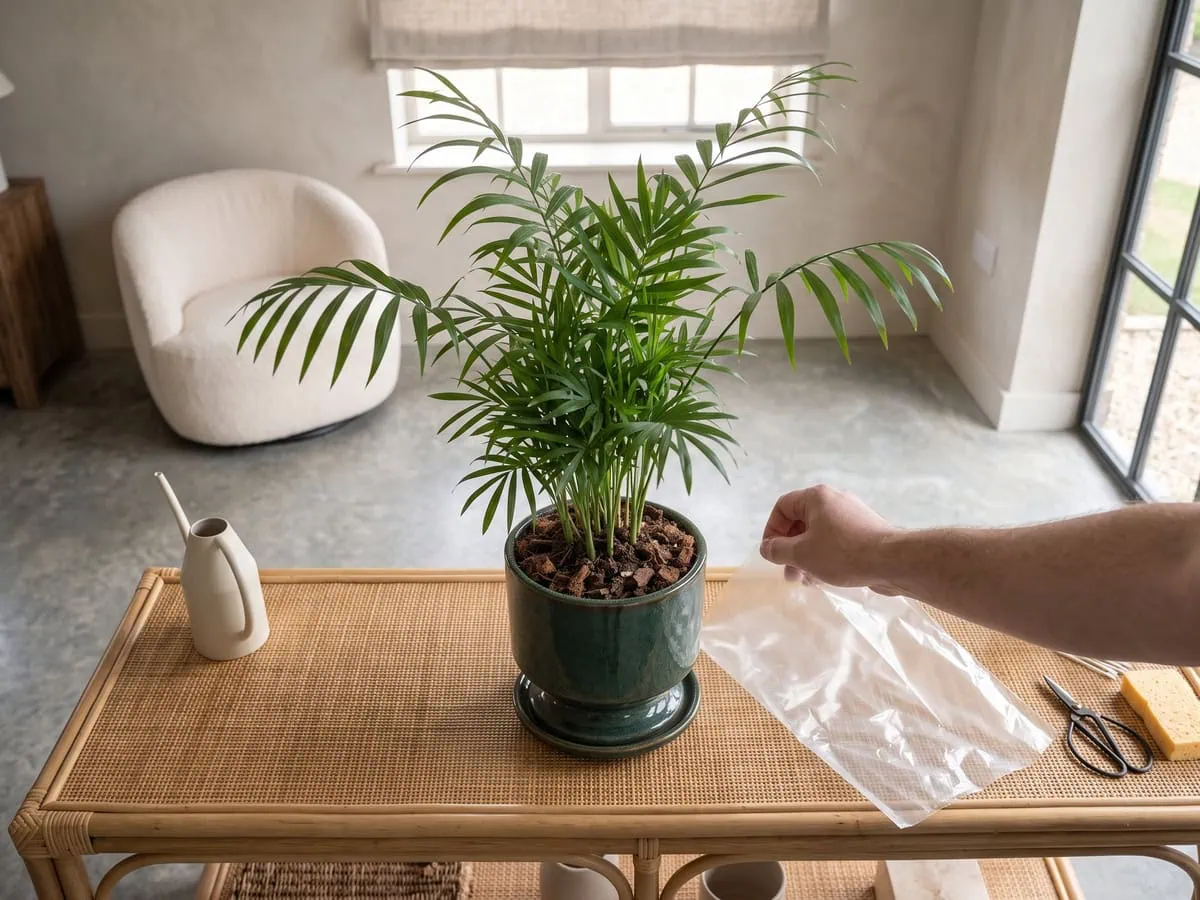
- Take off sleeves, foil and any sealed outer pot.
- Keep the nursery liner with its drainage holes.
- Leave a loose decorative sleeve only if you empty it.
What the first day is for, and what it is not
“What should I do the day a parlor palm arrives in the post” divides neatly by what each action risks if you guess wrong. Looking, counting, unwrapping and choosing a stable spot risk nothing. Changing the container, cutting green tissue and feeding all ask a root system for work at the moment you know least about it.
The plant’s life before your room is on record. According to the International Society for Horticultural Science, this species is grown from liners to marketable size in a shaded greenhouse. Your room is not that greenhouse, and the first week is the plant finding that out.
Read the pot one stem at a time
A parlor palm pot holds several separate seedlings rather than one plant, so you judge the thing in front of you stem by stem rather than as a whole. The following three checks work outward from one stem to the whole container.
The growing point check on each stem
Close a finger and thumb around the base of the new central growth at the top of one stem, with the other stems of the same container standing behind it. Firm there means that stem still has a future.
Every frond that stem will ever carry has to come out of that one point, because a palm stem grows from a single terminal bud and keeps nothing in reserve behind it.
Soft or hollow? That stem is done. No amount of water, light or feeding brings it back.
Run the check once per stem. The answers can differ inside one container, which is why a verdict passed on the whole plant is the wrong shape of answer for this species.
When only some of the stems are failing
Yes, and the answer to “is it normal for some stems in a new parlor palm pot to die off” starts with counting the stems where they enter the medium.
Each one grew from its own seed and a grower potted it alongside the others for fullness, so each one fails or holds on its own account. I lost two stems out of an otherwise sound pot once and read it as the whole plant going.
Where the browning starts is what separates the two cases.
- One stem browning from its own base while its neighbors hold color: that plant is failing alone.
- Every stem browning at the base at once: the shared root zone is the subject, not the stems.
- Either way, a lost stem does not come back from below; the pot simply holds one plant fewer.
A clean skewer or chopstick, roughly a quarter inch thick, goes into the mix right beside the failing stem. Then smell the tip. A sweetish fermenting edge, like the bottom of a fruit bowl left a week, puts the root zone in the frame rather than that one stem.
And a failed stem then comes off at the medium surface, while refilling the container is a job for separating the living plants at the next settling the plant back in after a move, never for regrowth from the dead one.
Four things not to do to a new parlor palm
Four instructions circulate for this plant and every one of them takes something back. And the first does the most damage.
- Do not water it like a succulent. A widely shared claim files this palm with the succulents and, on that basis, has you let the surface dry out completely between waterings. Look at the stems: slim, ringed, the same width from the medium upward, nothing thickened anywhere to hold a reserve. Keep the mix moist but not saturated.
- Do not jump container sizes. Move up one size at a time, a 6-inch to an 8-inch or an 8-inch to a 10-inch, so the roots fill what you give them.
- Do not feed it yet. Hold a freshly potted palm off fertilizer for six to eight weeks, and a plant that has just changed rooms is in no better shape to use it.
- Do not pull the dead fronds. Cut them, and stop short of the green: pulling tears at the one place on that stem new growth can come from.
Which leaves “how soon after getting a parlor palm should it be repotted” with one answer here. Wait until a frond has opened under your roof. Until that happens you cannot tell a container change’s effect from the move’s.
If what sent you looking was something moving on the leaflet undersides instead, shifting an insect problem off a newly bought plant has an article of its own.
Frequently asked questions about a new parlor palm going backwards
How do I bring my Parlor Palm back to life?
Work down from what is still doing damage to what has already happened. Tip out any water standing in the outer pot, turn the leaflets over and look for a sap-feeding organism, then settle the plant in one position and leave it there.
Change one condition at a time after that. Keep the mix moist but not saturated, hold off fertilizer, and judge each stem separately, because a stem whose central growing point has gone soft will not open another frond whatever you do for the rest of the pot.
Why do my parlour palms keep dying?
Because what repeats between attempts is usually not the plant. Three conditions carry over from one purchase to the next: the position you keep putting it in, the water you keep using, and the shop you keep buying from.
Hold each of those against the failures you have had. A cause that changed between attempts cannot explain a result that did not. Start with the position, since a cold moving air stream and a night minimum under 61F both sit outside what this palm holds.
Can you revive a dying palm tree?
It can, up to a limit that is structural rather than a matter of effort. In the first weeks after purchase most of the damage arrived with the plant, and a frond that was already open when it came home cannot be rebuilt.
Recovery turns on the bud sitting at the top of each stem. Firm central growth means that stem can still produce fronds, and soft means it cannot. One container holds several plants and can carry both answers at once.
What does a sick palm tree look like?
Look for change that is still running rather than for damage that has stopped. Several fronds yellowing, drooping or browning together reads as decline, while one old lower frond fading slowly is ordinary aging on this species.
Fine stippling or an even pale cast on the leaflets points at something feeding on them. A sour smell at the medium, with the pot still wet days after watering, points at the root zone instead. Note today’s frond count and read the plant again a week later.
How do you know if a palm tree is completely dead?
Take the new central growth at the top of each stem between finger and thumb. Soft or hollow there means that stem has lost the one point every future frond has to come from, and it will not resume growth.
Firm means that stem is alive, however poor the fronds below it look. Because one pot holds several separate plants rather than one, run the check on every stem before drawing any conclusion about the container as a whole.
From a pot you are watching fail to one you can read
Most of what a new parlor palm shows you in its first weeks happened under the flat warm smell of a polytunnel, in a box you never saw.
Read the pot stem by stem. Judge each one separately. Several plants, each with its own answer.
Once a frond has opened under your roof you have a plant that records your room rather than its last one. The watering rhythm and the first feed belong to the main care guide.
And the honest answer to why is my new parlor palm dying after bringing it home is that the question points backwards more often than it points at you. Every stem in that new pot answers for itself, and the one that still holds a firm growing point is the one that will carry the plant forward.
Tap the button below to get more plant fixes in your Google Search results