🎯 Quick Answer: snake plant fungus
Knowing how to treat snake plant fungus switches Dracaena trifasciata (Asparagaceae, formerly Sansevieria trifasciata) back to its preferred dry 25-40% humidity. Isolate the plant. Cut every spotted leaf back to firm tissue. Apply a copper or leaf-spot fungicide. Then stop misting and keep the air dry and moving.
- First move: isolate the plant away from every other pot
- Then: cut spotted leaves back to firm tissue with a sterile blade
- Spray: a copper or leaf-spot fungicide over the affected leaves
- Dry out: stop misting; keep the air moving and humidity low
- Never: hydrogen peroxide on living leaves, roots, or crown
The first black-flecked brown spot on a snake plant leaf looks like nothing — a smudge you could wipe away. It isn’t.
Over three years I let four upright leaves go spotty, soft, and streaked because I babied them with a humidifier and nightly misting, sure that more moisture meant a happier plant (TBH — a snake plant wants the opposite).
Rather than a thirsty plant begging for humidity, I discovered a drought-adapted succulent whose thick, waxy, water-storing leaves are built to shed moisture, not hold it — and a film of standing water on that cuticle is exactly what a fungal spore needs to germinate.
Fungus here is almost always an environment problem, not bad luck. But the leaf still needs help too. Fixing the room matters as much as fixing the leaf, so it helps to know how the right environment keeps a snake plant healthy.
Look — if your snake plant already has spots, don’t panic. The following table lays out the signs, the fix, and the one thing to keep off the leaves.
How to treat snake plant fungus: a quick-reference spec table
| Snake plant specs | Recommended care |
|---|---|
| Most common foliar fungal signs | Brown spots with black dots, white powdery film, rusty patches at the leaf base. |
| Contagious to nearby plants? | Yes — spores can spread (at least to other snake plants); isolate the infected plant early. |
| Main driver | Free surface water on leaves, plus stagnant humid air and low light. |
| First action | Isolate the plant, then cut affected leaves back to firm tissue with a sterilized blade. |
| Fungicide class | A copper-based product, or one labeled for leaf-spot disease; re-apply per the label. |
| Tissue-safe wound dressing? | Yes — powdered cinnamon on a callused cut; keep hydrogen peroxide to pots and tools only. |
| Recovery outlook | Foliar spot recovers with prompt, correct action; an advanced soil-line case can be fatal. |
Tap the button below to get more plant fixes in your Google Search results

Table of Contents
What snake plant fungus actually looks like
Snake plant fungus shows up as one of three distinct marks: dark-dotted brown lesions, a dusty white film, or rusty patches creeping up from the soil line. Updating my earlier point — calling it only an environment problem is half the story, because the exact mark tells you which fungus you have and how far it has spread.
One of those signs, white powdery mold on snake plant leaves, sits on the surface like spilled flour and is the easiest to catch early. Read the sign first. Then act.
Brown spots and the black dots inside them
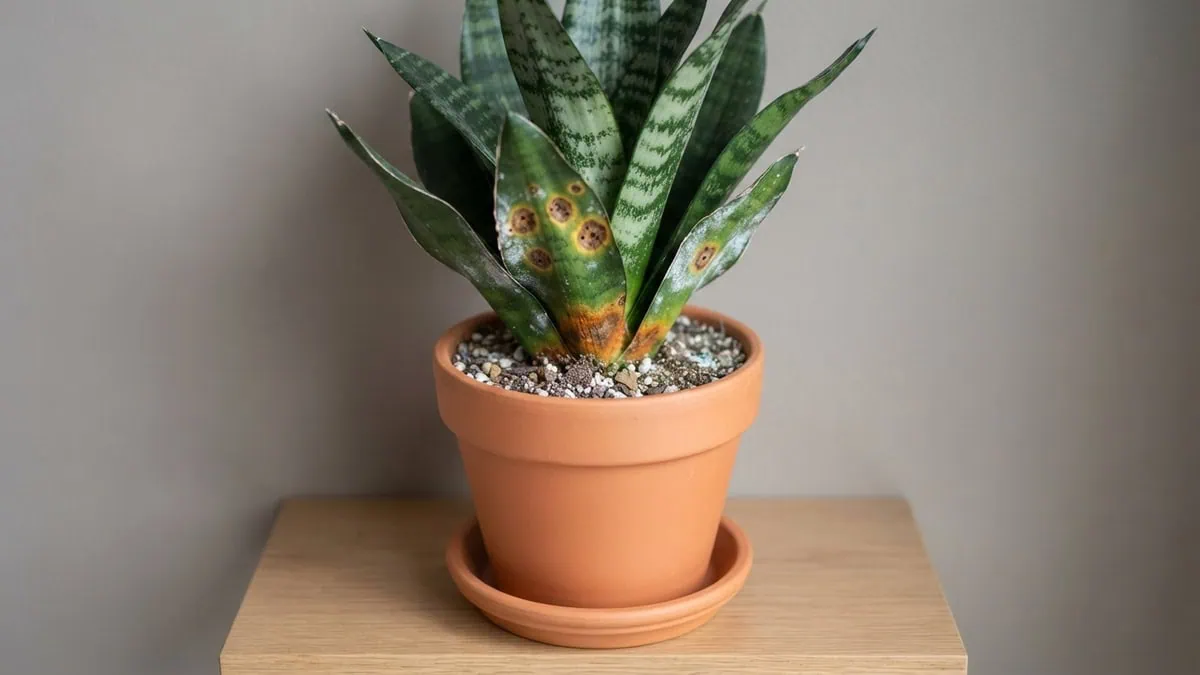
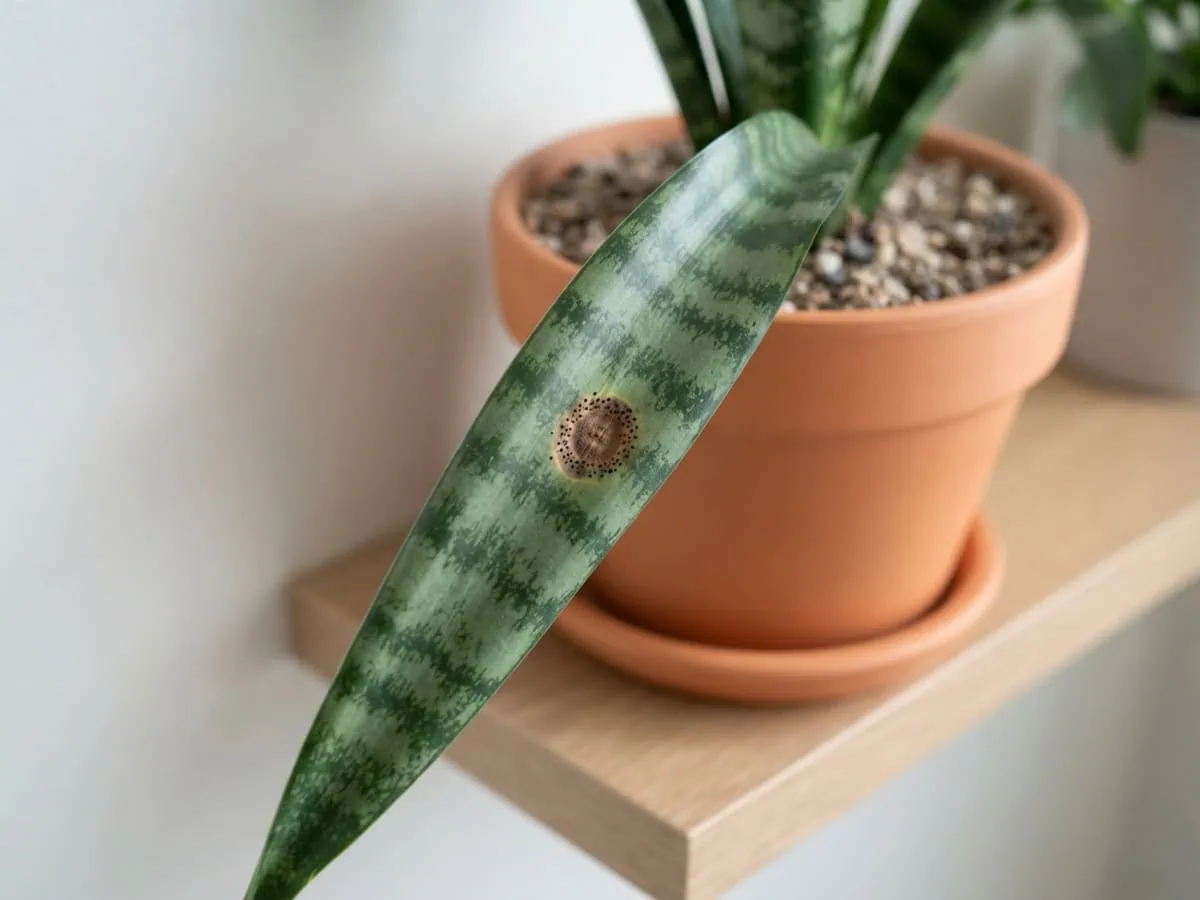
Brown spots with black dots on snake plant leaves are the classic fungal signature. The spot starts as a small water-soaked patch, darkens to brown over a week or two, then grows a ring of pinpoint black specks inside the lesion.
That black-dot detail is the tell: a dry, cracked patch with no dots is usually old sun or cold damage, not a fungus. The dots are the detail the whole call turns on.
Which fungus, exactly? I’m still figuring this out — and so is the wider literature.
Sources call the black-dotted spot an Alternaria brown spot, a soil-borne southern blight, or a host-specific anthracnose tied to Colletotrichum sansevieriae. For a home grower the label matters less than the response, because the fix is the same across all three.
Rusty orange patches at the leaf base
Rusty orange spots on snake plant base tissue are the sign growers most often misread. They sit low, where the stiff leaves meet the soil and moisture lingers longest, and they can look like either fungus or feeding damage from mites. Two checks settle it:
- Fine webbing or moving specks point to mites, not fungus.
- Watch the patch over several days — a fungal patch spreads and softens; mite stippling stays dry and flecked.
Leaking brown liquid: fungus, nectar, or honeydew?
A snake plant leaking brown liquid has three possible sources. And only one is a fungus. A brown, foul-smelling droplet from a darkening lesion is necrotic fungal weep — act on it.
Clear, sweet droplets on a flower spike are harmless nectar; leave them alone. A shiny sticky film with tiny insects is pest honeydew, which belongs with clearing bugs off a snake plant, not here.
Run the wet-spot field test before you reach for a fungicide. Smell it, note the location, and check for company:
- Foul smell, lesion on the blade, black dots forming — fungus.
- Sweet smell, droplet on a flower spike, no insects — nectar.
- Sticky film, no smell, small bugs present — honeydew.
When two of the three point the same way, match your response to the actual cause.
Tap the button below to get more plant fixes in your Google Search results

Isolate, prune, and apply the right fungicide
Treating snake plant fungus runs in a fixed order: separate the plant, remove the infected tissue, then apply a targeted fungicide. Spraying while the plant still sits in a humid huddle just re-seeds the problem (FYI — a snake plant’s stiff, upright leaves shed water faster than flat-leaved plants, so most of your job is keeping that surface dry).
Distance first, blade second, spray last.
Isolate first, then prune into healthy tissue
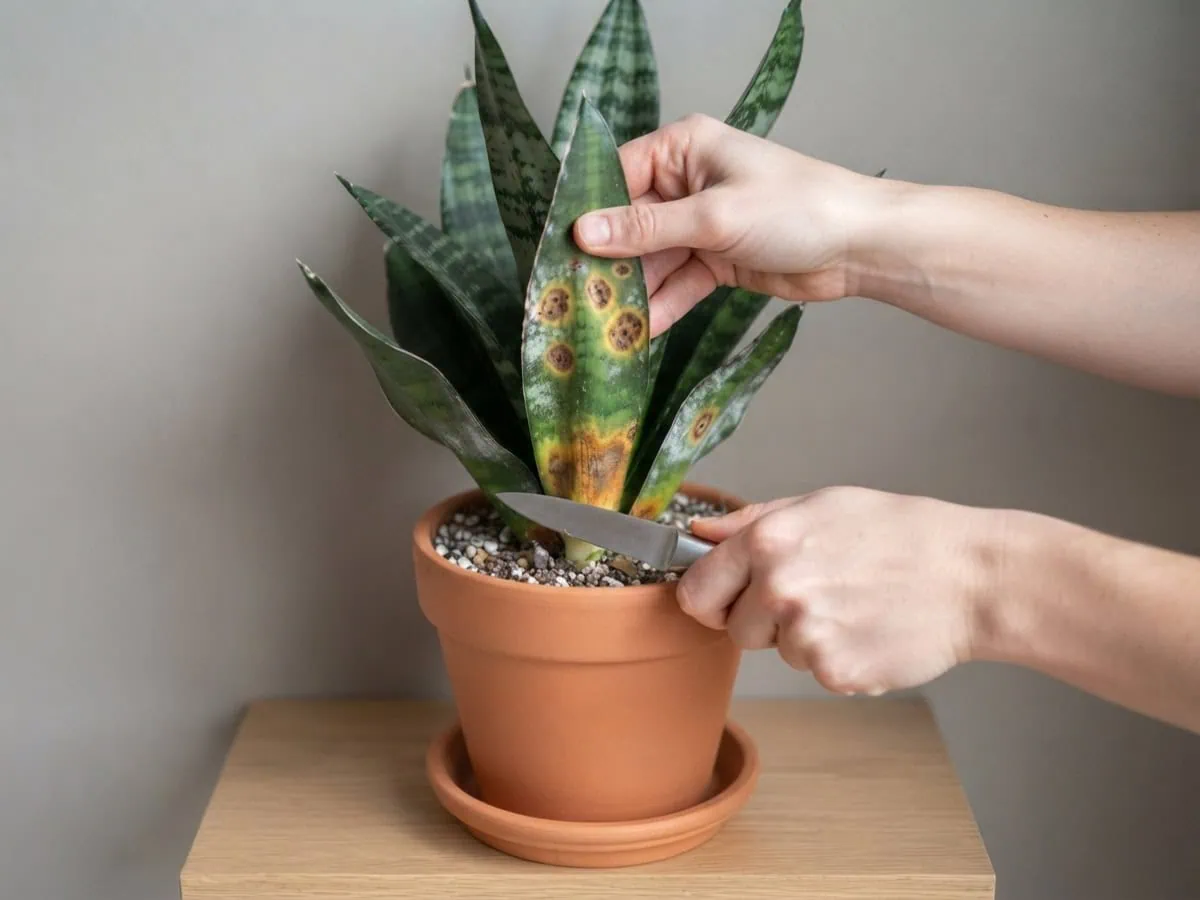
Move the infected plant away from every other pot the moment you spot a lesion. Spores travel on splashing water and moving air, so distance buys you time. Then cut:
- Trim each spotted leaf back into firm, unmarked tissue, well below the lesion.
- Remove whole leaves that are more spot than green.
- Drop each cutting straight into a bag — never onto the soil or a nearby bench.
- A sterilized stainless blade or scissors, wiped clean between every cut.
- A copper-based or leaf-spot-labeled fungicide.
- Powdered cinnamon for the callused cut sites.
According to Clemson Cooperative Extension, managing houseplant fungal leaf spot comes down to removing infected leaves, keeping water off the foliage, and improving air circulation.
Copper or leaf-spot fungicide: coverage and re-spray
Coat the remaining foliage with a copper-based product, or one labeled for leaf-spot disease, at the label rate. A fungicide is a shield, not a reset — it stops new spores landing on tissue that is still clean. Over the next couple of weeks, watch for fresh spotting and re-apply on schedule; one pass rarely finishes the job.
Sterilize the tools and pot, then bin the debris
Decontaminate everything the fungus touched:
- Wipe the blade with one part bleach to nine parts water after the last cut.
- Bag and bin all trimmings — do not compost them.
- If you reuse the pot, sterilize it; sun-baking an emptied pot for a few days works.
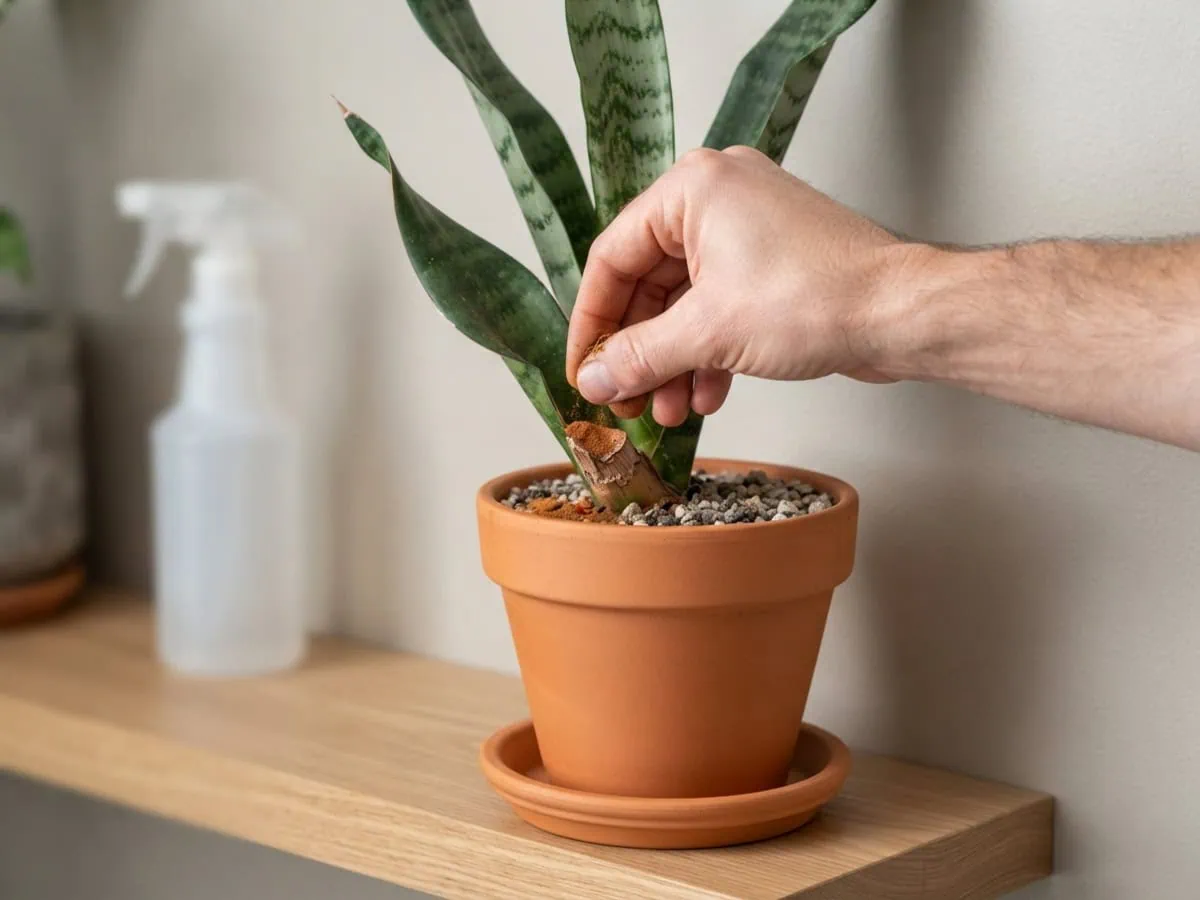
Keep hydrogen peroxide OFF living roots, crown, and leaves — reserve it for empty pots and tools only. On plant tissue, dust a callused cut with powdered cinnamon instead.
Always test on a small area first. Results may vary depending on your specific conditions.
Stop the spread and what recovery looks like
Halting snake plant fungus means changing the air around the plant, not just spraying it. Every foliar fungus here needs the same three things to spread: a film of water on the leaf, still humid air, and low light.
A spore has to sit in that surface water for hours to germinate and push into the blade. So a canopy that dries within minutes never hands it the window. Take those away and the outbreak stalls on its own.
Dryness starves the spore.
Dry canopy, moving air, and no misting
Keep the leaves dry and the air moving. This desert-adapted succulent already thrives in the dry 25-40% humidity of a normal room, so you are working with its biology, not against it. Do three things:
- Stop misting entirely, and water the soil, not the leaves.
- Open up space around the plant so air moves across every blade.
- Give it brighter light; dim corners keep leaves damp longer.
Most of this overlaps with getting the watering right so moisture does not linger — dry soil and a dry canopy go together.
Will it recover, or clear up on its own?
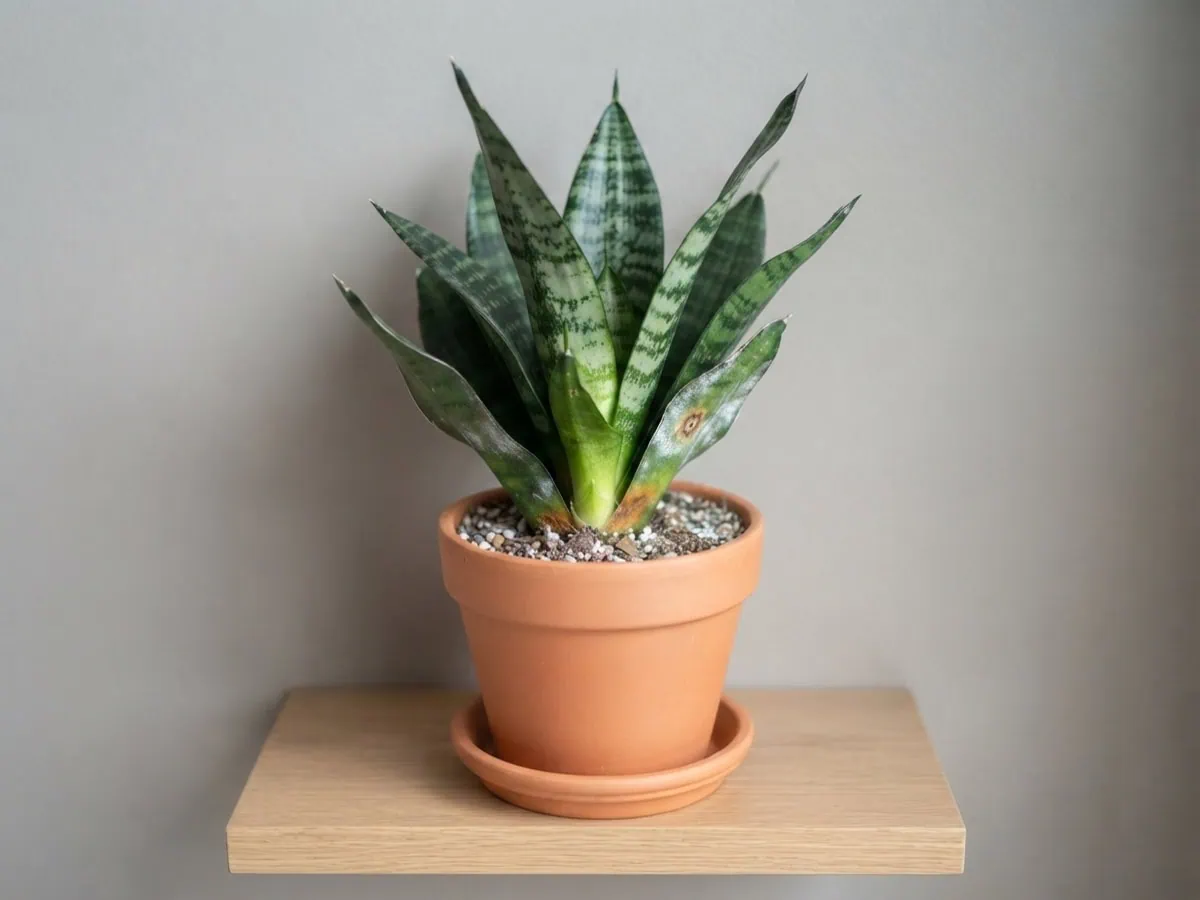
An active fungal infection does not clear on its own; left alone, it keeps spreading while you wait. The good news is that a foliar leaf spot on a snake plant is low-lethality and recovers well once you halt the spread. Two things to expect over the following weeks:
- Existing lesions do not turn green again — judge recovery by clean new growth, not old leaves.
- Spotting slows, then stops, as the dry-canopy routine takes hold.
- Give it a couple of weeks before you call it — the turnaround is gradual, never overnight.
The exception is a soft, foul case that has climbed into the base and soil, which is far harder to reverse and overlaps with when the rot is at the roots, not the leaves.
Fungus on a dry-loving snake plant is an environment alarm. Without a drier canopy, moving air, and no misting, it comes back — no fungicide out-sprays a wet, stagnant corner.
Common mistakes and fungus-remedy myths
Most snake plant fungus advice online leans on kitchen chemistry that was never tested on a waxy succulent. Skip most of it. Two habits do real harm: reaching for improvised sprays, and putting the wrong thing on living tissue.
Dry air beats kitchen sprays.
❌ Myth: a kitchen spray of baking soda, vinegar, or peroxide fixes snake plant fungus. ✅ Fact: none of them works as a fungicide on this succulent — the reliable path is dry air, pruned leaves, and a copper or neem product.
Do baking soda, vinegar, and cinnamon work?
Of the popular home remedies, only two have real footing, and one of those is narrow:
- Baking soda, vinegar, and apple-cider vinegar are improvised folk sprays that do not act as fungicides on this thick-cuticled succulent. Baking soda is a salt that crusts and marks the waxy blade over repeated use; the acids in vinegar can scorch that same cuticle faster than they ever stop a spore.
- Cinnamon for snake plant fungus earns a real but narrow role — an anti-fungal dusting on a callused cut site, where it guards the open wound. It is not a foliar spray, and it does nothing sitting on an intact waxy leaf.
- Neem oil is the one legitimate natural fungicide here, recognized against powdery mildew, rust, black spot, and anthracnose-type spots, and it can go on the foliage at label strength.
Why hydrogen peroxide stays off living tissue
The single most repeated bad tip is pouring diluted hydrogen peroxide on roots or leaves. It oxidizes fungal cells, true — but it oxidizes your plant’s own living cells the same way, and no dilution is weak enough to tell the two apart. So it belongs on inert surfaces only:
- Empty pots and metal tools — hydrogen peroxide is fine here.
- Living roots, crown, and leaves — keep it off; use cinnamon on cut sites instead.
Give any change a week or two before you judge it; fungus fades slowly, and swapping remedies every few days does more harm than the fungus.
Snake plant fungus FAQ
What does fungus look like on a snake plant?
Snake plant fungus looks like one of three marks: brown spots ringed with tiny black dots, a dusty white powdery film, or rusty orange patches near the base. The black-dotted brown lesion is the most common. A dry, cracked brown patch with no dots is usually old sun or cold damage, not a fungus, so look for those pinpoint dots first.
Can a plant recover from fungal disease?
Yes, a snake plant usually recovers from a foliar fungal disease when you act promptly. Isolate it, cut the spotted leaves back to firm tissue, apply a copper or leaf-spot fungicide, and dry out the canopy. Existing lesions will not turn green again, so judge recovery by clean new growth. An advanced case that has reached the base and soil is far harder to reverse.
What does baking soda do to snake plants?
Baking soda is an improvised folk fungicide that does not fix snake plant fungus, and it carries a real risk here. As a salt, it can build up and mark the thick, waxy leaves faster than it stops a spore. Dry air, pruned leaves, and a copper or neem product are the reliable route; keep the baking soda in the kitchen.
How to get rid of fungus in snake plant?
Getting rid of snake plant fungus takes four ordered steps, not a single spray. First, isolate the plant so spores cannot jump to neighbors. Second, cut every spotted leaf back into firm tissue with a sterilized blade. Third, coat the remaining foliage with a copper or leaf-spot fungicide. Fourth, keep the canopy dry and the air moving so spores lose the moisture they need.
Troubleshoot, assess, fix — the three-sign fungus test
Snake plant fungus comes down to reading one leaf correctly, then changing the air around it. Truth is — the spray matters far less than the environment. Run the three-sign test whenever a mark appears:
- Black dots inside a brown spot — anthracnose-type leaf spot.
- Flour-white film — powdery mildew.
- Rusty patch at the base — check for mites too.
Catch it small. Isolate fast, cut into clean tissue, and dry the canopy, and the outbreak fades within a couple of weeks. For the wider symptom picture, keep decoding other snake plant leaf symptoms.
Once you know how to treat snake plant fungus this way — sign first, environment second, spray last — you stop losing leaves to a problem the room was quietly causing.
May your snake plant’s leaves stay firm, dry, and unspotted, and may every fleck you catch stay small enough to snip away.
Tap the button below to get more plant fixes in your Google Search results