🎯 Quick Answer: getting rid of mealybugs and scale
A Phalaenopsis orchid, of the Orchidaceae family, suffers under mealybugs and scale until you dab the colonies with 70% isopropyl alcohol. Knowing how to get rid of mealybugs and scale on Phalaenopsis orchids means a repeating cycle — swab, then oil, then repot — never one pass.
- Isolate the plant: carry it well away from every other plant first.
- Swab each colony: dab the bugs on a cotton tip, never a blanket spray.
- Coat every surface: work oil into the undersides and crevices you cannot reach.
- Repeat on a cycle: hit them again and again until two checks run clean.
- Empty the reservoir: repot into fresh bark so hidden eggs go with it.
A single white, cottony speck in a leaf joint is how it starts — easy to wipe off, easy to ignore. Sidebar — that speck is rarely alone.
I lost moth orchids to mealybugs and scale that hitchhiked in on a new plant, draining sap and dropping sticky honeydew before I ever found the colony (stay with me here). The mistake I kept making was drenching the whole plant in spray and hoping.
Let me try that again — what fixed it was learning where these pests hide: wedged into the tight joints and undersides of those thick, leathery leaves, the crevices a swab reaches but a spray skates over. The first warning I learned to catch was a sound — the dry tick of a hardened shell flaking loose under a fingernail.
Pests, medium, and roots all need attention, not just the leaves you can see. For the full picture, start with the moth orchid care reference.
Take a breath — if pests already have a foothold, the following table sorts which one you are facing and the fix for each, before the full walkthrough below.
How to get rid of mealybugs and scale on Phalaenopsis orchids — quick specs
| Moth orchid specs | Recommended care |
|---|---|
| Mealybug | White cottony clusters at leaf and stem joints, with sticky honeydew nearby. |
| Scale | Hard or soft brown bumps; sticky honeydew, sometimes black sooty mold. |
| Spider mite | Fine pale stippling, sometimes webbing; a white-cloth wipe shows rust streaks. |
| Alcohol | Isopropyl 70% or less on a swab; patch-test; never ethanol or methanol. |
| Soap or oil | Insecticidal soap 1-2% or neem; full coverage, under 85F, out of sun. |
| Reapply | Every 10-14 days for several cycles; rotate chemistry; repot to clear the medium. |
| Do coffee grounds repel these pests? | No — they neither deter nor kill mealybugs or scale. |
| Does one spray finish an infestation? | No — control runs over several reapplication cycles. |
Tap the button below to get more plant fixes in your Google Search results

Table of Contents
Mealybug, scale, or spider mite? Spot the pest first
Correct control starts with a correct ID, and the three pests here leave different marks. All three are sap-suckers that share a few telltale signs — honeydew, crawlers, and sooty mold — worth defining once before the sections below take each in turn.
- Honeydew: the sticky, sugary liquid that sap-sucking pests excrete onto leaves.
- Crawlers: the tiny mobile young stage, the one stage you can actually kill with ease.
- Sooty mold: a harmless black fungus that grows on honeydew and flags a pest below.
Mealybugs: white cottony clusters at leaf joints
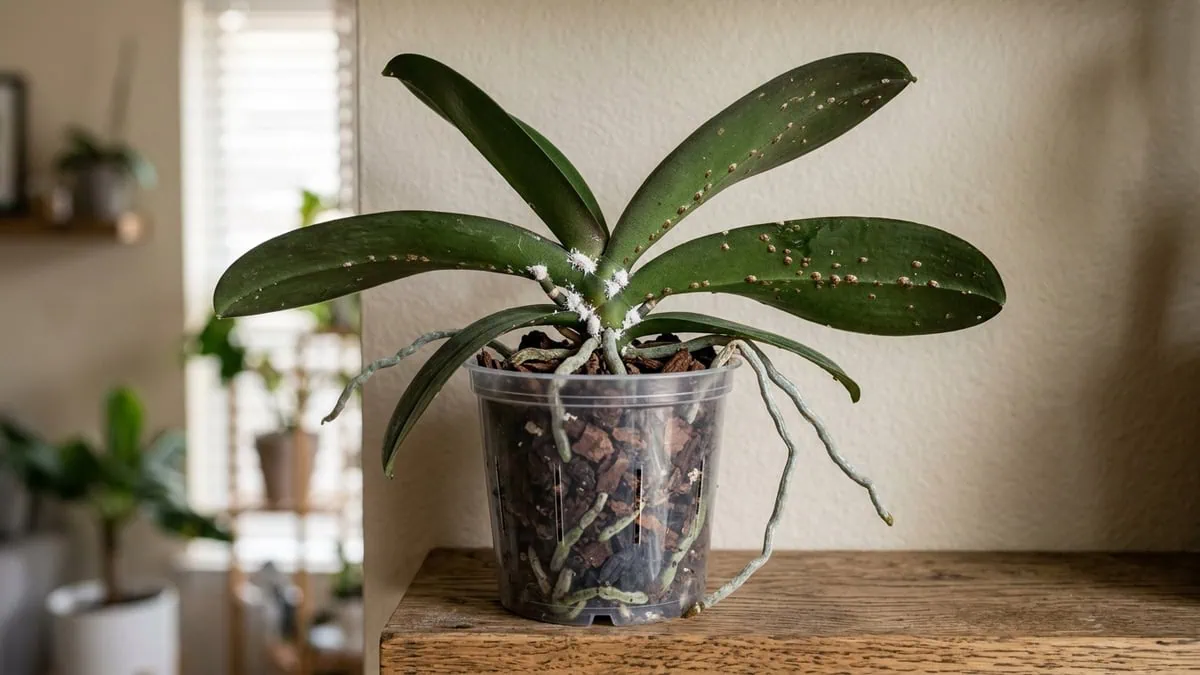
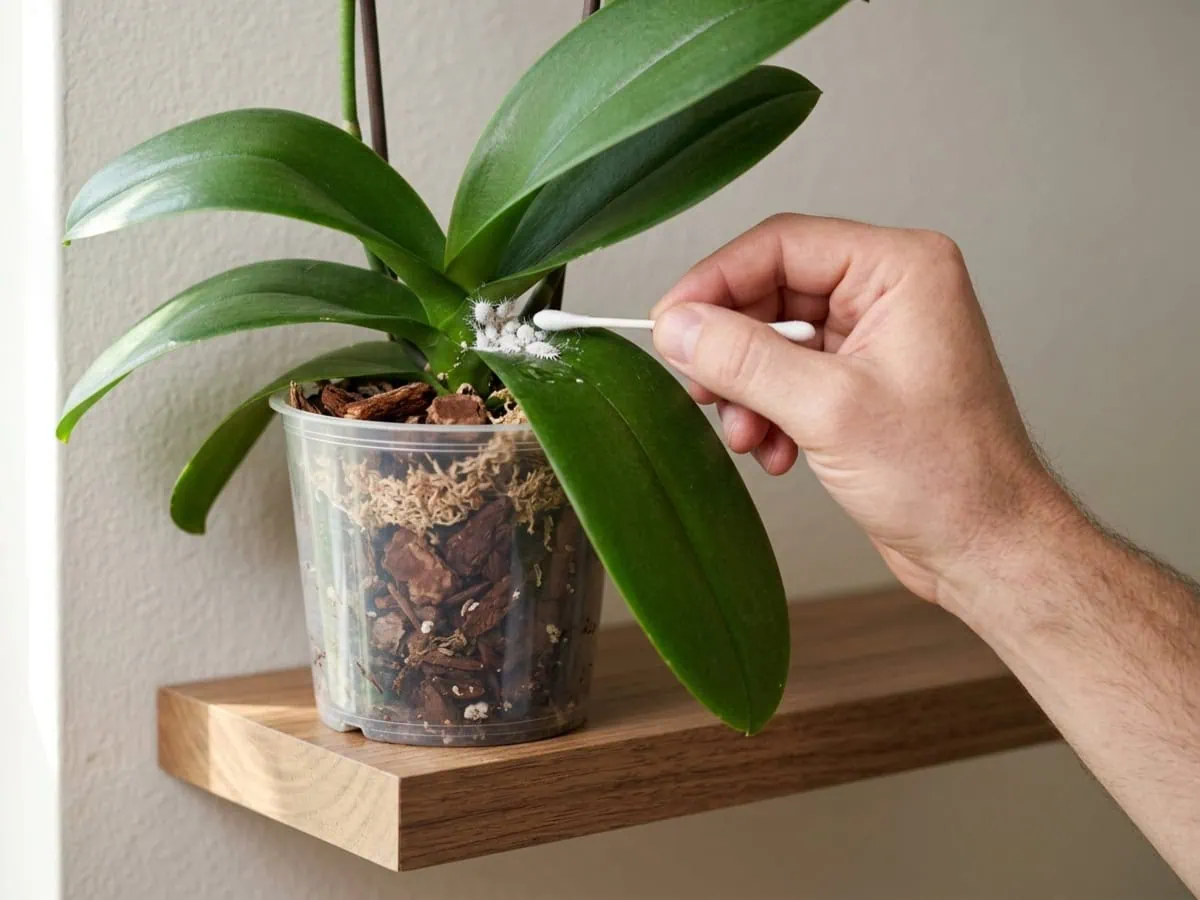
What do mealybugs look like on a Phalaenopsis orchid stem? They show up as white, cottony tufts wedged into the leaf-and-stem joints, the flower spike, and the crown: the tight spots a spray never reaches.
Rub one between your fingers and the fluff smears soft and waxy, not gritty like household dust, and a sticky film of honeydew usually coats the leaf just below. Disturb a cluster and the tiny crawlers scatter. Soft, waxy, unmistakable.
Scale: hard or soft bumps with sticky honeydew
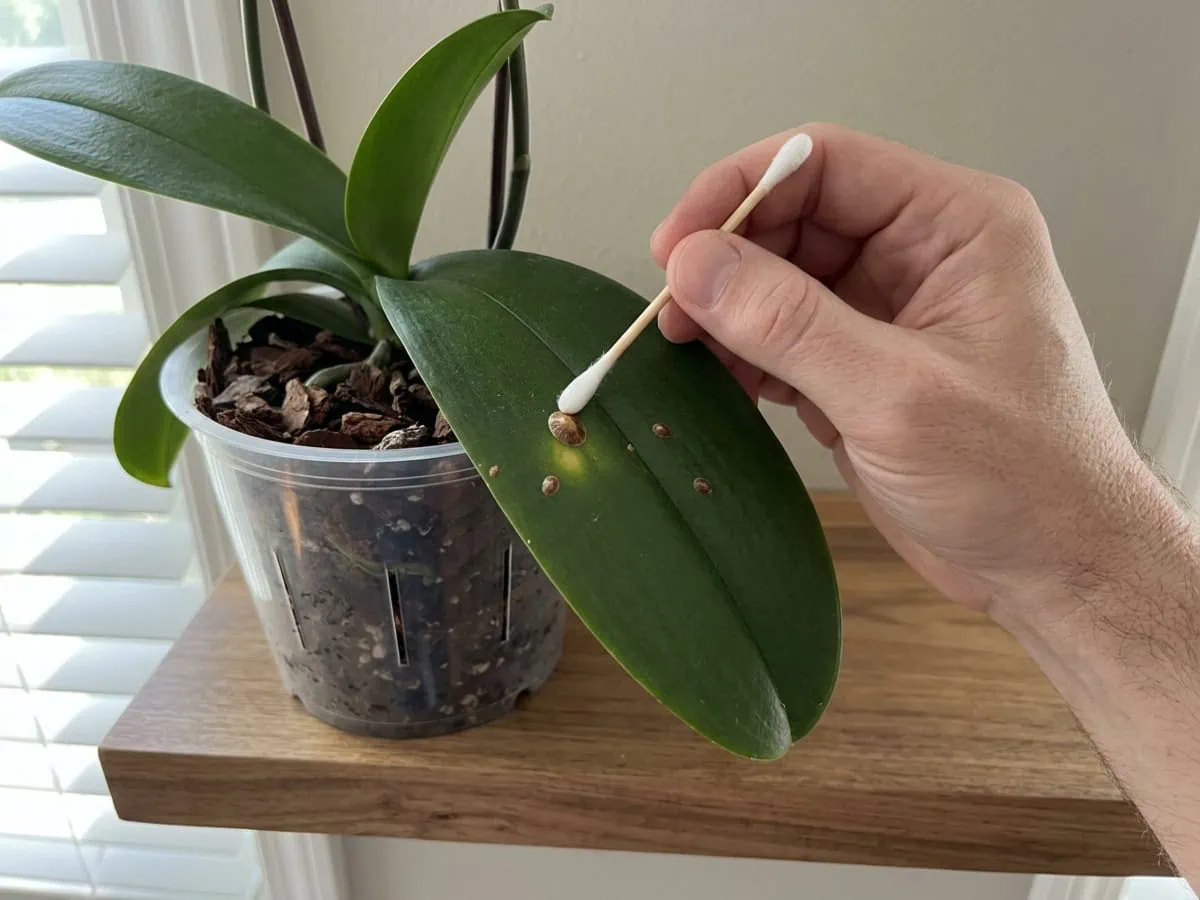
Scale plays dead. It hides in plain sight as small brown bumps that look glued to the leaves, stems, and the midrib underneath.
Soft scale weeps honeydew and draws sooty mold; armored scale forms a dry shell — flick one with a fingernail and it pops free with a faint, dry tick.
The biggest, darkest shells are usually dead already. But they are packed with eggs, so they still matter. Dead shells, live eggs.
Spider mites: stippling, webbing, cloth test
Learning how to identify spider mite damage on Phalaenopsis leaves comes down to a wipe test. The mites are nearly invisible, so you read the damage, not the bug: fine pale stippling or a silvery, pock-marked sheen, sometimes with faint webbing in the leaf axils.
One catch — the flat mite that targets moth orchids spins no web at all, so “no webbing” never rules mites out.
Wipe a suspect leaf with a white tissue. Rusty red or brown streaks confirm them. Mites are not insects, so reach for a labeled miticide, not a general insecticide.
Is sticky residue on my Phalaenopsis a pest sign or normal? Inspect before you assume the worst. Sticky residue paired with cottony fluff, brown bumps, or sooty mold means a pest; sticky droplets on a genuinely clean, insect-free surface can simply be the plant’s own harmless exudate.
If a careful look turns up no insect, the residue is likely benign, and any separate leaf change belongs to a different workup. See leaf-damage triage.
Pause for a sec. The first time scale fooled me, I read the little brown bumps as part of the stem and slid right past them — until my nail caught one and it flaked off with a tiny, dry click.
That sound, the click of a shell popping free, is the first thing I listen for now when I run a finger down a spike.
Tap the button below to get more plant fixes in your Google Search results

What clears them: alcohol, oil, and the medium too
Three tactics clear these pests when you combine them: isopropyl alcohol, a smothering oil, and clearing the medium. No single trick does it alone. The sections below take each in turn.
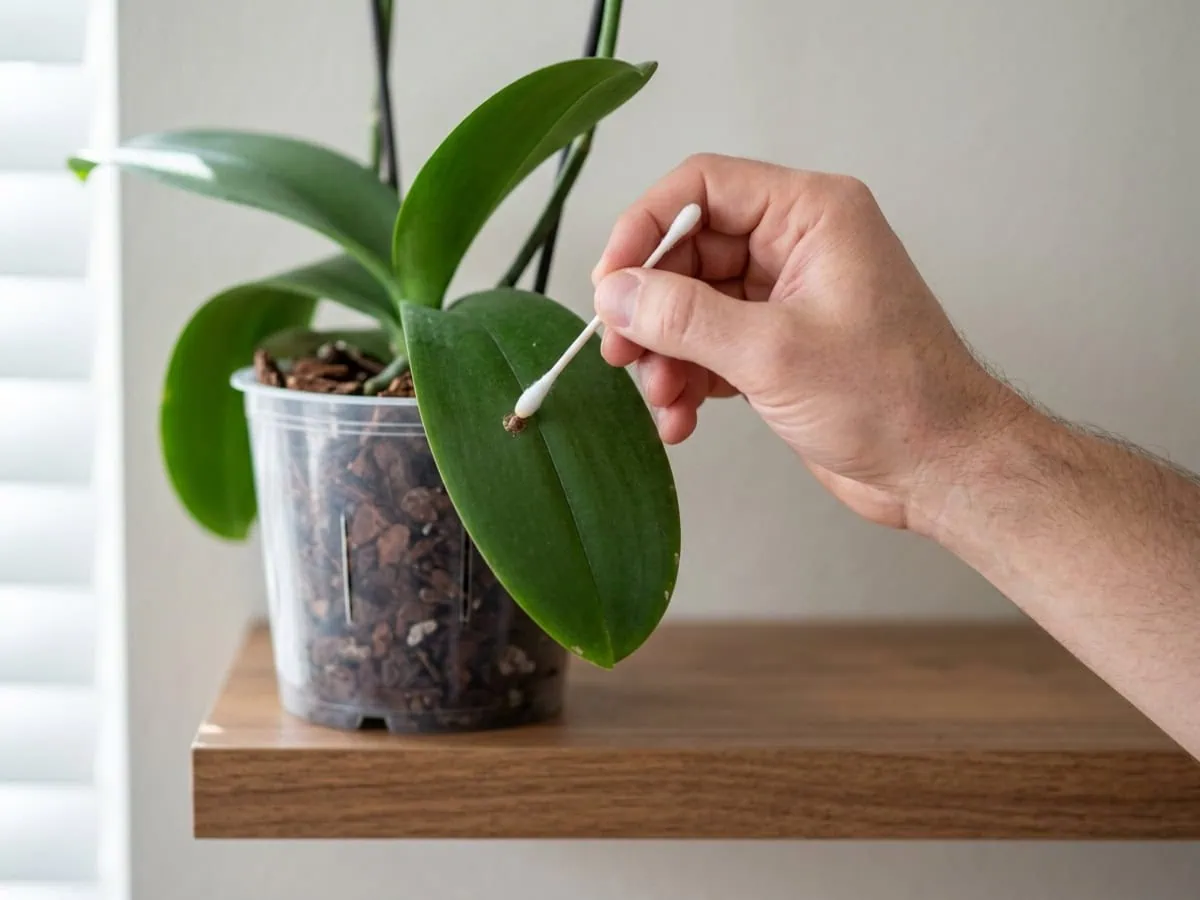
Isopropyl 70% or less, swab not spray, patch-test first
Here is how to use rubbing alcohol on Phalaenopsis orchids for scale: use isopropyl at 70% or lower, dabbed onto each colony with a cotton swab. Never use ethanol or methanol, which soak into leaf tissue and cause damage.
Skip the blanket spray; a swab reaches the crevices and spares the rest of the plant. Patch-test one small spot first, then wait a day or two for any burn before you go any wider.
Why bother with a patch test? Alcohol injures a leaf by flash-evaporating and over-cooling the surface, chilling pockets of cells into dead, sunken tissue. The risk is worst in moving air or low humidity.
So blot the residue rather than letting it dry on its own (FYI — moth orchid leaves are thick and waxy, which plausibly buys more tolerance than the soft-leaved orchids most warnings target).
This is anecdotal, so weigh it lightly: across my own plants the thick Phalaenopsis leaf shrugged off a careful 70% swab, yet I still patch-test every single time.
According to the University of Florida IFAS Extension, soaps and horticultural oils are natural products for scale and mealybugs, the lower-toxicity options for these soft-bodied pests. They work best on the younger crawlers, before the pests grow a waxy shield, so match the tool to the stage and keep the pressure on.
- 70% isopropyl alcohol + cotton swabs: spot-dab colonies; never ethanol or methanol.
- Insecticidal soap (1-2%): smothers soft-bodied crawlers; full coverage, out of direct sun.
- Neem or horticultural oil: smothers scale and mealybugs; mix fresh, apply under 85F.
- Soft toothbrush or microfiber cloth: lift hard scale shells off leaves and stems.
- Fresh orchid bark and a clear pot: to repot and clear the medium reservoir.
Neem and oil: total coverage, then repeat
Does neem oil work on orchid scale and mealybugs? Yes — neem and horticultural oils smother both pests, which means they only work where they actually land.
Coat every surface: leaf tops and undersides, the crown, the leaf axils, and the stem, because miss a patch and you reseed the colony from it. Oils hit the soft young crawlers hardest, since the waxy armor of adult scale shrugs the coating off.
Mix a fresh batch each time, apply below 85F and out of direct sun, then repeat, because one thorough pass still will not finish them.
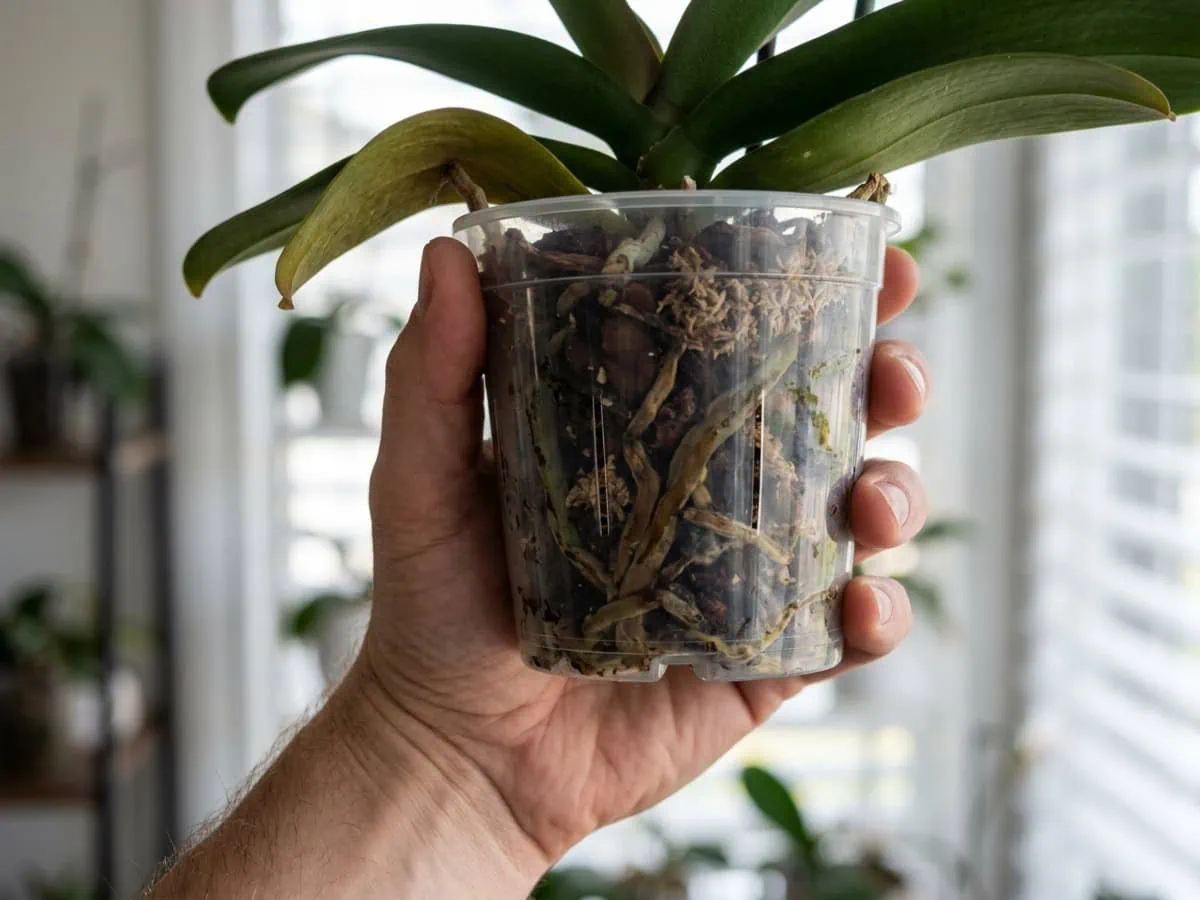
The medium and roots are a reservoir — repot too
Surface sprays fail when crawlers and eggs ride out the spraying down in the bark and along the roots.
A clear pot earns its keep here: hold it up to the light, tap the wall, and read the root mass for cottony white masses before you decide; soaked bark answers with a dull, wet squish when you press it, a quick tell that the reservoir is still damp enough to shelter them.
If the colony has gone underground, lift the plant, then rinse and inspect the velamen-covered roots. Velamen is the spongy, silver-white sheath that wraps orchid roots and greens when wet. Move it into fresh medium next, the same careful pass as repotting out an infested medium. Clearing that reservoir is what stops the comebacks.
Pest myths: coffee grounds, cinnamon, and “one spray”
A few popular fixes do nothing here, and one wrong assumption keeps infestations alive. Sort fact from folklore before you waste a week. The two sections below cover the kitchen-remedy myths and the “one and done” trap.
Coffee grounds and cinnamon don’t kill these
Do coffee grounds repel mealybugs? No — nothing supports coffee grounds as a repellent or a killer for mealybugs or scale, so skip them.
Cinnamon has a real job on the moth orchid. But it is the wrong tool here — it works as an antifungal dust for sealing a cut wound, not as an insecticide, and it will not touch a sap-sucking colony.
The overwatering myth is the stickiest of all: too much water does not summon mealybugs.
The real drivers are warm, stable indoor temperatures and lush new growth pushed by heavy nitrogen feeding — the tender tissue where these pests settle and lay eggs. Keep the plant on sane watering that won’t invite trouble plus steady feeding, and you strip away the conditions they exploit.
Myth: coffee grounds, cinnamon, or “just drying it out” will get rid of the pests. Fact: none of these clear mealybugs or scale — cinnamon is a cut-wound antifungal, coffee grounds show no effect, and dryness does not repel them. Only repeated alcohol, oil, and clearing the medium do the job.
Why one spray never finishes an infestation
One spray fails because it cannot reach every life stage at once. The math is against you.
Control works on the crawlers, the one stage you can actually reach; the hardened adult shells and the egg masses tucked beneath them ride right through a single pass. Overlapping generations are the real problem, since eggs keep hatching for weeks.
The numbers explain the grind: a scale generation can run as short as two to three weeks, and a single mealybug can lay 100 to 200 eggs over about two weeks. Each overlapping wave resets the clock.
So reapply every 10-14 days for at least three rounds, rotate between alcohol and oil so the pests do not adapt, and keep flicking the adults off by hand — each one lifts with that same dry click.
Expect a multi-week to multi-month grind, not an overnight win. The dark, brittle shells you snap off today were laid by a generation you already missed. Two clean inspections in a row is your signal to stop.
Frequently asked questions about moth orchid pests
How to get mealy bugs off of orchids?
Dab each colony with a cotton swab dipped in 70% isopropyl alcohol, then wipe the residue away, reaching the leaf joints, crown, and undersides where they hide. Move the plant away from the others first so it cannot spread. For anything a swab cannot reach, switch to a neem or horticultural oil that coats every surface, and repot into fresh bark to clear hidden eggs. Repeat every 10-14 days until two checks in a row come up empty.
What kills mealybugs immediately?
A direct touch of 70% isopropyl alcohol collapses an individual mealybug on contact, which is the only thing that happens “immediately.” It kills just what the swab reaches, not the eggs and crawlers hidden in crevices, the crown, and the potting medium. No product clears a whole infestation in one go, so plan on repeated rounds every 10-14 days over several weeks, rotating alcohol with oil until two inspections turn up nothing.
Will dish soap kill mealy bugs?
Diluted dish soap or a 1-2% insecticidal soap can suppress soft-bodied mealybugs and crawlers by smothering them, but only where it fully coats the pest. Test one leaf first for burn, since soap can damage tender new growth and reacts badly with hard water. Cover every surface, undersides and crevices included, and repeat on a cycle. Use it as a control that buys time, not a one-time fix, and rotate it with alcohol or oil.
What causes scale on orchids Phalaenopsis?
Scale usually hitchhikes in on a newly bought or nearby infested plant, then spreads in warm, stable indoor conditions. Heavy nitrogen feeding and lush new growth hand the crawlers the tender tissue they settle on. Cross-contamination and year-round warmth drive it, not too much water, which is a common myth. Quarantine every new plant for a few weeks and inspect the leaf joints and undersides before you set it beside the others.
Will my plant recover from mealybugs?
Yes — most moth orchids recover if you catch the infestation early and stay consistent. Swab the colonies with alcohol, smother the rest with oil, clear the medium by repotting, and repeat every 10-14 days over several weeks. Expect a multi-week to multi-month effort, not an overnight fix. A badly overrun plant with collapsing roots may not be worth saving, and discarding it can be the move that protects the rest of your collection.
What do you spray on orchids for mealybugs?
Use a 1-2% insecticidal soap, neem, or horticultural oil for full-coverage sprays, or spot-dab small colonies with 70% isopropyl alcohol. Apply oils below 85F, out of direct sun, and mix them fresh, since oil loses its effect after sitting for hours. Coat every surface, undersides and crevices included, because these products only kill what they actually touch. Rotate the products so pests do not adapt, and reapply on a 10-14-day cycle.
Can you just wipe off mealybugs?
Wiping helps but rarely finishes the job. A swab or soft cloth removes the adults you can see, yet eggs and crawlers stay behind in the crevices, the crown, and the bark. Pair manual removal with alcohol or oil, and clear the potting medium by repotting if the colony has spread to the roots. Then repeat on a 10-14-day cycle until inspections come up spotless. Manual removal is one tool in the rotation, not the whole fix.
Do coffee grounds repel mealybugs?
No. Coffee grounds neither repel nor kill mealybugs on orchids, so skip the kitchen remedies. Rely on what works: 70% isopropyl alcohol on a swab, neem or horticultural oil for full coverage, clearing the medium, and reapply every 10-14 days. The real drivers of an infestation are warmth and lush, over-fertilized growth, so easing off heavy nitrogen feeding does more than any pantry trick.
Win your next pest battle on the moth orchid
You can win this — it takes a rhythm, not luck. Identify the pest, dab the colonies with 70% alcohol, smother the rest with oil, and clear the medium so nothing survives to stage a comeback — the step most people skip.
That is the whole game. Stay with it. Stay on the 10-14-day cycle until two inspections run clean, and each week run a fingertip down the leaf joints, listening for nothing: no gritty catch, no dry click of a shell pulling loose.
If the marks turn out to be spots rather than bugs, switch tracks and rule out leaf-spot disease, not a pest. Master how to get rid of mealybugs and scale on Phalaenopsis orchids, and a clean, glossy fan of leaves is your reward. May your leaf joints stay quiet and cottony-free, and every swab come up clean.
Tap the button below to get more plant fixes in your Google Search results