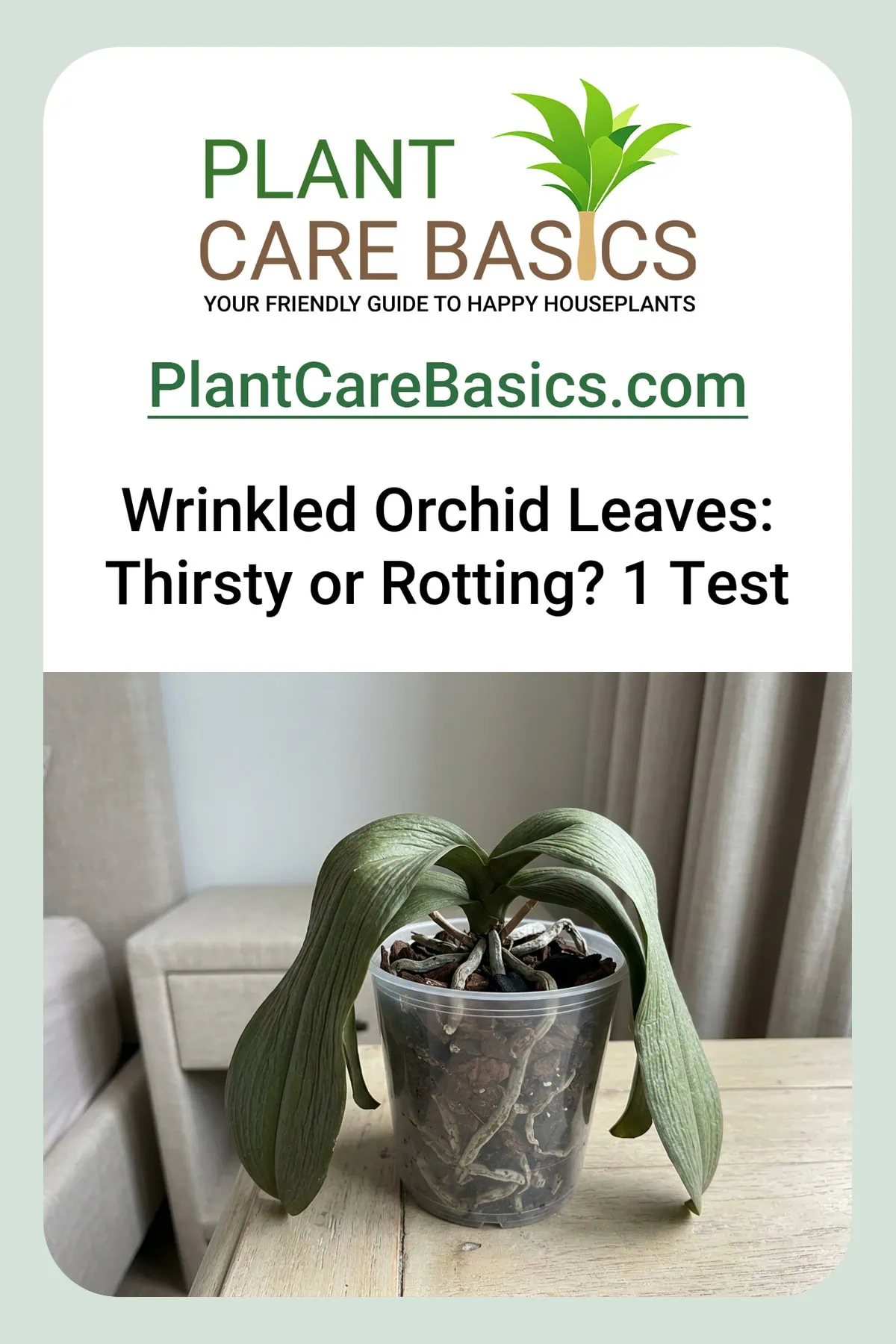
🎯 Quick Answer: wrinkled, limp leaves on a moth orchid
Wrinkled, limp leaves on a Phalaenopsis — a moth orchid, family Orchidaceae — signal a root-water problem at 50% RH or below. So why are my Phalaenopsis orchid leaves wrinkled and limp? Check the roots first. Brown, mushy roots mean over-watering; gray, shriveled roots mean thirst, not disease.
- Read first: check root color through the clear pot, not the leaves
- Lift the pot: bone-light means thirsty; heavy and wet means rot
- Finger-test the bark: trust the medium, not dry-looking aerial roots
- Hold humidity: keep a hygrometer near the plant above the floor
- Expect slow: firm new growth, not the old leaf, shows recovery
Look — the first time you pinch a limp moth orchid leaf, it feels wrong. Soft and pliable, almost like warm wax instead of a taut, glossy blade. That softness is the first sign of water loss.
I misread that exact feel, and I lost plants to it (yes, this sounds avoidable — bear with me). I kept adding water, certain the wrinkled, accordion-folded leaves were simply thirsty.
Pouring on more water sounds right. Honestly, that’s not quite right. It isn’t the leaf that’s thirsty — it’s the roots under the bark that have stopped moving water.
What a wrinkled Phalaenopsis blade is really telling you is this: it keeps water almost entirely in its leaves (they are its only reservoir), with no pseudobulb to fall back on. The moment the roots stop delivering, the leaf is first to deflate.
Think of the next few minutes as triage: read the symptom, read the roots, then route to the real fix. For the complete routine, start with the moth orchid care master guide.
One quick map before you act: the table below pairs each wrinkled-leaf clue with what it really means — and the single move it calls for.
Why are my Phalaenopsis orchid leaves wrinkled and limp? The quick read
| Moth orchid specs | Recommended care |
|---|---|
| Over-watered roots | Brown, mushy — route to the root-rot rescue, not more water |
| Under-watered roots | Gray, shriveled — soak the bark thoroughly now |
| Humidity floor | 50–60% RH; below ~50% can cause limpness alone |
| Brown crispy tips | Low humidity and/or salt build-up, not disease |
| Sunburn patch | Dry, sharply bounded, on the light-facing side (permanent) |
| Bottom-leaf yellowing | A single oldest leaf is normal senescence |
| Will a wrinkled leaf re-plump? | Only if still green and caught early; deep creases will not |
| Is one dying bottom leaf normal? | Yes — a single oldest leaf is natural senescence |
Tap the button below to get more plant fixes in your Google Search results

Table of Contents
Read the roots, not the leaves — over- or under-watered?
A limp, wrinkled Phalaenopsis leaf is almost always a root message. So read the roots before you reach for water. Two opposite problems make the very same soft leaf — roots run dry, or roots rot and stop drinking.
The leaf looks identical both ways. The fix is not. The two checks below — your eyes on the roots, then your hands on the pot — tell them apart in seconds.
If the roots are gray and shriveled and the pot feels light, then the plant is thirsty — soak it. However, if the roots are brown and mushy and the mix is soggy, then it is over-watered and rotting — withhold water and inspect the roots. Same wrinkled leaf, opposite move.
The 3-cue check: root color, weight, finger test
Run three fast checks before you decide anything.
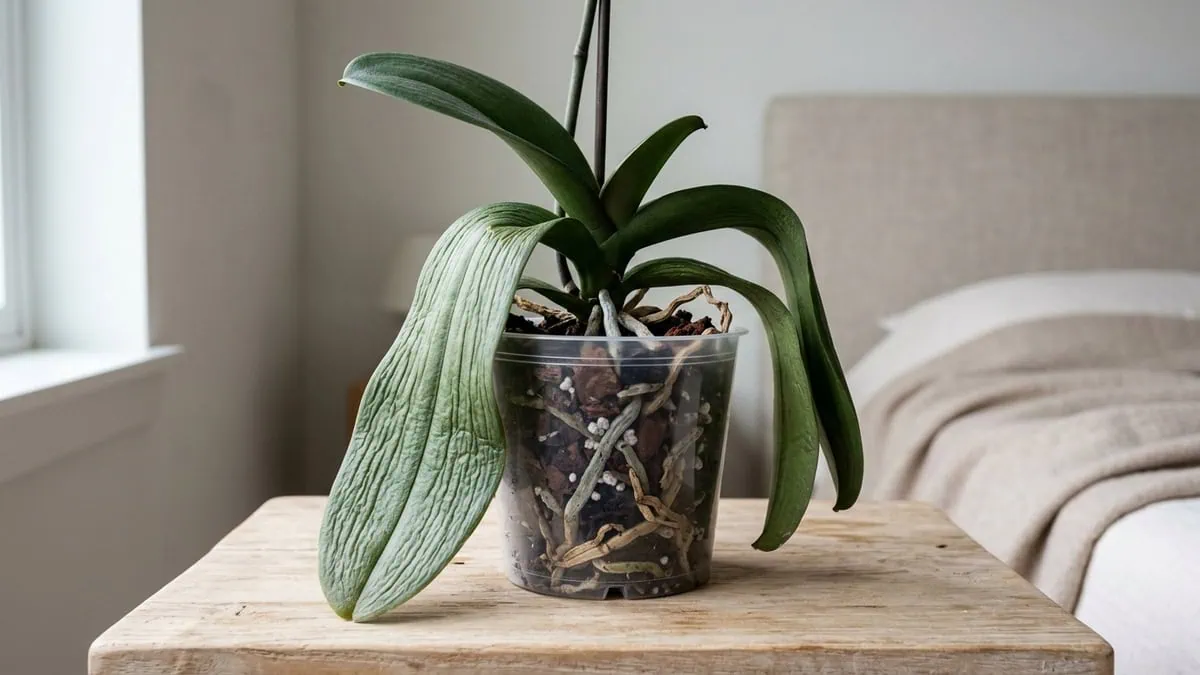
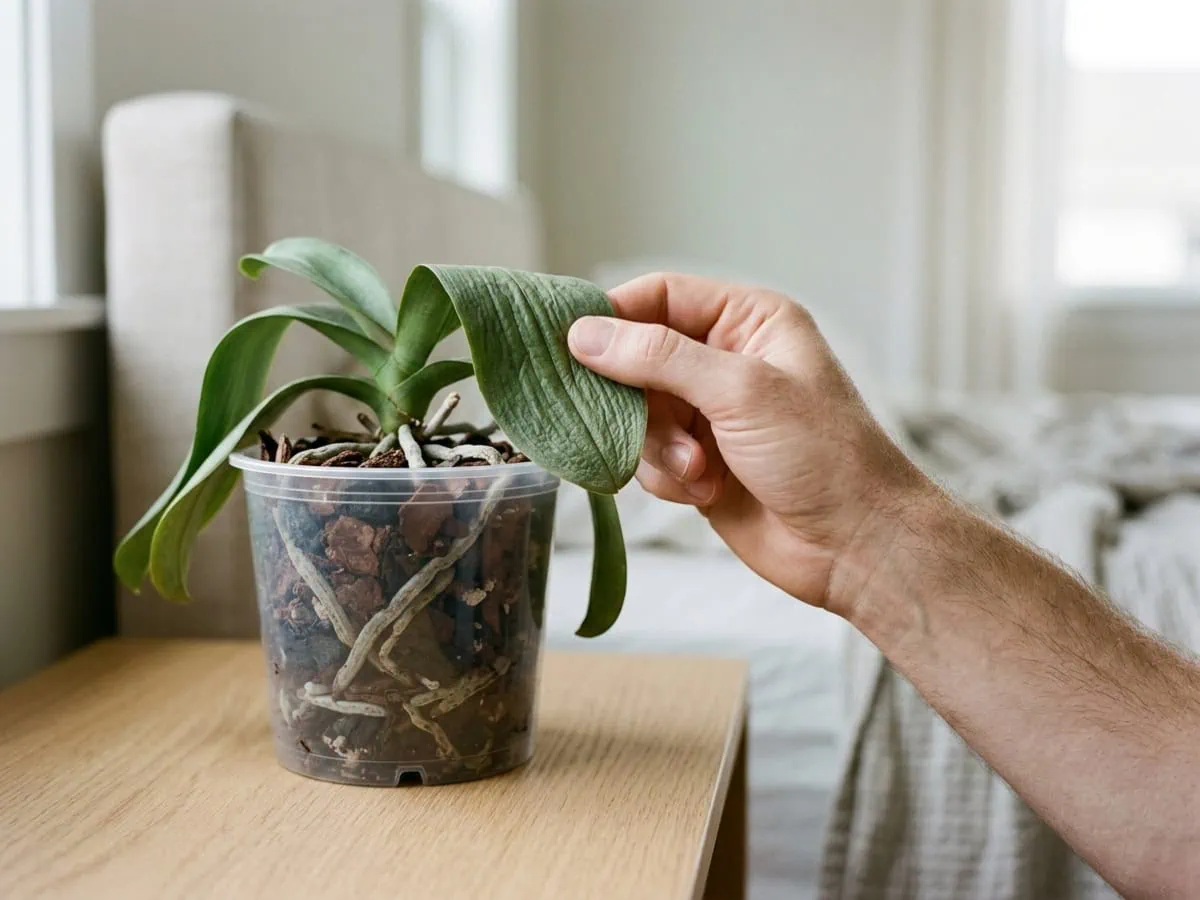
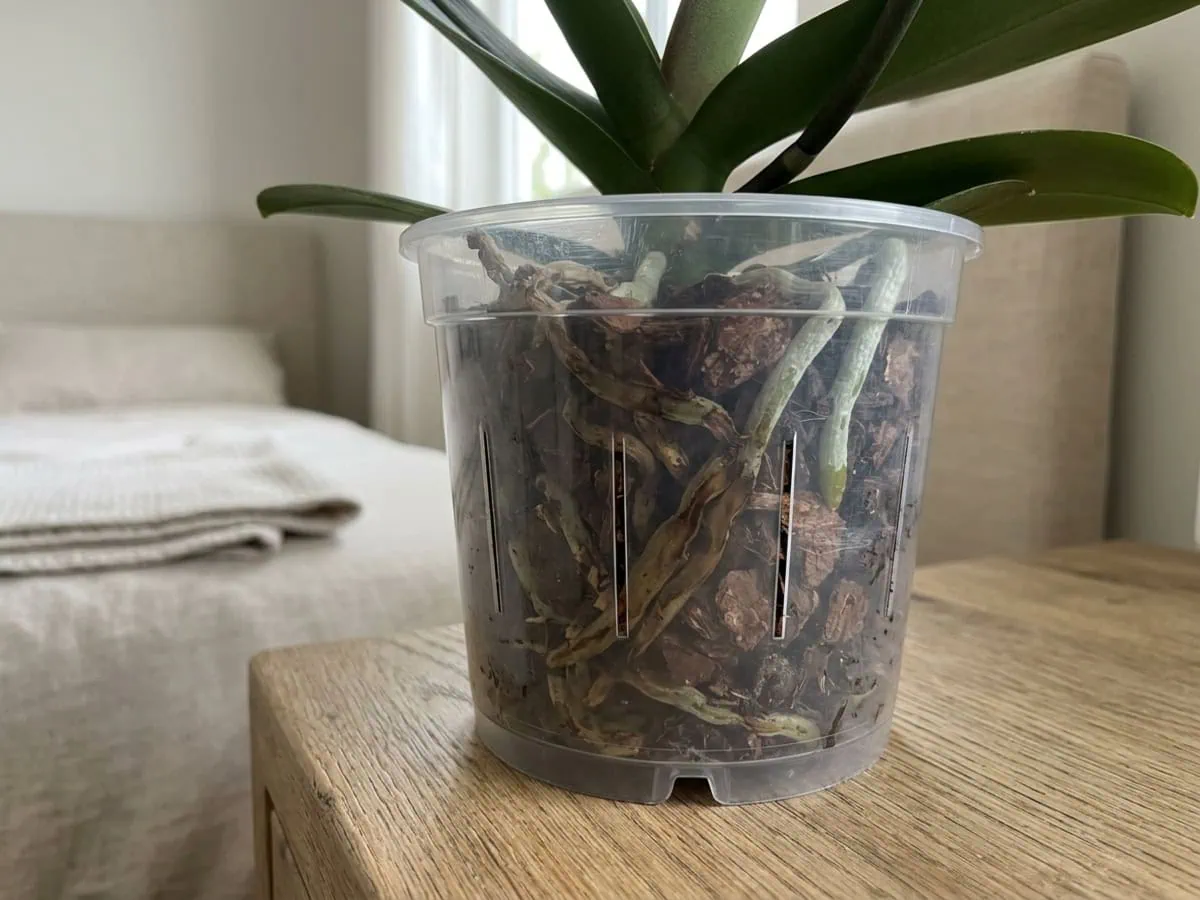
First, read root color through the clear pot wall. Silvery-gray, papery, shriveled roots mean thirst. Brown, soft, mushy roots that squash flat mean drowning.
Second, lift the pot. Bone-light points to a dry root ball. Heavy and waterlogged means a mix that never dried out.
Third, push a finger into the bark. Trust the medium, not the aerial roots. They can feel dry while the mix below stays damp.
Read those three cues together and the verdict is usually clear within a minute. If they come back wet-and-mushy, you are in brown, mushy roots and the rescue territory, not a watering-can problem.
Why a no-pseudobulb orchid loses turgor fast
A healthy leaf stays rigid for one reason: turgor pressure (the outward push of water-filled cells against the leaf wall). Picture those cells packed tight, holding the blade firm. Lose that pressure, and the leaf goes limp.
A Phalaenopsis is monopodial (it grows from one upward point, with no side bulbs). It builds no pseudobulb — the swollen water-storage organ that orchids like Cattleya lean on — so the broad leaf itself is the plant’s only real water store.
So when root uptake drops below what the leaf loses to dry air, leaf water potential falls and those mesophyll cells (the spongy water-holding tissue inside the blade) lose pressure. The thick blade folds lengthwise into accordion-folded pleats, instead of flopping flat like a thin houseplant leaf.
The crease runs the length of the leaf. That is the tell.
Full stop. The day I finally unpotted instead of re-watering, the roots told the whole story in a second — a fistful of brown, collapsed strands that gave like wet paper between my fingers (low-key still annoyed I kept watering that plant). The leaves had felt soft long before that. The roots had been dead even longer. I trust my fingers on the roots now, not my eyes on the leaves.
Tap the button below to get more plant fixes in your Google Search results

Yellowing, crispy tips, sunburn, or normal senescence?
Not every off-color leaf means the same thing. So sort the symptom before you act. The sections below split the usual suspects — yellowing, crispy tips, sunburn, and plain old age.
The big question — why are my Phalaenopsis orchid leaves turning yellow and dropping — usually splits three ways. One old bottom leaf fading is normal. Several leaves yellowing at once points back to the root-and-water problem above.
The third pattern is different. Dark, soft, floppy leaves with no flower spike point to too little light — a lighting fix, covered in dark leaves and no spike point to light. Color tells you which path you are on.
Brown crispy tips: low humidity or salt
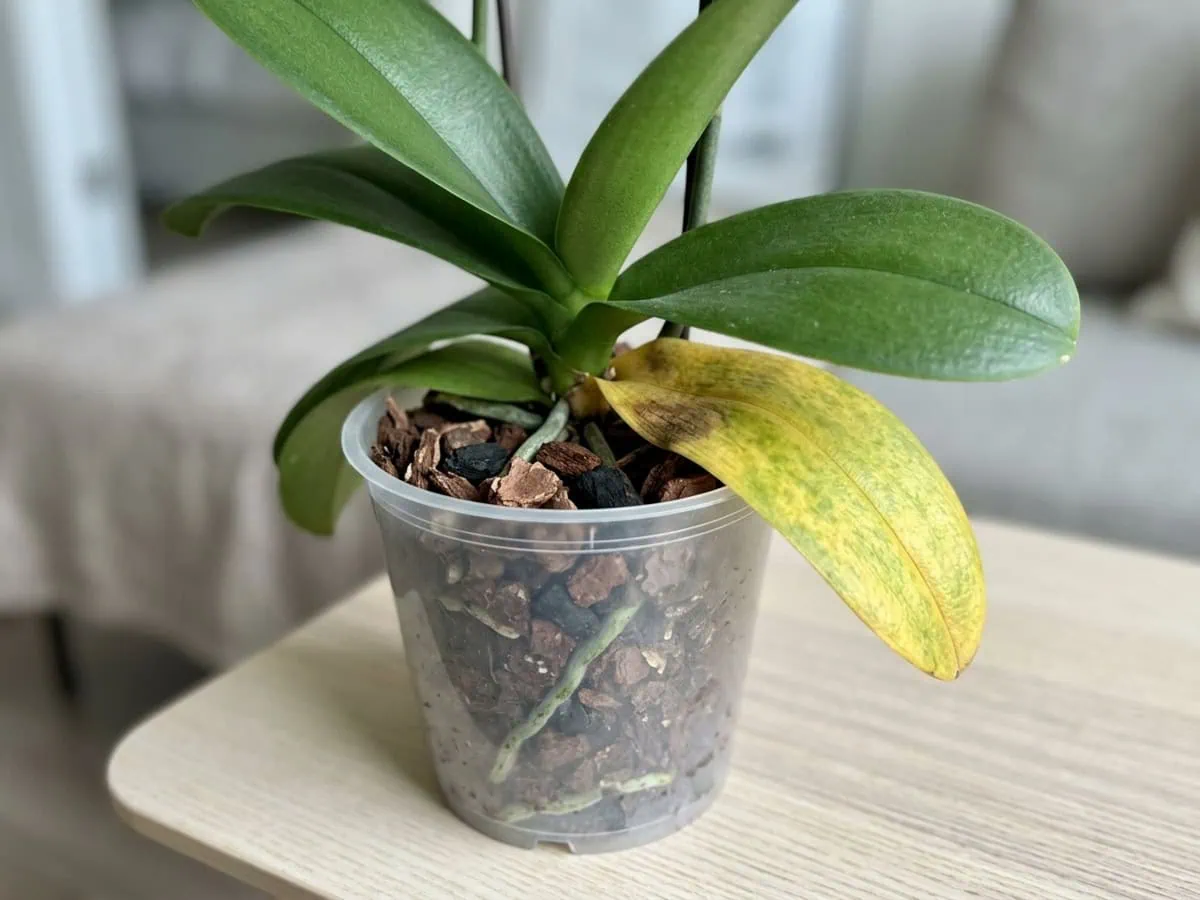
Brown, crispy leaf tips are an environmental signal, not a disease. Pinch one and it crackles, then crumbles like a dry cornflake between your fingers. The tissue is dead, not sick.
So why does my Phalaenopsis have brown crispy leaf tips? Usually dry indoor air, or mineral salt building up at the leaf margins. The last-served tissue at the tip desiccates first.
Per the Royal Horticultural Society, indoor humidity and leaf health for orchids track together. Aim for 50–60% RH (relative humidity — the water vapor already in your room’s air). Below roughly 50%, a well-watered plant can still wrinkle, because the leaf keeps losing water to the air faster than the roots can resupply it.
This is an open question for me. The exact humidity floor where firmness tips into visible creasing shifts with airflow and warmth. A hygrometer beats any single published number.
Sunburn spots versus a spreading wet lesion
Sunburn and disease look nothing alike once you know the tells. So what do sunburn spots look like on a Phalaenopsis orchid leaf? Dry, sharply bounded, bleached-to-brown patches — on the exact face that took the light.
Flat, crisp, fixed in size. Sun damage stays put. Because that scorched tissue is permanent (the bleaching breaks down chlorophyll, which never regrows), the fix is to slide the plant out of direct sun rather than cut the leaf off.
A bacterial or fungal patch behaves differently. It looks wet and sunken, and it spreads outward day by day. That is infection, not a turgor problem.
When a bottom leaf yellowing is normal
One yellow bottom leaf rarely matters. Owners constantly ask, is it normal for the bottom leaf of a Phalaenopsis to die — and yes, it usually is. A single oldest, lowest leaf that slowly yellows and drops is natural aging (senescence — the plant’s planned hand-off of an old leaf).
The plant is pulling mobile nutrients out of it to feed new growth. Worry only when the pattern widens. Two or more leaves yellowing together, soft upper leaves, or wrinkling alongside the yellowing — that sends you back to the roots.
Will a wrinkled leaf plump back up — and when to route elsewhere
Sometimes a wrinkled leaf re-firms. Sometimes it is gone. Which way it goes — and when to route the problem elsewhere — comes down to how far the cells collapsed and how fast you act.
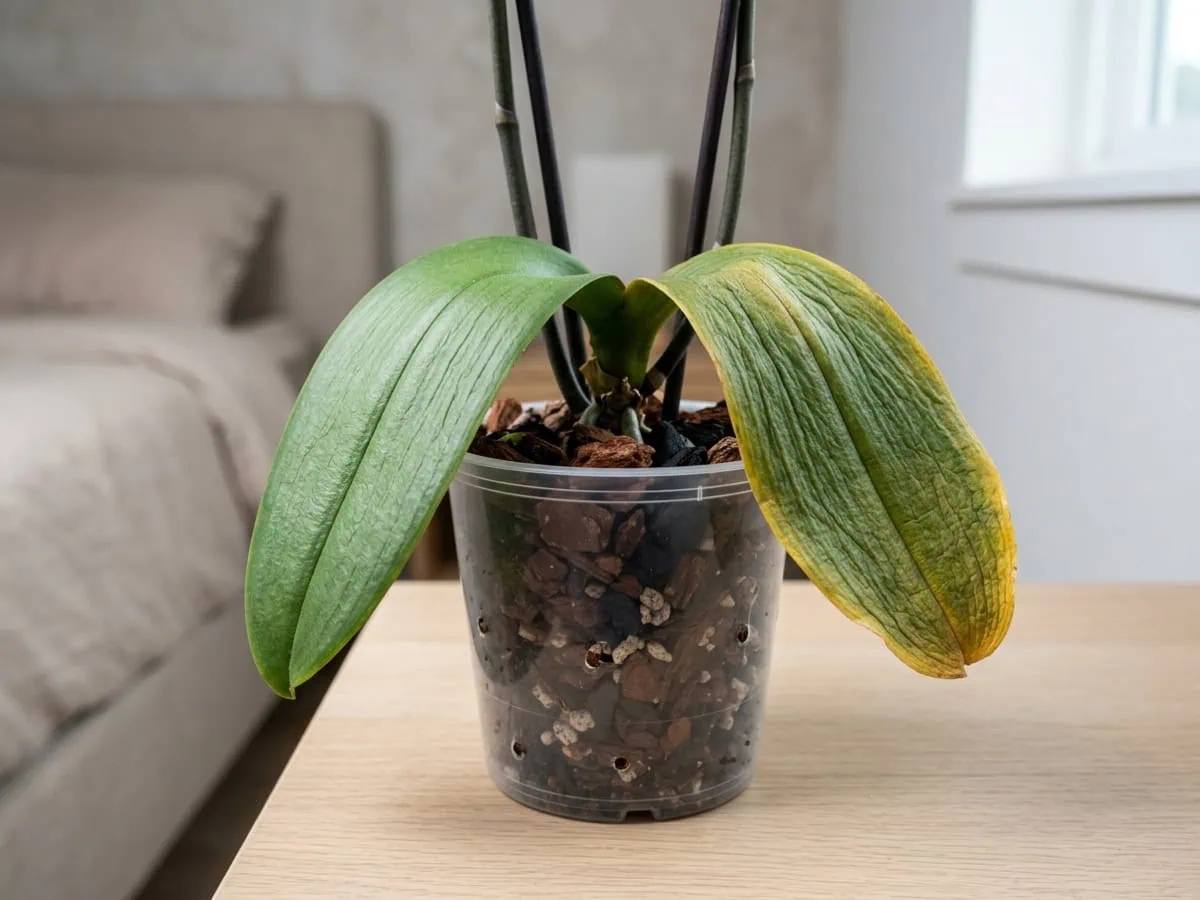
The clock matters. Catch it while the leaf is still green and only lightly creased, restore water uptake at the root zone, and the cells can refill until turgor (that firm internal water pressure) returns. Let it go leathery and deeply pleated, though, and that leaf stays creased for good.
Still-green wrinkles re-firm; deep creases won’t
The honest answer to whether can wrinkled Phalaenopsis orchid leaves recover plumpness is this: it depends, mostly on timing.
In my own testing, the leaves that bounced back were always the ones still firm-green and freshly wrinkled at the moment I fixed the roots. The leathery, yellow-edged ones never came back.
Real recovery shows up as new roots first (often in about four to six weeks, never overnight), then a stiff new leaf — not the old one re-inflating. So judge success by what grows next, not by the wrinkled leaf you are staring at.
A leaf that creases then splits
Sometimes a hard-wrinkled leaf does not just crease. It cracks open.
A blade that dehydrated stiff, then rehydrated too fast, can split along a fold as the cells swell unevenly (a fast soak forces the tissue to expand quicker than it can stretch). An old, leathery leaf can also crack under simple handling. A clean dry split is mechanical, and harmless to the rest of the plant.
What you do not want is different. A soft, sunken, spreading wet leaf lesions pattern is disease, not a turgor crack.
Myth: a wrinkled orchid leaf either always bounces back or is gone for good. Fact: it depends on the cell damage. A leaf that is still green and only lightly creased can re-firm once the roots take up water again. A deeply creased, leathery, or yellowing leaf will not re-plump — that tissue is spent — but the plant recovers by pushing sturdy new growth, not by reviving the old leaf.
When to route to rot, pests, or leaf spot
Once the symptom is read, hand the real cause to the right fix. Brown, mushy roots in a soggy mix mean root rot. Work the rescue, not the watering can.
Moving specks, fine webbing, or sticky residue on the leaves point to pests behind leaf damage, which need removal rather than a change in watering.
And a plant that is simply thirsty or dry-aired? Correct the water and the humidity. The next leaf comes in firm.
Frequently asked questions
Can limp orchid leaves recover?
Sometimes — a still-green, lightly wrinkled leaf can re-firm once the roots take up water again. Deeply creased, leathery, or yellowing leaves will not re-plump; that tissue is spent.
Either way, read the roots first and fix the water-uptake problem at the source. Recovery shows as firm new growth, with new roots usually returning in about four to six weeks once conditions are corrected.
How do you fix droopy orchid leaves?
Fix the roots, not the leaves. Droopy, limp leaves almost always trace to roots that cannot move water — either bone-dry and shriveled, or brown, soft, and rotting.
Check root color through a clear pot, lift the pot to judge its weight, and press a finger into the bark. If the mix is dry, soak it thoroughly and let it drain; if the roots are mushy, withhold water and inspect for rot. Hold humidity near 50–60% so corrected watering can hold.
How to perk up orchid leaves?
Restore water uptake at the root zone — that is the only thing that re-firms a limp leaf. Soak a dry, bark-grown plant until water runs through, then drain it fully and never leave it standing in water.
Raise humidity toward 50–60% with a hygrometer and a tray or humidifier. Plump leaves return as new growth; a deeply creased older leaf stays that way for good.
What does an overwatered orchid leaf look like?
An overwatered moth orchid shows soft, limp, often yellowing leaves while the potting mix stays wet. The real tell is below the surface: roots turn brown, soft, and mushy instead of firm and silvery-green, so they can no longer carry water up to the leaves, which wrinkle and droop even though the pot is damp. A wet pot plus limp leaves points to root rot, not thirst.
Should I water my orchid if the leaves are wilting?
Not until you have read the roots. Wilting can mean too little water or too much, and watering a plant whose roots are already rotting only makes it worse.
Check first: gray, shriveled roots and a bone-light pot mean it is thirsty, so soak it; brown, mushy roots and a heavy, wet pot mean rot, so withhold water and deal with the roots. The leaf alone cannot tell you which — the roots and the pot weight can.
Troubleshoot, assess, fix — the 3-cue test
The move that ends the guesswork is simple. Troubleshoot, assess, then fix — in that order. Press a leaf between your fingers and feel whether it is firm or pliable (turgor, read by touch).
Then read the roots and the pot weight before you reach for the watering can. Roots first, leaf second. Pot weight settles the call.
That one habit answers why are my Phalaenopsis orchid leaves wrinkled and limp faster than any leaf-only checklist — and once you know whether the plant is thirsty or drowning, it points you straight to correcting the watering itself.
May your next leaf unfurl thick, glossy, and stiff enough to bounce back a fingertip.
Tap the button below to get more plant fixes in your Google Search results