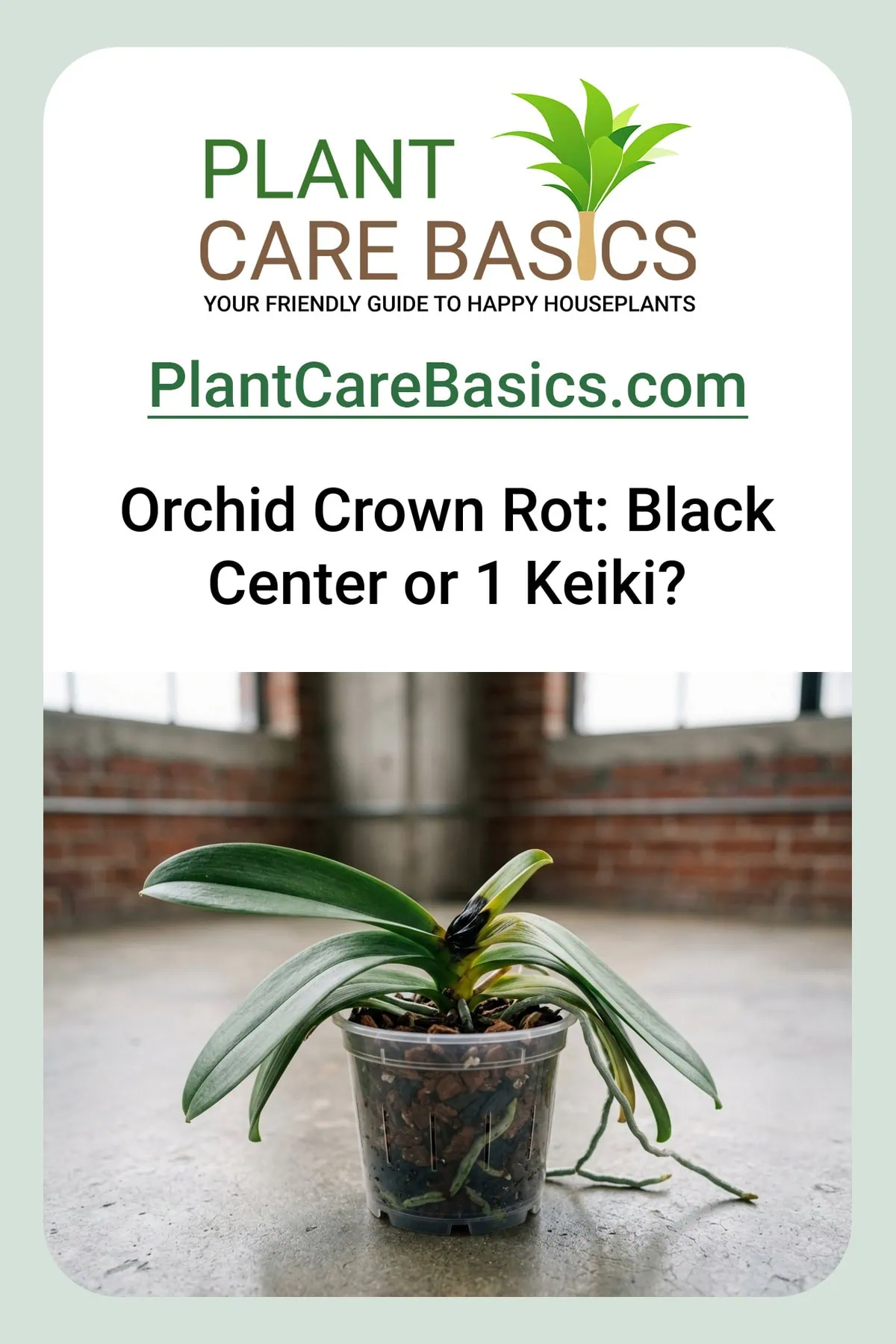
🚨 Emergency 30-Second Answer: saving a black, rotting crown
Move it out of standing water and dry the crown now — Phalaenopsis, in the Orchidaceae family, can still recover. Knowing how to fix Phalaenopsis orchid crown rot comes down to speed.
Cut the blackened, water-soaked tissue back to firm green with a sterile blade, then dust the cut with ground cinnamon. Keep hydrogen peroxide for pots and tools only. Never pour it into a living crown.
Dry the center within about 4 hours, at 60% humidity or lower, with gentle airflow. Even if the growing point is lost, a healthy root system can still push a basal keiki.
- Move it now: lift the plant clear of any standing water
- Drain the crown: tilt the plant so the center runs dry
- Cut to green: excise the black tissue with a sterilized blade
- Change the watering: base only, in the morning, never the leaf cup
- Add airflow: a low fan keeps the crown from staying wet
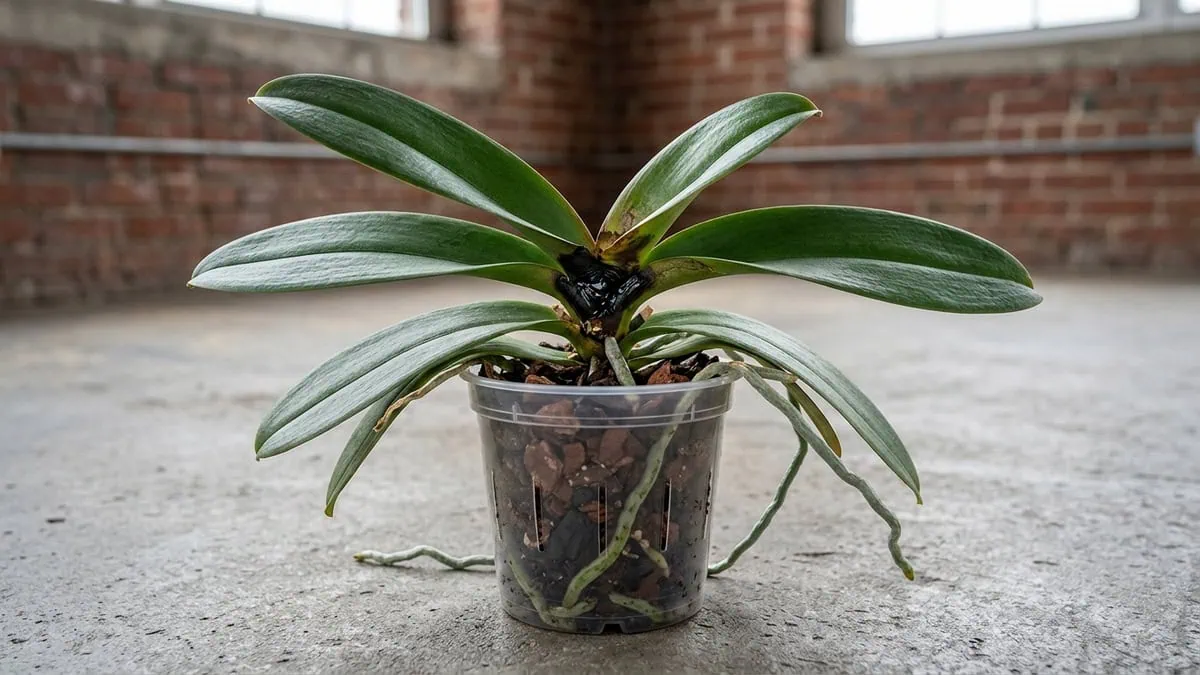
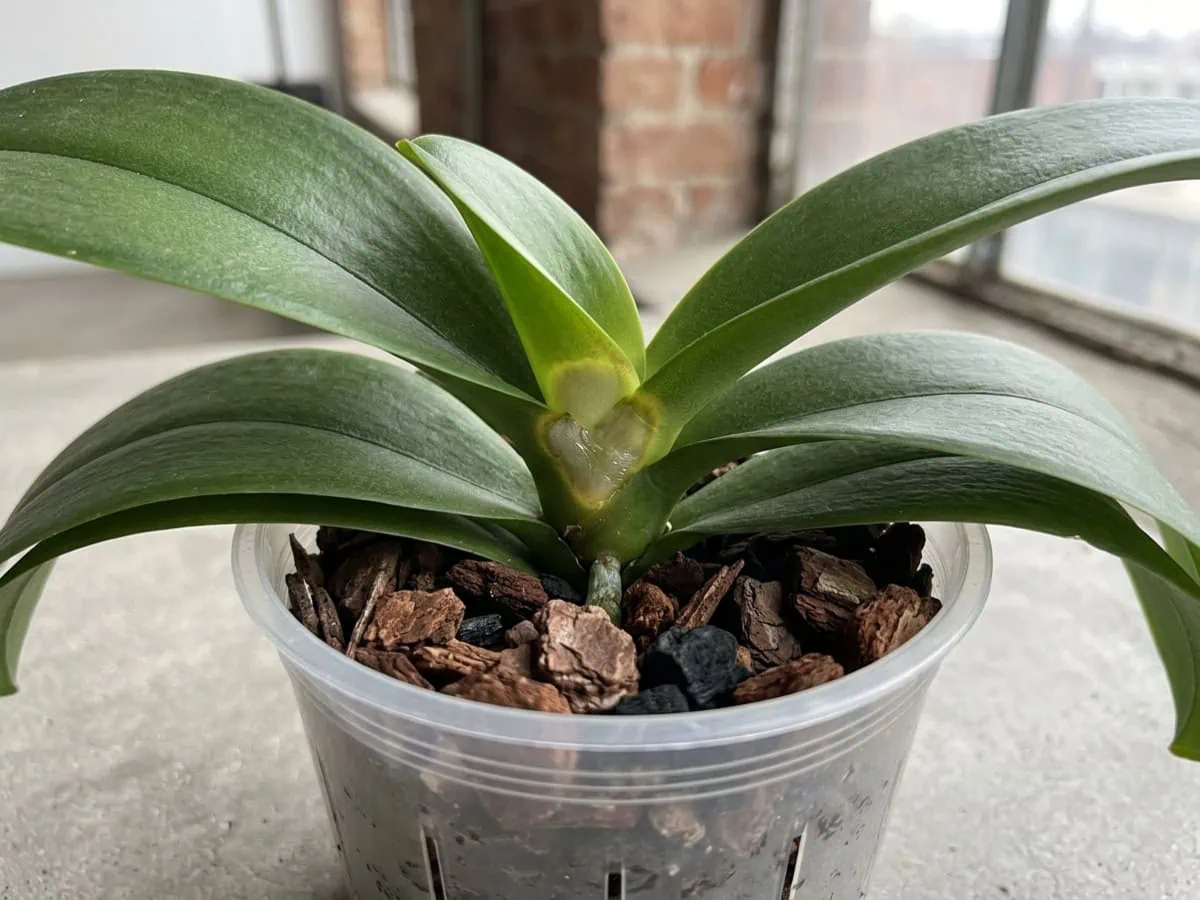
The first sign is small. A soft, water-soaked patch shows up at the base of the newest leaf. The green fades to a translucent tan, then to a wet, ink-dark center. I have watched that exact gradient sink into the crown of one moth orchid after another. The panic it triggers is real.
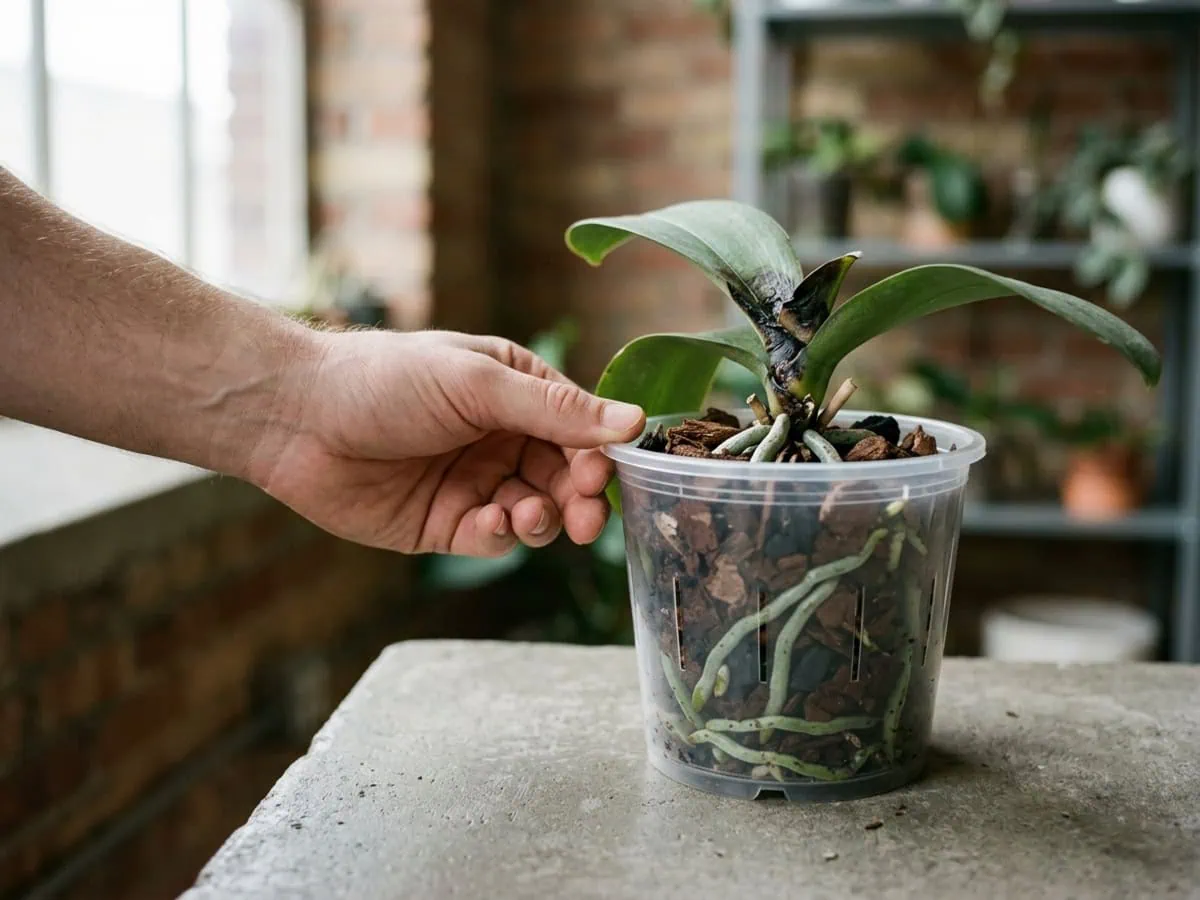
That blackened center is the visible problem. The actual problem is the anatomy underneath it: a Phalaenopsis grows from a single apical point, with no pseudobulb and no spare bud to swap in, so once rot reaches that tip the plant cannot grow it back.
Caught early, though, crown rot is fixable. Move fast. Cut clean. Keep the center dry, and you protect the roots below. For the full routine behind every step here, start with the indoor moth orchid care manual.
Take a breath before you cut. The following table maps the whole rescue at a glance, from the rot’s first look to the crown-dry target.
How to fix Phalaenopsis orchid crown rot, at a glance
| Moth orchid specs | Recommended care |
|---|---|
| Crown-rot look | Black, water-soaked rot at the base of the newest leaves |
| Causal agent | Bacterial (fastest, hours to days), fungal such as Fusarium, or oomycete |
| Rescue | Excise to firm tissue; sterile blade disinfected between cuts |
| Cut dressing | Ground cinnamon on the cut surface — a sealer, not a fix |
| Crown-dry target | Residual water gone in about 4 hours at 60% humidity or lower, plus airflow |
| Second lever | Adequate calcium and medium pH near 5.5–6.5 for cell-wall strength |
| Recover after losing the growing point? | Yes — a basal keiki, if the roots are healthy |
| Hydrogen peroxide poured on the crown? | No — pots and tools only |
Tap the button below to get more plant fixes in your Google Search results

Table of Contents
Stop crown rot now: excise, dry the crown, reposition
Crown rot spreads downward fast, so the rescue runs today, not next week. Cut every soft, blackened, water-soaked patch back to firm green tissue, and sterilize the blade between cuts. Dust each cut with ground cinnamon. Then tilt the plant so the center drains. Keep hydrogen peroxide for empty pots and tools only. Poured into a living crown, it oxidizes healthy cells and widens the wound.
What does crown rot look like on a Phalaenopsis orchid in the early stage? Before the center turns solid black, the base of the newest leaf goes translucent and water-soaked. Sometimes a faint yellow halo rings it, with a sour, musty smell up close.
This damage is pinpointed at the crown, not the whole-plant droop you might be reading distressed leaves over. Catch it here and you may lose only a leaf or two (I’ll point out exactly where to cut in a second).
Cut back to firm tissue with a sterile blade
Firm, pale-green tissue is the target. Anything soft, brown, or water-soaked has to go. I cut a little wider than the visible rot, because the infection runs ahead of what the eye can see, and a clean margin is the only way to be sure I am into living tissue. Wipe the edge with 70% isopropyl alcohol between every single cut.
The sequence is short:
- Sterilize the blade, then slice just above the rot line into firm green tissue.
- Re-sterilize and re-cut until every surface you expose is clean and dry-firm.
- Blot the area, then dust the cut with ground cinnamon as a drying seal.
Dust the cut with cinnamon to seal it
Ground cinnamon has one job here. It caps the open wound and helps the cut surface dry. Dust a thin layer on and leave it. The cutting and drying halt the spread, not the spice. Always test on a small area first. Results may vary depending on your specific conditions.
Keep water out of the crown from now on
The fix only holds if you change how water meets the plant. Learning how to stop water from sitting in a Phalaenopsis crown is mostly routine. Water at the base. Water in the morning. Let the center drain. The target is measurable: residual water in the crown should dry within about four hours, which happens at 60% humidity or lower with gentle air movement. Above roughly 75% humidity, it can linger for days.
Three rules carry most of the protection:
- Water early so daylight drives the evaporation window.
- Pour onto the medium, never into the leaf cup, and tip out any pooled drops.
- Add a small fan on low if a hygrometer near the plant reads above 60%.
Tap the button below to get more plant fixes in your Google Search results

What turns the center black — and whether it can recover
A pathogen turned the center black. The water itself did not. The wet, poorly drained crown just gave it a home. According to a peer-reviewed Phytophthora pathology study, orchid black rot caused by Phytophthora spreads through standing water films. That film is exactly what a crown offers when water pools in its center.
Bacterial, fungal, or oomycete: the agent sets the speed
So why is the center of my Phalaenopsis orchid turning black? The cause is microbial. One of three classes of organism is feeding on the wet crown, and the class sets how fast you must move.
- Bacterial soft rot (Erwinia, Pseudomonas, sometimes Dickeya): fastest, a foul, water-soaked collapse that spreads within hours to days.
- Fungal rot, including Fusarium: slower, often with reddish-brown lesions near the base.
- Oomycete black rot (water molds such as Phytophthora palmivora): thrives in standing water films and creeps toward a vascular wilt.
A fast, smelly, soupy collapse means you cut now. A slow darkening still needs the blade. It buys a little room. In the plants I have taken apart, the roots were often still firm while the crown had gone soft. That tells you the trouble started at the top. The pot is fine.
Calcium and pH: the second lever besides a dry crown
A dry crown is only half the defense. The other half is built into the leaf wall. Calcium is the mineral that builds firm cell walls. It is immobile, so the plant cannot shuttle it from old tissue to new, which means the newest crown leaves stay weak whenever calcium runs short.
Weak walls give a pathogen an easier door. Keep the medium in the slightly acidic range orchids favor so calcium stays available, and feed on a steady, dilute schedule.
Losing the growing point: a basal keiki carries on
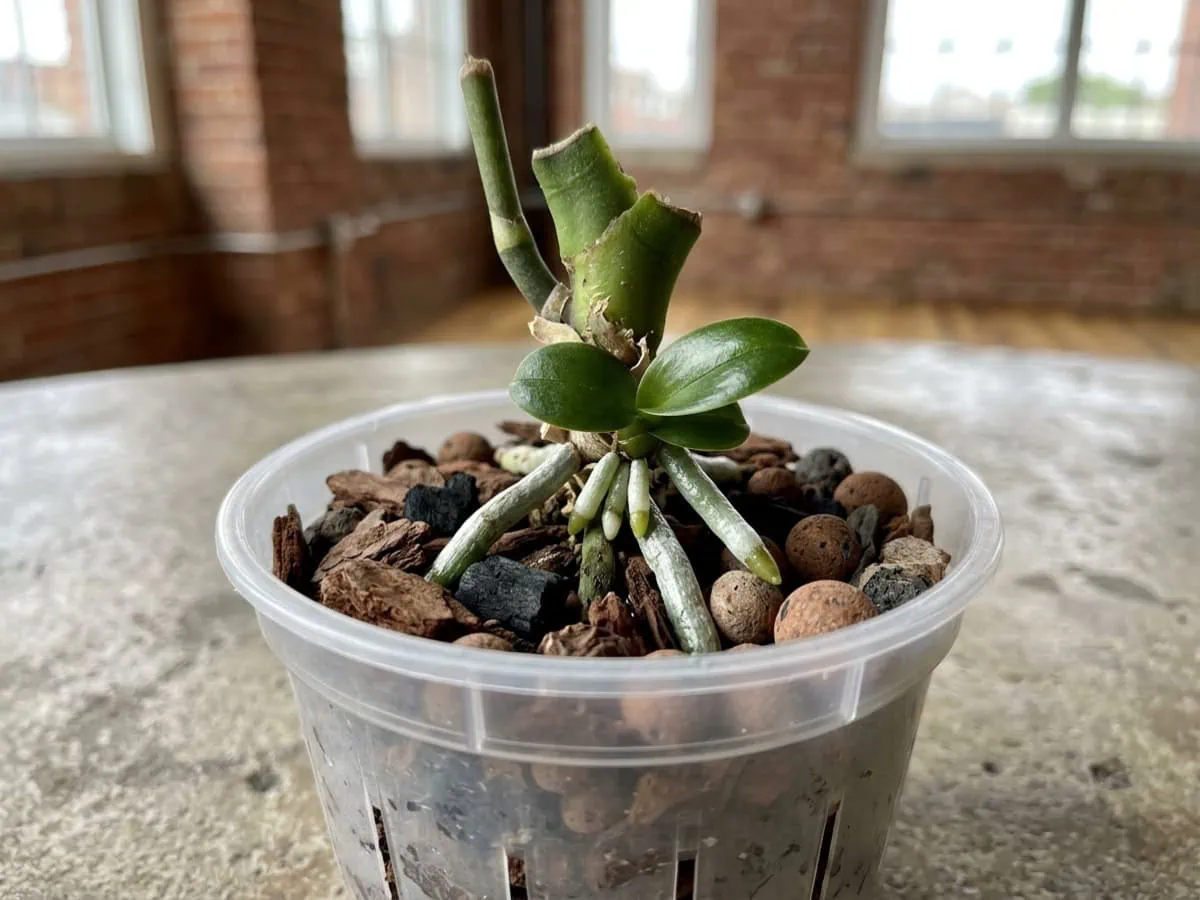
Can a Phalaenopsis recover after losing its growing point? Often yes, just not the way you picture it. The plant grows from a single apical tip and cannot regrow that exact point. So if rot takes the crown, it stops getting taller. But the roots are the lifeline. As long as they stay firm and silver-green, the plant can redistribute its hormones and push a basal keiki, a small plantlet, from a dormant node low on the stem.
Recovery hinges on what is left below the rot:
- Firm, silver-green roots: a basal keiki can form and grow on, even on a leafless plant.
- Mushy or missing roots: the odds fall sharply, so the roots become the priority.
That plantlet is the very structure growers raise on purpose when growing on a basal keiki. Rescue and propagation quietly converge.
Crown-rot myths and the peroxide trap
Three myths cause most of the avoidable damage here. The following sections clear them up.
Peroxide on the crown: why ‘full strength’ harms
The most-repeated advice online is to pour hydrogen peroxide on the crown. It is also the least bounded. Sources call for anything from “a small amount” to “full strength.” Here is the catch. That fizz is a catalase reaction, and on exposed living crown cells, strong or repeated peroxide oxidizes the very tissue you are trying to save and widens the wound. Stronger is not safer. It is the opposite.
- Safe: sterilizing empty pots and reused tools, which are inert surfaces.
- Unsafe: any root, stem, leaf, or crown, where it oxidizes living cells.
The mechanical route wins every time. Cut to firm tissue. Dry the crown. Reposition the plant.
Cinnamon is a sealer, not a fix
Is cinnamon safe to apply on a Phalaenopsis crown wound? Yes. Dusted on a fresh cut, it is generally considered pet-safe and helps the surface dry. But safe is not the same as effective.
The antifungal punch people credit cinnamon with comes from a volatile oil, and that oil fades out of long-stored, ground spice, so a jar from the cabinet behaves as a drying surface seal, not a fix that clears an active crown infection. Use it to cap a clean cut. Do not lean on it to stop a spreading rot on its own.
Crown rot is not root rot
Crown rot and root rot get lumped together. They fail in different places and call for different hands. Crown rot starts aboveground, at the growing point where water pools in the leaf cup, and the roots can stay firm and silver-green while the center blackens. Root rot is the mirror image: mushy brown roots in a soggy, broken-down medium while the crown looks fine at first.
The quick tell:
- Crown rot: black, soft center at the leaf base; roots often still intact.
- Root rot: mushy brown roots in wet medium; crown intact early on.
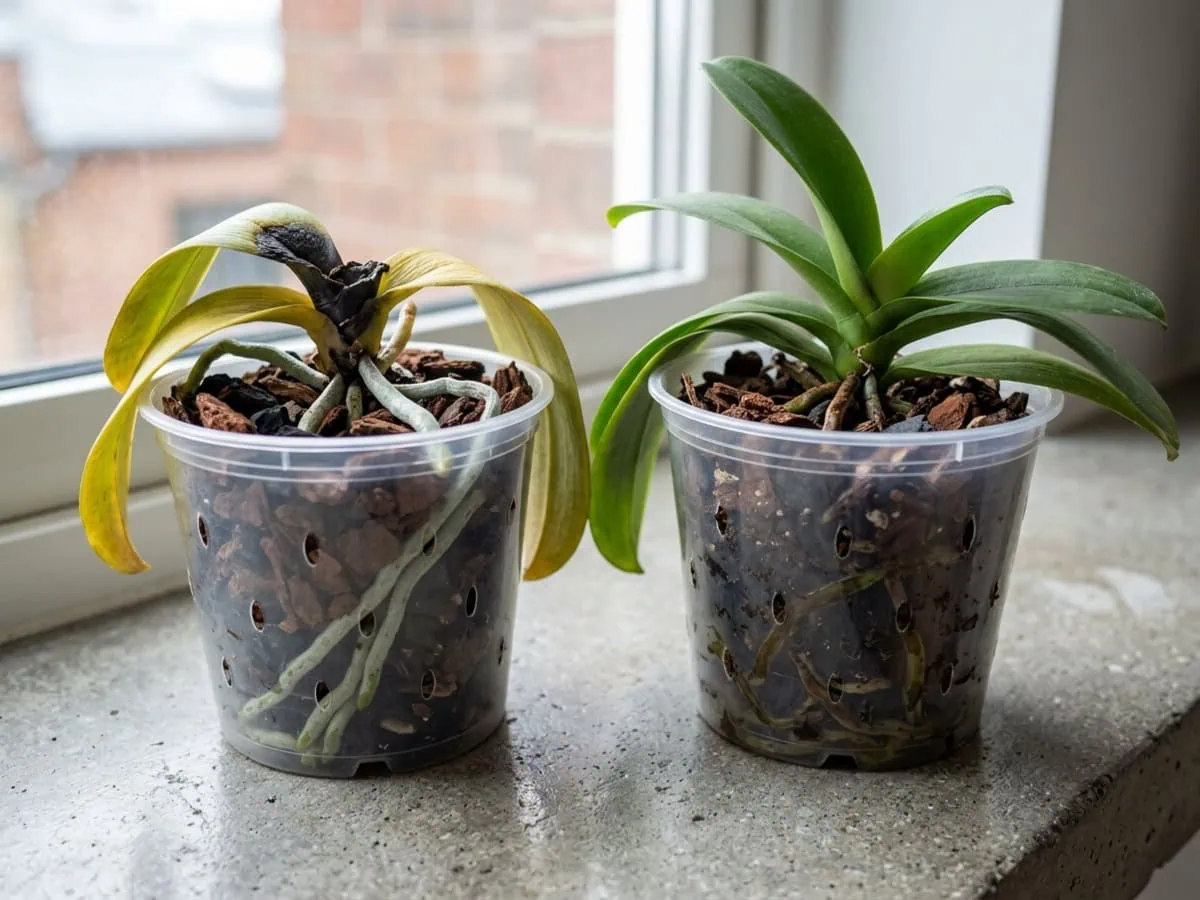
If your trouble is really down in the pot, the cut-and-dry routine here will not reach it. That is rot down in the root zone instead, a different rescue.
Crown rot questions, answered
Can an orchid with crown rot be saved?
Yes, if you catch it before the rot consumes the growing point and reaches the roots. Cut the blackened, water-soaked tissue back to firm green with a sterile blade, dust the cut with cinnamon, and dry the crown fast. A plant that keeps a healthy root system often recovers, sometimes by pushing a basal keiki even after the central tip is gone.
What does Phalaenopsis crown rot look like?
It looks like a soft, black, water-soaked patch at the base of the newest leaves, right in the center of the plant. Early on the tissue turns translucent and slightly yellow before it darkens, often with a sour smell. The roots may still look firm and silver-green while the crown blackens. That crown-centered spot is what sets it apart from leaf or root trouble.
Can you resolve crown rot?
You resolve early crown rot mechanically, not with a single spray. Remove every soft, blackened patch back to firm tissue with a sterilized blade, seal the cut, and keep the center dry within about four hours of any watering. A fungicide can support a clean cut, but cutting, drying, and better airflow are what actually stop the spread. The earlier you catch it, the more of the plant you keep.
What causes crown rot in orchids?
Crown rot is caused by water pooling in the crown, where bacterial, fungal, or oomycete organisms colonize the wet tissue. The water is the enabling condition; a pathogen is the agent. Cold water, overhead watering, low airflow, and a calcium-short plant all raise the risk, by keeping the center wet or leaving cell walls weak. Watering into the leaf cup is the single most common trigger.
What is an effective fungicide for crown rot?
A copper-based fungicide is a common choice, and a biological option such as Trichoderma harzianum can support recovery on a cleaned wound. Whichever you use, apply it only after excising the rot to firm tissue, because no fungicide rescues tissue that is already dead. Keep hydrogen peroxide off living tissue; it is for pots and tools. The blade and a dry crown do the real work.
End the soggy-crown era, dry it out for good
Crown rot looks like the end. It is really a plumbing problem with a deadline. Caught early, it is fixable. The center blackens because water sat where it should not, and a pathogen moved in. So the whole rescue is three moves: cut, dry, reposition.
Then never let the crown stay wet again. Keep the blade sterile. Keep the peroxide on pots and tools. Keep a hygrometer honest about that four-hour drying window. If the plant looks shaky weeks later after you move it into fresh bark, read that as a plant struggling after a repot, not a relapse.
Master how to fix Phalaenopsis orchid crown rot once, and you stop losing plants to a problem that is almost always avoidable with a dry center. May your crown stay bone-dry and your newest leaf push up clean and green.
Tap the button below to get more plant fixes in your Google Search results