🛠️ Quick Prep Summary: dividing one crowded clump
Knowing how to divide and propagate a peace lily starts with a damp root ball, not a blade. Water Spathiphyllum wallisii 1 day ahead, then gather the few things below. Each finished piece keeps its own roots and healthy foliage.
- Sharp knife, sterilized: wiped or dipped in alcohol, with no long soak
- Timing: divide when growth has resumed and the clump sits crowded
- Difficulty: low-medium, because hands do most of the separating
Real talk: my first peace lily division came out of its pot as one sodden lump. Over 6 years I have split 7 clumps, and the hurried ones gave me leaf fans that lifted away with almost no roots (TBH — a fan without roots is a cutting, and this plant does not root from cuttings).
Teasing beats tearing. A dull blade is the visible problem. The actual problem is anatomy: leaves rise straight off a low creeping crown, so every piece needs its own crown buds and roots instead of a node that can root.
Updating my earlier point, the blade matters only after your hands find the seam where two fans part. Watch the cut face there. Cream at first, tan by the next morning, which is the wound closing rather than rot.
If you would rather grow one strong clump than several, start with raising a healthy clump from the start.
Slow your hands down before you touch the clump — the table below sets out the specs, timing and tools this job actually needs.
How to divide and propagate a peace lily: the specs at a glance
| Peace lily specs | What this job needs |
|---|---|
| Difficulty level | Low-medium (beginner) |
| Time needed | One sitting |
| Best moment to do it | When the clump is crowded and growth has resumed, not by a calendar date |
| Sterile blade required? | Yes – only when hands cannot part the fans; wipe or dip it in alcohol |
| What every division must keep | Its own roots plus healthy foliage on the same piece |
| Container for each division | Same size the plant was in before, never a step up |
| Growing medium | A peat-and-pine-bark foliage mix, 2 parts peat moss to 1 part pine bark, top-dressed with a thin layer of the same coarse pine bark |
Tap the button below to get more plant fixes in your Google Search results

Table of Contents
Before you split: is division the right move?
Division is the right move once a crowded clump has outgrown its pot and you want more plants or the parent held at its size. Roots showing at the drainage holes, and a peat-and-bark mix that dries down faster than it did when you last repotted, are the two signals behind both branches. Both are visible.
Type “can you propagate a peace lily from a leaf cutting” into a search bar and the honest answer is no. Leaves and flower stalks rise straight off a low creeping stem, so none carries a growth point. No node, no new plant.
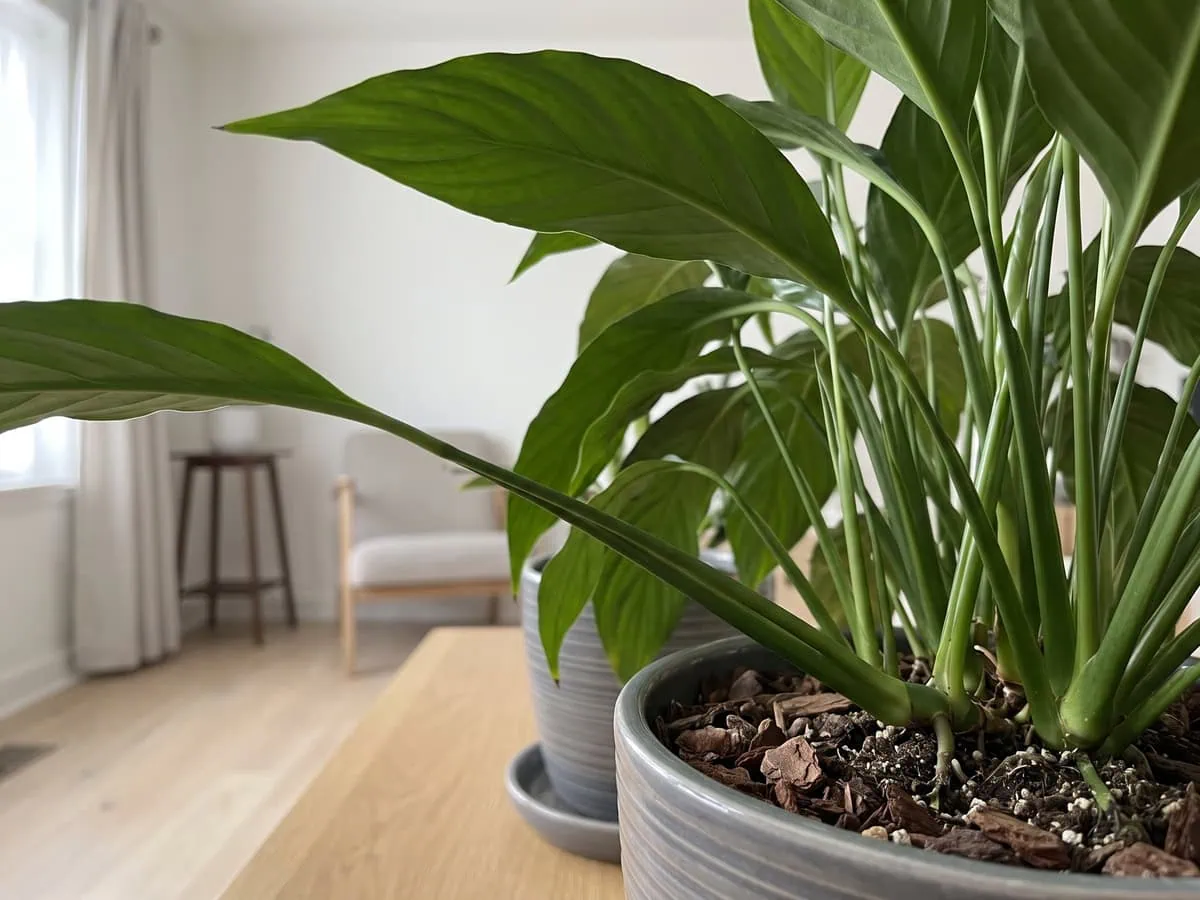
I’m still figuring this out, but the seed route looks closed indoors: pollination rarely happens in a living room, and seed takes years.
The following sections cover the choice, the signals, and the tools.
Dividing versus moving up a pot size
Both branches answer the same signals, so your aim is the selector. Division keeps the parent where it is. A wider pot does not.
- [PROS] Holds the parent at its size and gives a second plant off the same root mass. (Best For: an over-full clump)
- [CONS] Opens cut tissue, and every piece stalls while it re-anchors.
Verdict: Choose division to hold the parent at its size; choose a pot one to two inches wider for one larger plant, because wet mix no root reaches is what rots roots.
The signals that say the clump is ready
Read the pot, not the calendar. A clump I split had stayed heavy for a week after watering, and by the time I moved it the same pot felt light on the fourth day. Skip the job while a white spathe is open.
Type “best time of year to divide a peace lily” into a search bar; the answers contradict each other. This evergreen keeps no strict dormancy, so the window opens once growth resumes and the clump sits crowded. If the mix stays soaked instead, check how often the pot really needs refilling.
Tools, sterile blade, and the day before
Water the plant thoroughly 1 day ahead, so the mix is damp rather than soaking when the root ball comes out. A dry clump crumbles and takes roots with it. Damp tissue holds.
Wipe dirt and sap off the blade first, then wipe or dip it in alcohol; no long soak is needed. Sterilizing buys exactly one thing here: the cut face you are about to make is wet open tissue going straight into a mix that was never sterile.
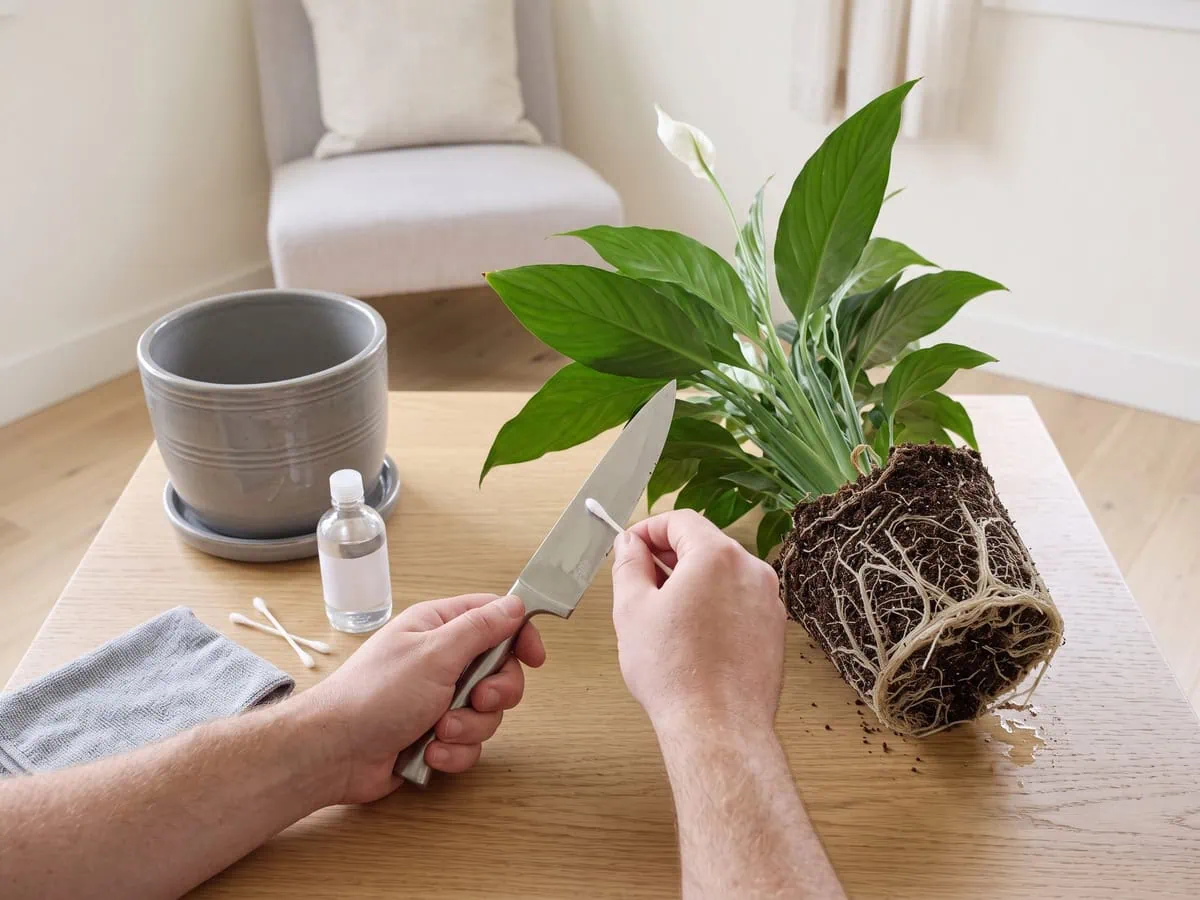
Wear gloves: this aroid’s sap irritates skin on contact. If it reaches bare skin, lather the area repeatedly with soap and rinse under warm running water. Keep the kit short:
- Sharp knife, sterilized, for fans that will not part by hand
- Nitrile gloves and soap at the sink for irritant sap
- Fresh mix and same-size pots, moistened first
Tap the button below to get more plant fixes in your Google Search results

Dividing a peace lily step by step
The whole operation runs in one sitting: lift the clump, find the seams, ease the fans apart, then pot each piece at its old depth.
Type “how to split a peace lily into multiple plants” into a search bar and most guides start at the blade. Start at the crown instead, because according to University of Florida IFAS Extension each section needs a share of the root system and several crown buds.
The five steps below run in order, and the tools do not change between them.
Step 1: Ease the root ball out of its pot
Tip the pot on its side and slide the root ball out whole rather than pulling on the leaves. Work over a tray. Yesterday’s watering makes this the easy part.
Step 2: Find where the fans separate
Brush the surface mix back from the base and look for leaf fans rising from different points on the short creeping stem. Those points are where the clump has already divided itself. Count them before you pull.
The “how to separate peace lily crowns when dividing” question comes down to finding the natural divisions, which names the goal rather than the method. A small clump splits in two. A large one takes as many pieces as you want, provided each keeps roots enough to drive further growth.
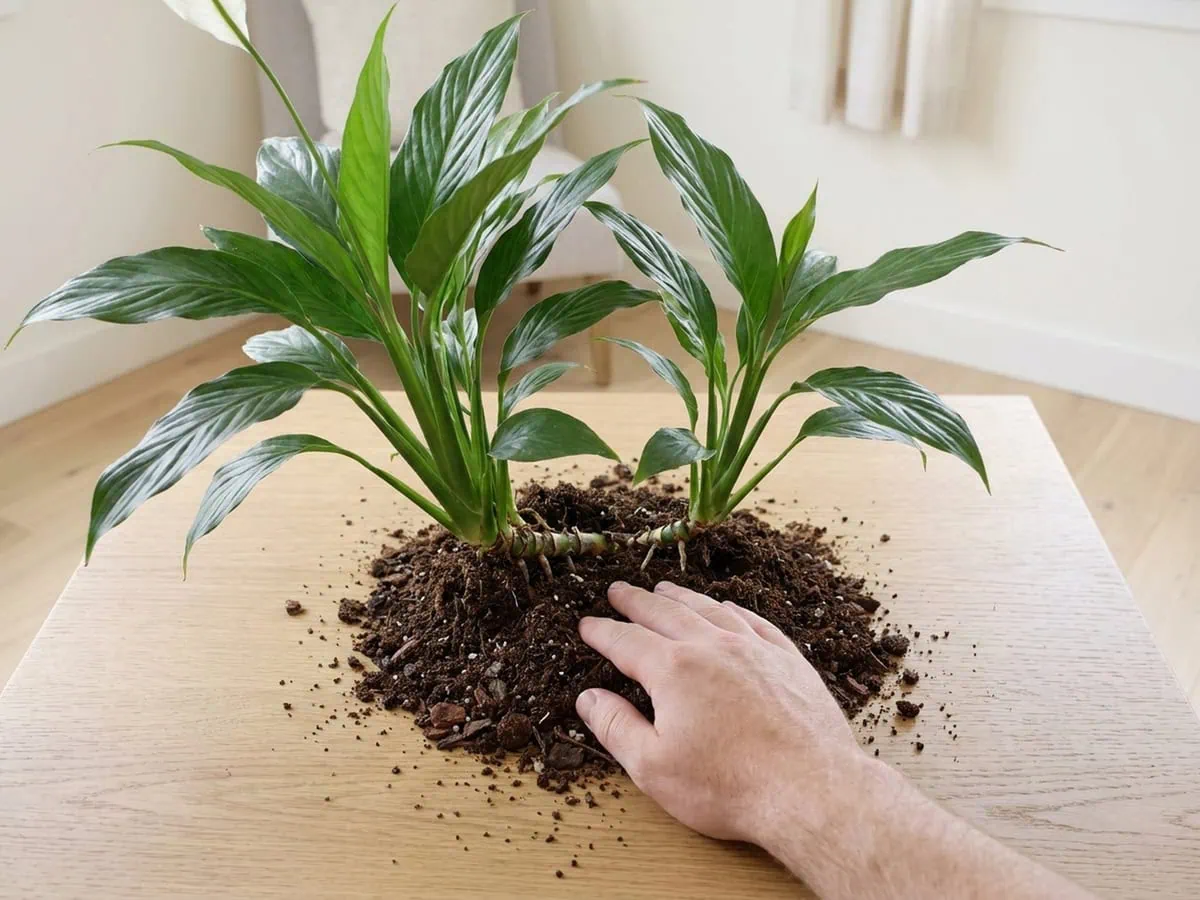
Step 3: Pull first, cut only if it will not give
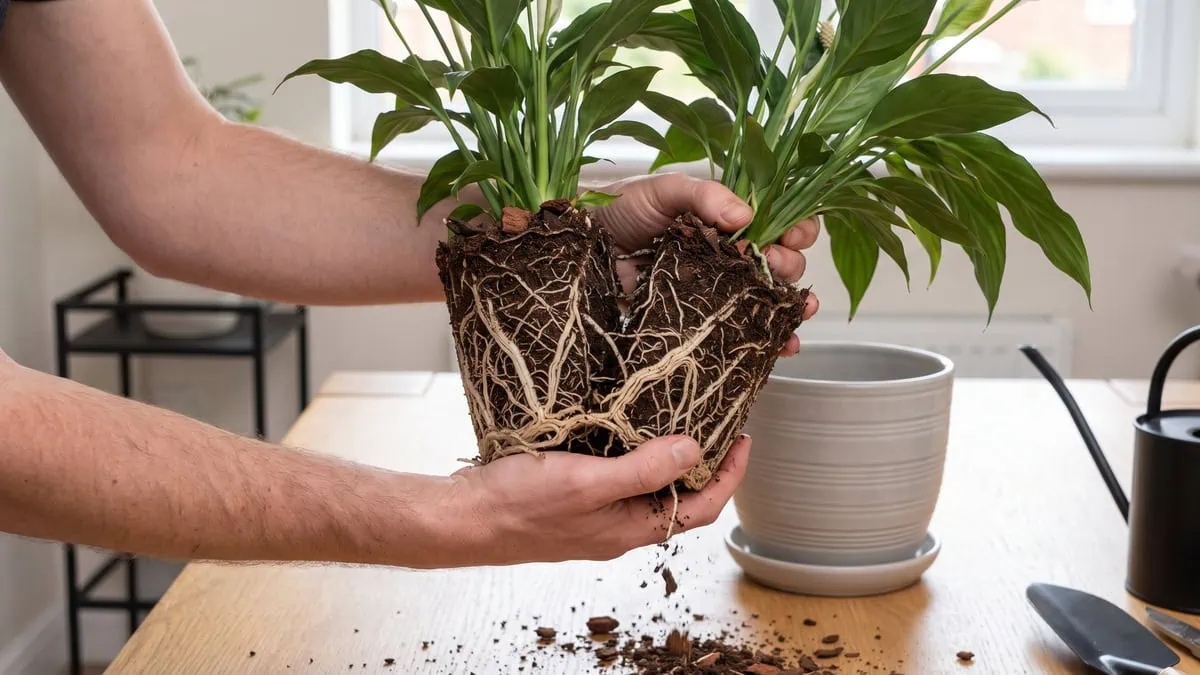
Grip the clump low, half in each hand, and wiggle the halves apart with steady outward pressure. My first fan came free in seconds, while the last one took a full minute of that same steady pressure before the roots let go. Reach for the sterilized knife only when the pieces stop moving against each other.
Every division leaves a wet cut, and that cut face is where the risk actually lives: calcium oxalate raphides ride in the sap and irritate skin on contact, so keep nitrile or heavy garden gloves on through the whole split. Should any sap land on bare skin, flush it under running water at once, working in soap more than once before you rinse clean, and keep your hands off your face until they are washed. This species carries no photodermatitis risk, so sun exposure afterward changes nothing. If a severe skin reaction develops (blistering or intense burning), seek medical attention immediately. For chemical exposure, you can also contact Poison Control (1-800-222-1222 in the US).
Step 4: Check each piece for shoots and roots
Every piece keeps two to three stems and its own share of roots, not a few strands trailing off a neighbor. Type “will a peace lily division survive with few roots” into a search bar, then judge the piece in front of you: firm white roots on its own base, not a count.
- Two to three stems standing on the same piece
- Its own roots, firm and white, with feeder branches
Discard roots that have gone soft and dark in a waterlogged pot before you pot anything up.
Step 5: Pot each division at its old depth
Each division goes into a pot the same size the plant was in before, never a step up, and sits at the depth it sat at before. The parent goes back into its own container. Firm the mix gently and water once.
- Same-size pots for every division
- The parent back in its own container
Fill with the mix this plant’s roots actually breathe in: a peat-and-pine-bark foliage mix, 2 parts peat moss to 1 part pine bark, top-dressed with a thin layer of the same coarse pine bark.
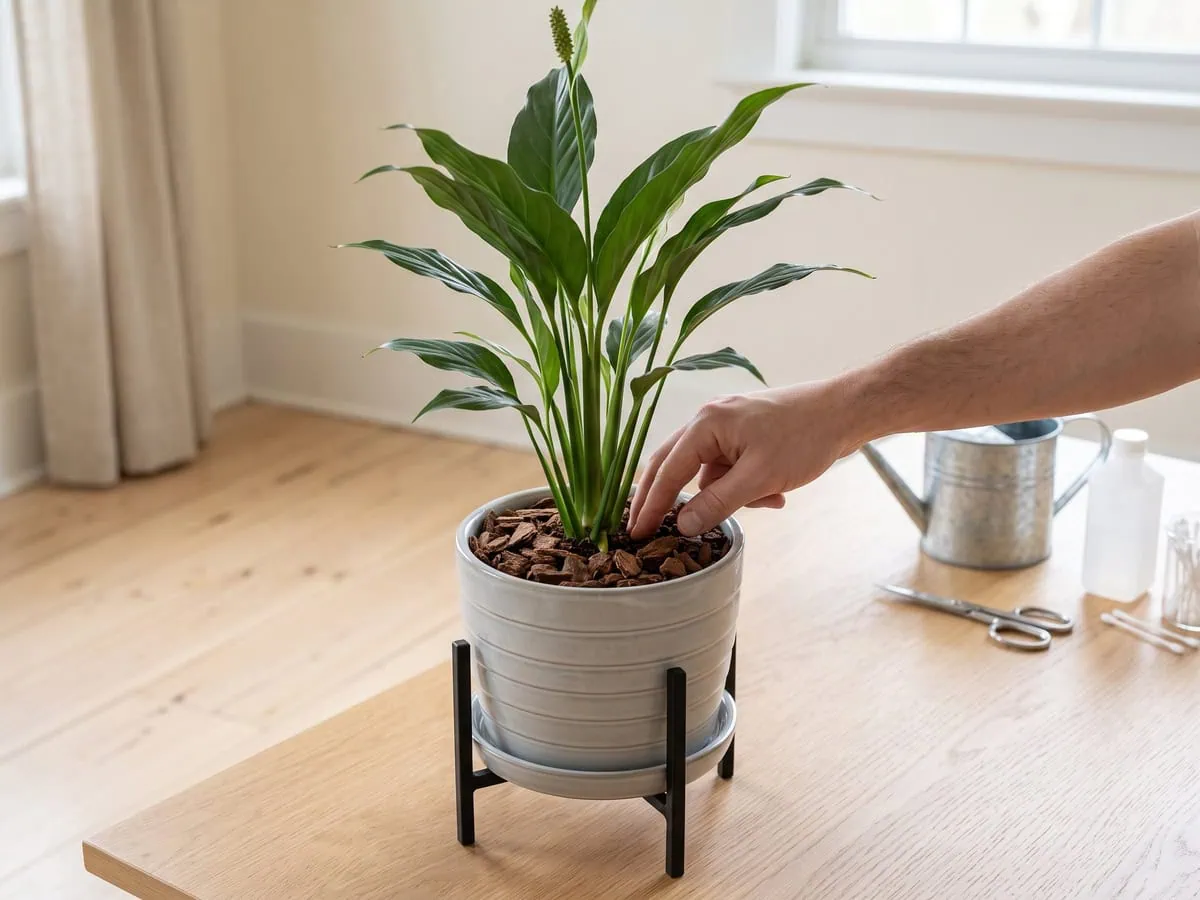
Aftercare for fresh divisions
Fresh divisions need three things and nothing more: one settling watering, a bright indirect spot out of any draft, and no fertilizer while the roots re-establish. Each piece is running on roots that were pulled apart minutes ago. Watering, feeding and recovery come next.
First watering and where to stand them
Water each division once, right after potting, until the mix settles around the roots and the excess runs out of the base. Then empty the saucer. A pot standing in its own drainage is the fastest route back to the rot the division was meant to avoid.
Stand the pots where light is bright but never direct: a north or east window, or several feet back from a south or west one. Hold the room between 65-80F at 40-50% humidity, out of the line of a heat vent or an air-conditioning draft.
- Light: bright indirect, 150-500 FC, never direct sun on the blades
- Air: 65-80F at 40-50% humidity, clear of vents and draft lines
- Saucer: emptied after every watering, never left standing full
Hold the fertilizer while roots re-establish
Give a fresh division no fertilizer for the first few weeks, until new leaves appear. Severed roots take up very little, so the salts sit in the mix instead, and salt load is what browns this plant’s leaf edges.
When feeding does resume, keep it to once a month at half label strength through the brighter half of the year. Stop again once growth stalls under short days.
- First few weeks: water only, no feed of any kind
- Once a new leaf shows: balanced liquid feed at half strength, monthly
What normal recovery looks like, and what does not
A normal division looks like it is doing nothing for a while, because everything it has is going below the surface into roots. Watch the newest leaf rather than the oldest: over the first week or two it lifts from slack to holding its own weight, a little further each morning.
The check that separates the two cases is anchorage. Tip the pot gently in one hand: a piece that has rooted resists and travels with the pot, while a piece that has not anchored slides in the mix and stays slack.
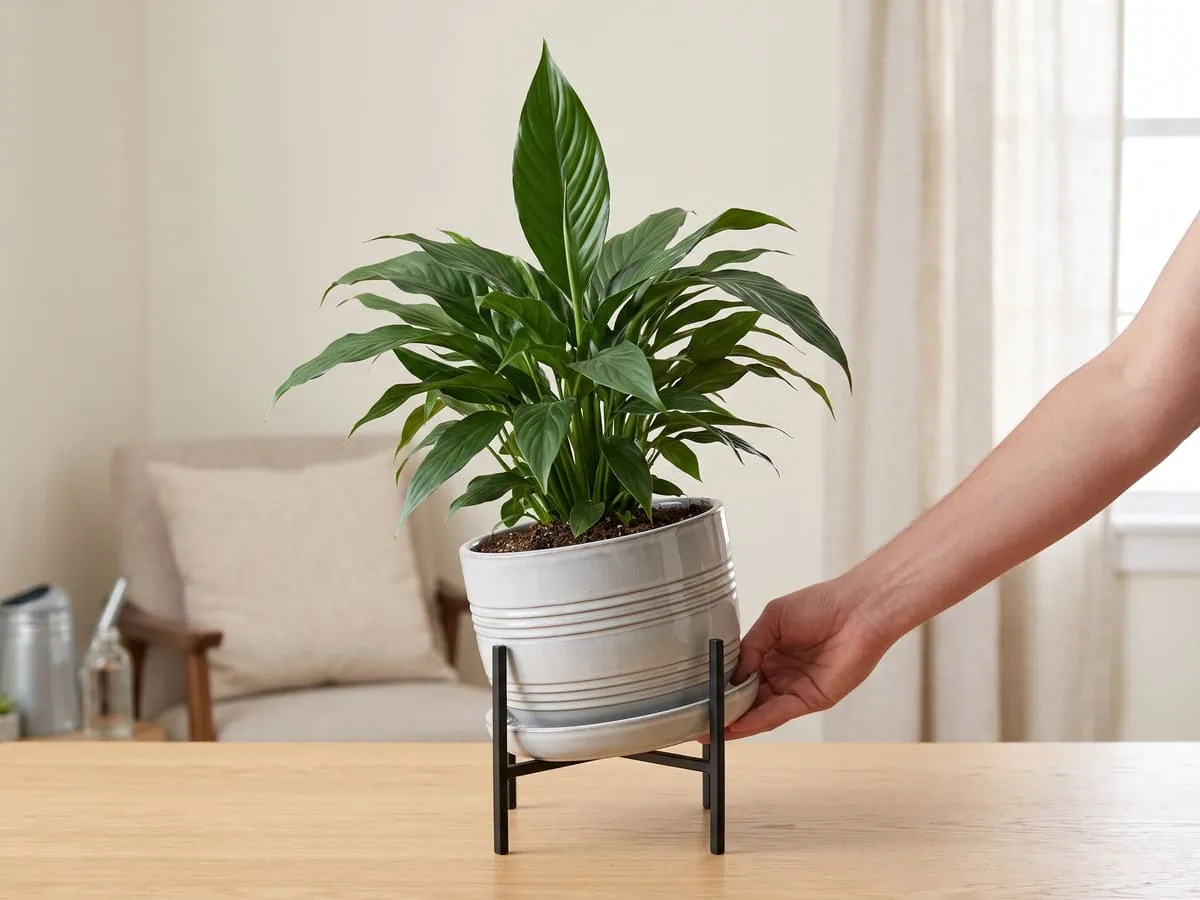
Give that second piece the same light, the same watering, and time. Nothing else. For the wider picture of what a plant does in the weeks after its roots are disturbed, the recovery guide carries it in full.
Frequently asked questions about dividing a peace lily
Can a peace lily be split and replanted?
Yes. Split the clump into pieces that each keep their own roots and healthy foliage, then replant every piece the same day. Work while the mix is damp from yesterday’s watering, because a dry clump crumbles apart and drops roots.
The parent is part of that same day’s work. It returns to its own container at the size it was, with fresh mix, rather than being left out on the bench while the split pieces get all the attention.
Can I root a peace lily in water?
Only if the piece already carries its own roots. A jar of water can hold a rooted division while you find it a pot, and it will sit there for weeks without complaint.
What water cannot do is start roots from nothing. Both the leaves and the flower stalks rise straight off a low creeping crown with no growth point on them, so a leaf or a bare stalk stood in water softens and rots instead of rooting.
How do I divide my peace lily?
Give the clump a thorough drink 1 day ahead, slide the root ball out whole, then brush the surface mix back and find where separate leaf fans rise from different points. Ease those points apart with your hands.
Reach for a sterilized knife only where the pieces will not give. A finished piece keeps its own roots and its own foliage, goes into a pot the same size the plant was in before, and gets one settling watering.
What are some common repotting problems with peace lilies?
The two that matter here are the same two the division step guards against: a pot larger than the roots can drink, and mix that stays wet because nothing is drawing on it. That is the waterlogged root zone this plant dies from more than any other cause.
Full recovery-after-repotting territory, including what a flopping plant does over the fortnight afterwards, belongs to the repotting recovery guide in this series rather than here.
What happens if you cut all the leaves off a peace lily?
You take away everything the plant feeds itself with, and there is no stem bud waiting to replace it. Every leaf rises from the crown on its own stalk, so cutting the lot leaves a crown with no working leaf area at all.
Groom instead: take spent flower stalks and yellowed leaves off at the base, one at a time, and leave every green blade in place. The whole-plant grooming rules sit in the main peace lily care guide.
Do peace lilies like to be crowded?
They tolerate a snug pot better than a roomy one, which is exactly why crowding is the signal to divide rather than an emergency. Roots at the drainage holes and a mix that dries faster than it used to are the two visible marks.
The opposite error does far more damage. A pot far bigger than the root mass holds wet mix no root reaches, and that standing moisture is what rots this plant from the roots up.
Troubleshoot, assess, fix — the three checks before you split
Three checks decide whether this works: every piece keeps its own roots, every piece keeps healthy foliage of its own, and every piece goes back into a pot the same size as the one it left. Get those right and the rest is patience.
And once the pieces are potted, the payoff shows up as one thing: the first new spear pushing out of a crown that spent weeks looking like it was doing nothing (it was not — the roots were). But leave the feed alone until that spear shows.
The whole trick with how to divide and propagate a peace lily is mostly knowing when to stop touching it. Two fans, two pots, and the clump you were afraid to touch becomes the shelf you were hoping for.
Tap the button below to get more plant fixes in your Google Search results