🎯 Quick Answer: getting rid of snake plant bugs
How to get rid of bugs on a snake plant — Dracaena trifasciata, family Asparagaceae — flips on three moves: spot, isolate, clear. Most bugs here are surface-dwellers, so a gentle soap, neem, or alcohol wash clears them without reaching for systemic poison.
- Spot check: wipe a white speck — a moving body means a live pest
- Rule out false alarms: hard-water crust and pale flecking just wipe clean away
- Isolate, then rinse: move it off and wash the rosette into the crevices
- Dab, then coat: alcohol on the clusters, soap or neem over the undersides
- Keep at it: the first pass spares the eggs, so more passes finish the job
The white fleck near the leaf base looked like nothing — until, under a hand lens, it inched sideways on six legs. My own plants taught me to slow down: over two years I fussed over three snake plants, scrubbing at mealybugs that were only hard-water crust while the real bugs sat deep in crevices my spray never reached.
Instead of reaching for a stronger poison, I realized the plant’s own armor does the work. Its thick, waxy leaf skin and water-thrifty tissue make it a poor host, so the pests that appear stay on the surface (FYI — those upright leaves are its water tanks, so sap-suckers like mites hit it where it banks its reserves).
The plan is simple: identify what you are seeing, isolate the plant, and clear it with the gentlest thing that works. When trouble runs deeper than a few bugs, ground yourself in the core routine that keeps a snake plant thriving.
Honestly? Most snake plant bug scares end in relief, not a spray bottle — so the table below sorts true pests from false alarms, letting you act or relax fast.
How to get rid of bugs on a snake plant: a quick-reference spec table
| Snake plant specs | Recommended care |
|---|---|
| Most likely indoor pests | Mealybugs, spider mites, fungus gnats (secondary: scale, thrips) |
| Naturally pest-resistant? | Yes — a tough, waxy cuticle and low-moisture tissue make a poor host for soft-bodied pests |
| Insecticidal soap / neem dilution | 1-2% solution (about 2.5-5 tablespoons per gallon), coating undersides and crevices |
| Isopropyl alcohol (spot-dab) | 70% grade on a cotton swab for visible clusters |
| Quarantine every new plant first? | Yes — isolate roughly six weeks before it joins the collection |
| Repeat-pass interval | Weekly until cleared — contact sprays spare eggs (mite eggs hatch in 3-15 days) |
| Fungus-gnat root cause | Over-moist substrate — let the top inch of the mix dry between waterings to deny larvae |
Tap the button below to get more plant fixes in your Google Search results

Table of Contents
Is it a bug at all? The white-dot and pest ID check
Settle whether the speck is even alive before you spray, because half the white specks people panic over on a snake plant are not insects at all. For years I told worried readers that any white dot meant an infestation.
I’d like to retract that — many are inert hard-water crust or pale cuticle flecking, and dousing those only stresses the leaf. So the “are those mealybugs on my snake plant” panic usually ends far calmer than the forums suggest.
Run the wipe-and-inspect test. Drag a damp cotton swab across the speck and ask three things: did it move, is there a soft body underneath, and does it return in a day?
A yes to any means a live pest. A clean wipe with nothing beneath it is mineral residue, so leave it.
Mealybug, scale, or a harmless mineral deposit?
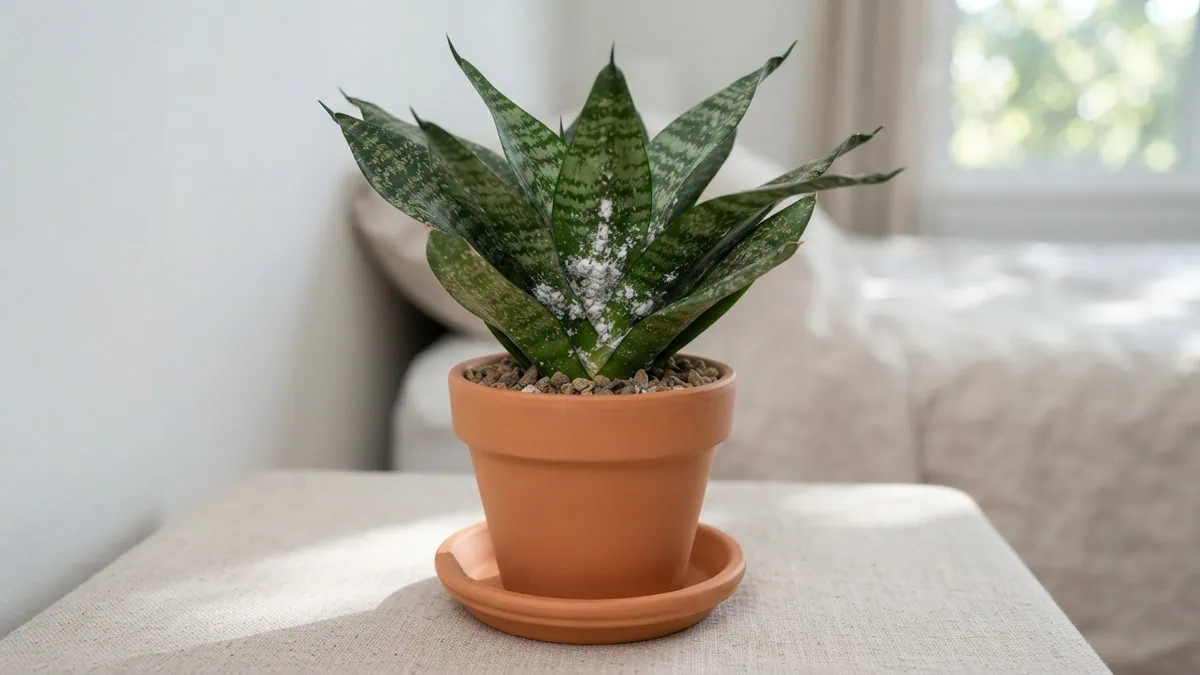
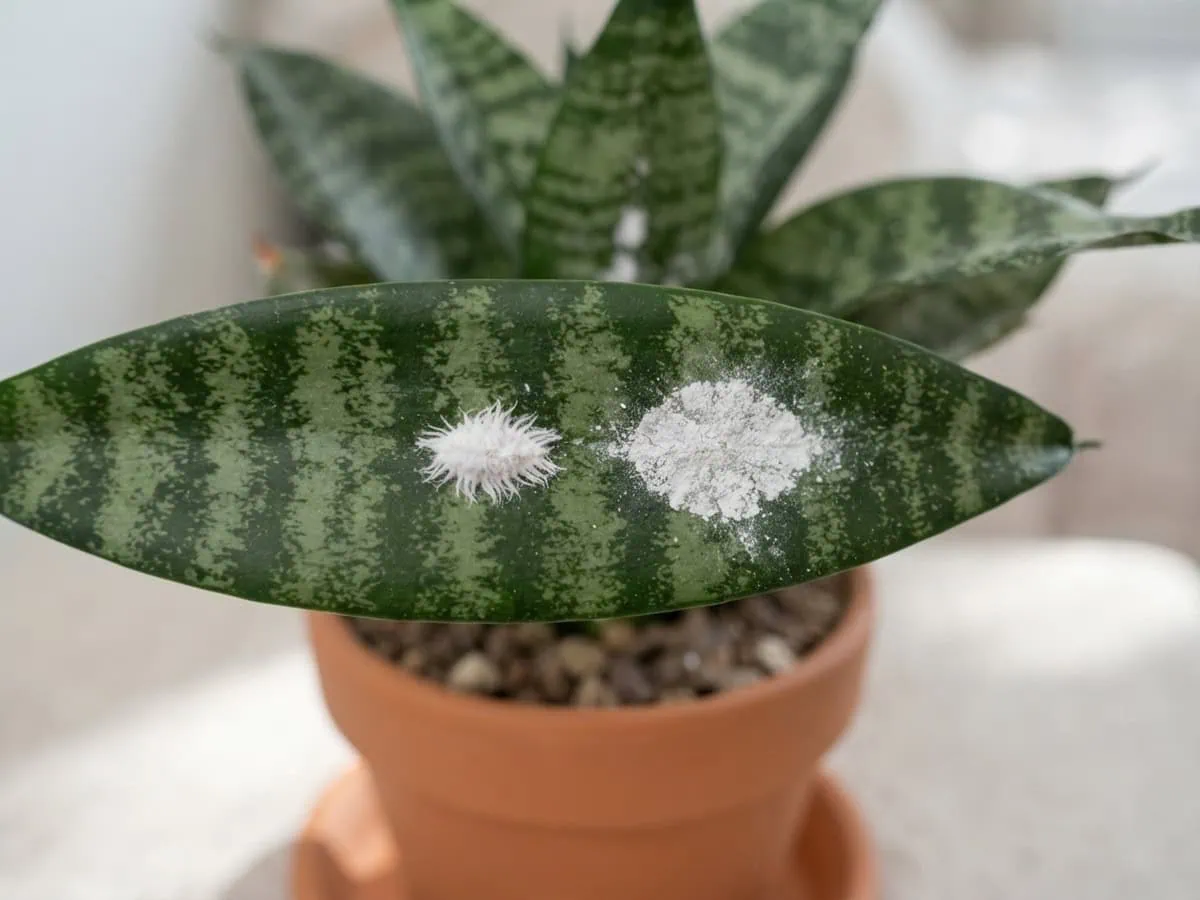
The most-searched version of this is simply white spots on snake plant leaves, and the answer splits three ways. Mealybugs are soft, cottony, movable clusters tucked into the tight leaf-base crevices. Scale shows up as flat, fixed brown-to-tan bumps that refuse to rub off, while a chalky mineral deposit from hard water wipes clean and hides no body at all.
When a leaf is speckled but its shape stays firm, look closer before you spray — and when the leaf itself is curling or browning instead, that is a different story, so start by reading other snake plant leaf symptoms.
| White speck | Look and feel | Verdict |
|---|---|---|
| Mealybug | Soft, cottony, movable; clustered in the leaf-base crevices | Live pest — clear it |
| Scale | Flat, fixed, brown-to-tan bump that will not rub off | Live pest — clear it |
| Mineral deposit | Chalky flecks that wipe off, with no body underneath | Harmless — leave it |
Once you have confirmed the speck is alive, the fix is the same short routine every time.
Spider mites, fungus gnats, and the rest of the lineup
Beyond mealybugs, the realistic cast is short. Spider mites — the twospotted kind, Tetranychus urticae — leave fine pale stippling and, in bad cases, gossamer webbing between the leaf edges; fungus gnats are the tiny dark flies from wet soil; scale and thrips turn up only rarely.
Tentatively, I would credit the plant’s own biology: the thick, waxy cuticle is hard to pierce and the low-moisture tissue offers a sap-sucker little reward, so a snake plant is a genuinely poor host for soft-bodied bugs. Most just leave it alone.
You notice the toll in movement first — a mite-drained leaf loses firmness and its once-vertical tip begins to tilt and sag. The lean is the tell. And brown patches studded with tiny black dots are fungus, not insects, on a separate track.
Tap the button below to get more plant fixes in your Google Search results

Your step-by-step pest removal routine, crevice to crevice
Work the routine in order, because on a stiff, upright rosette the pests hide exactly where a careless spray misses — the leaf-to-leaf crevices, the leaf bases at the soil line, and the undersides. Isolate the plant first.
Then knock the population down physically, hit what remains with a contact agent, and come back on a schedule, since one pass never finishes the job.
Isolate, rinse, then dab the visible bug clusters
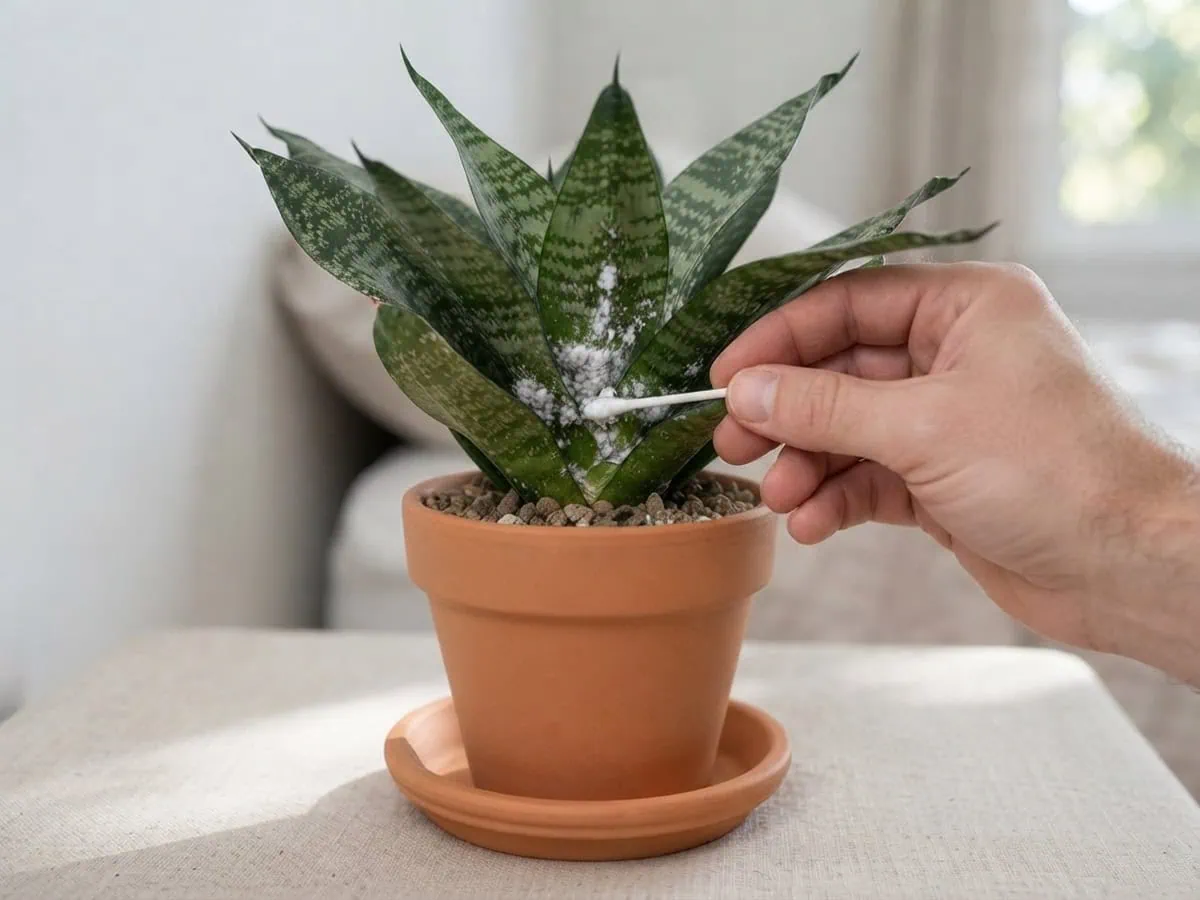
Move the plant away from its neighbors, then rinse the whole rosette under lukewarm water, aiming up into the undersides and crevices to wash loose insects down the drain.
Dab any visible mealybug or scale cluster with a cotton swab dipped in 70% isopropyl alcohol, which dissolves their protective wax on contact — but keep the alcohol off the soil.
(TBH — the first time I did this, I watched a leaf that had been leaning under its bug load lift back toward vertical within a week, once the drain on it stopped.) Reach every crevice, since a quick spray only glances over those hidden spots.
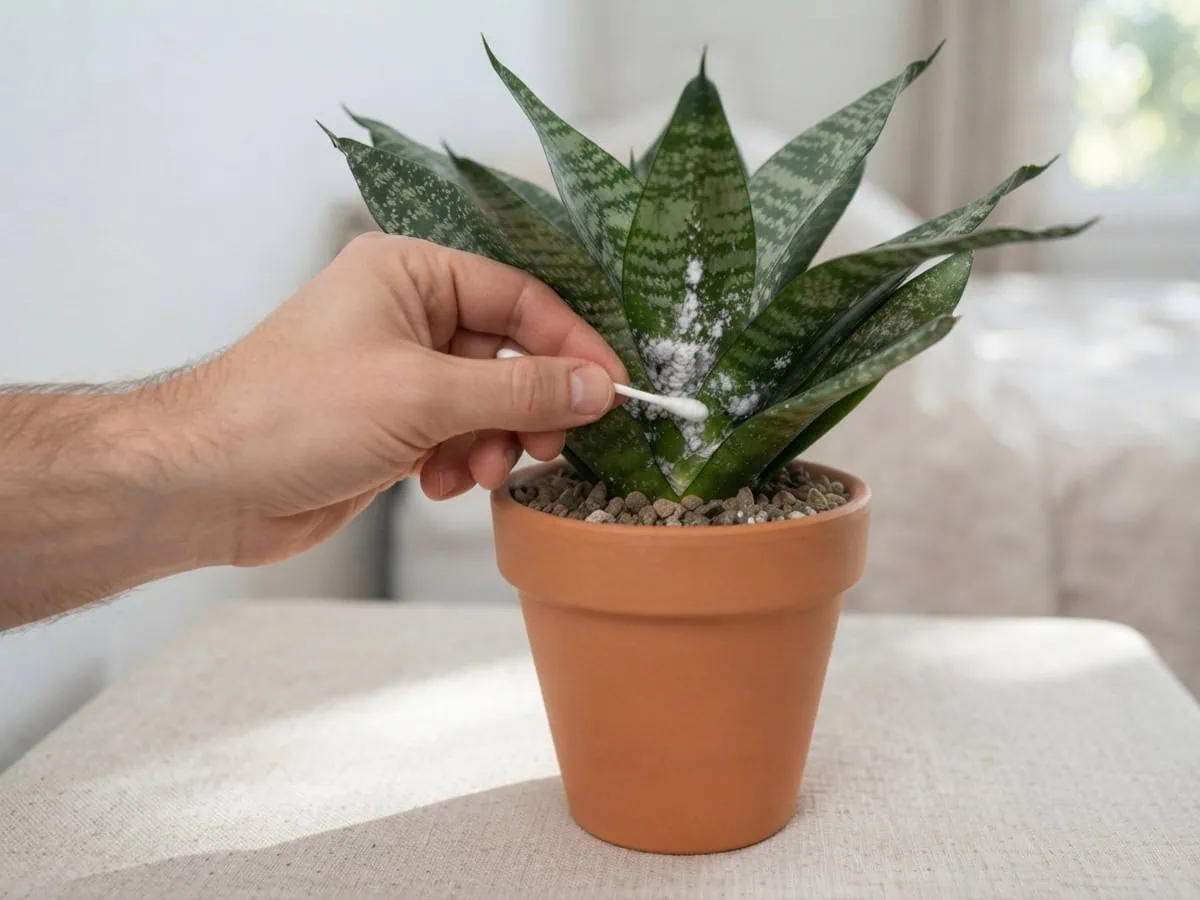
- Insecticidal soap or neem oil: a 1-2% solution, about 2.5-5 tablespoons per gallon, mixed with distilled or bottled water, since hard water weakens the soap
- 70% isopropyl alcohol: on a cotton swab for spot-dabbing the visible clusters
- A soft cloth and a hand lens: for wiping undersides and confirming what you are clearing
Insecticidal soap, neem, and alcohol — dose and reason
Coverage beats chemistry. Soap and neem oil both work by contact only: the soap’s fatty acids collapse a soft-bodied insect’s outer membrane, while neem disrupts feeding and molting, which is why a mealybug’s waxy armor lets a water-only spray slide off and fail.
According to UC IPM (University of California Integrated Pest Management), managing a mealybug infestation leans on repeated, thorough coverage rather than a stronger chemical.
The same holds for the “how to treat spider mites on a snake plant” question — soak the undersides, because oils and soaps kill only what they touch and leave no residue to catch the next hatch. Contact, not conquest.
Spot-test any soap, oil, or alcohol on one small leaf area 1-2 days before you spray the whole plant, and watch for burn. Never spray in direct sun, above 90F, or on a plant already stressed for water, and keep alcohol off the substrate. If leaf edges brown or soften after a pass, rinse the plant with clean water.
Tiny flies in the soil? Dry out the mix, not just the gnat
Those tiny dark flies rising from the pot are fungus gnats, and on a snake plant they are less a bug problem than a moisture alarm. The adults you swat are only the symptom.
Their larvae live in the top layer of chronically damp soil, so fix the moisture and you starve the whole cycle — chasing the flies with a spray while the mix stays wet gets you nowhere.
Why a soggy mix breeds fungus gnats on this succulent
The “do snake plants get fungus gnats” question has an honest answer — only when the mix stays wet, which for this species is a warning in itself.
A snake plant is a stored-water succulent built to dry out hard between drinks, so when its soil sits soggy enough to breed gnat larvae, that same saturation is quietly suffocating its roots. Dryness is the whole fix.
The shared cause is the real story, which is why dialing in the watering so the soil dries out ends the gnats and defends the plant at once.
Drying out, BTI drench, and sticky traps
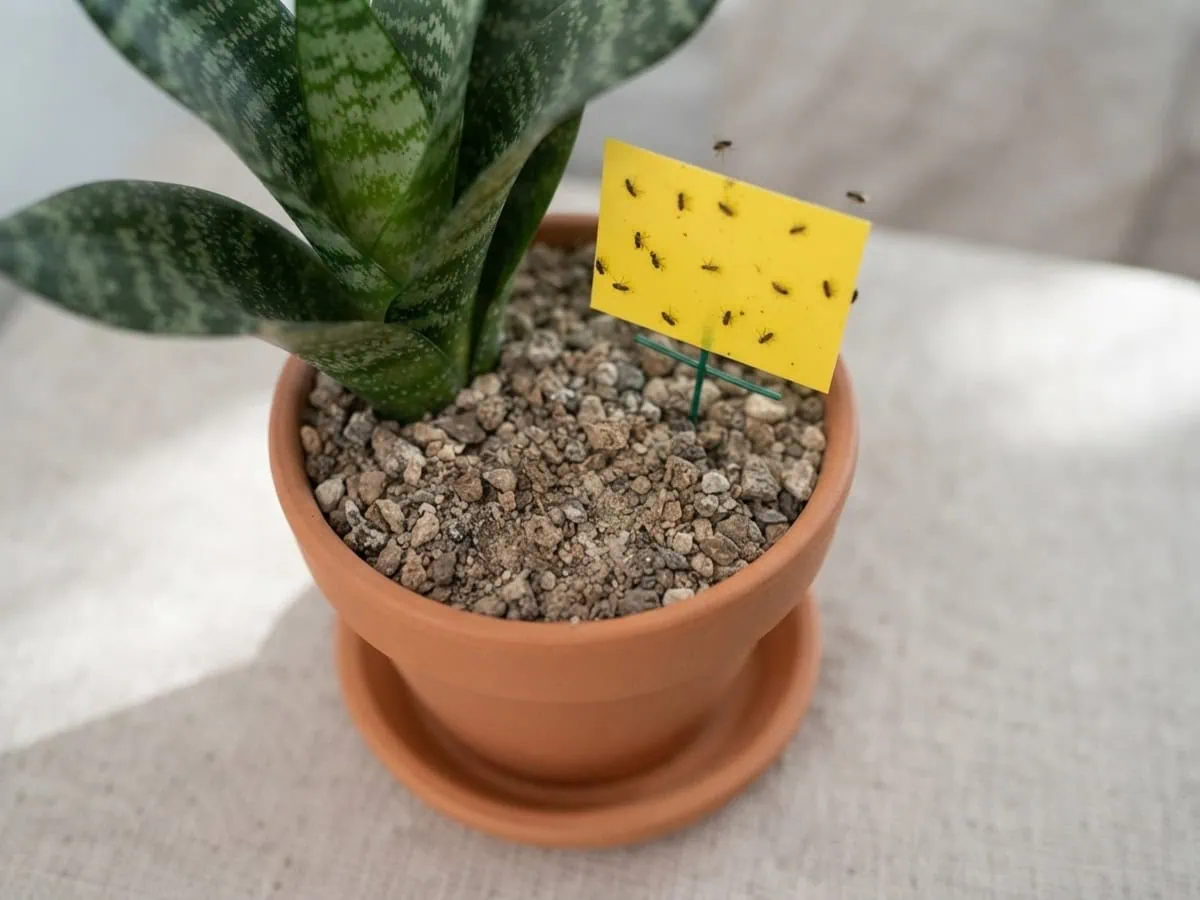
Drying the mix is the main lever, though you can push on three fronts at once. Let the top inch go dry between waterings, since the larvae cannot survive it.
Stake yellow sticky cards at the soil line to trap the drifting adults. And for a stubborn batch, a BTI larvicide — the mosquito-control bacterium sold for gnats — drenched into the mix per its label and repeated across a couple of weeks, breaks each successive hatch before the next generation can mature and take flight.
On a stored-water succulent, a fungus-gnat outbreak is an early warning that the pot is too wet — the very condition behind root rot. Tackle the gnats and the roots as one problem: correct the moisture now, and if the base already feels soft, move straight to rescuing a snake plant from root rot.
Keeping bugs away: habitat denial and quick scouting
There is no barrier spray that keeps bugs off a snake plant, so keeping them away really means denying habitat and catching trouble early.
Keep the top of the mix dry. Quarantine every new plant about six weeks before it joins the shelf, wipe the broad leaves now and then to clear dust and eggs, and check under the leaves every couple of weeks with a hand lens.
The payoff is quiet but real. A clean, well-watched rosette pushes its new center leaf straight up instead of leaning off toward trouble.
Common mistakes that let a snake plant infestation rebound
Most infestations that seem to come back were never fully cleared, undone by three predictable mistakes: trusting a repellent to do an eradicator’s job, reaching for the wrong tool, and chasing a pest the plant rarely even hosts. Effort spent, colony intact.
Why scent sprays and cinnamon don’t clear an infestation
Search natural pest remedies for snake plants and you will drown in scent-spray recipes — vinegar, garlic, hot pepper, essential oils — but read them closely and they only aim to make pests move on to easier targets. That is repellency, not lethality.
A scent that nudges a wandering bug away does nothing to desiccate an armored mealybug already dug in, and it never clears the eggs. Cinnamon carries the same tool-to-target problem: it is an anti-fungal folk agent, not an insecticide, so it is the wrong tool for a bug. The mismatch is the point.
Reach for the contact soap, oil, and alcohol that actually kill soft-bodied pests, and keep the folk sprays for the light deterrence they can still offer.
Myth: a garlic, vinegar, or cinnamon spray will end a snake plant bug problem. Fact: scent sprays repel rather than eradicate, cinnamon fights fungus rather than insects, and neither clears the eggs. Use a contact agent for a real infestation, and save the folk recipes for light deterrence at most.
Chasing the wrong bug — the aphid mix-up
One popular source even crowns aphids the snake plant’s most common pest, but the snake-plant-specific consensus does not back that up — mealybugs and spider mites clearly lead, with fungus gnats close behind, while true aphids are only an atypical visitor on such a tough-cuticled succulent.
So do not let a stray article send you hunting aphids that are not there; identify what is actually on your plant first. And if the trouble turns out to be brown, black-flecked lesions rather than a moving insect, that is fungus, so switch tracks to spotting and clearing snake plant fungus.
Aim right and the plant stops shedding and leaning and finally holds every leaf upright again.
Common snake plant pest questions
What can I spray on my snake plant to keep bugs away?
No spray reliably keeps bugs away long-term; habitat denial works better than any barrier. Keep the top of the soil dry to starve fungus gnats, quarantine new plants about six weeks, and wipe the leaves now and then to remove dust and eggs. A diluted 1-2% insecticidal soap clears what is present, but it leaves no lasting shield — routine scouting under a hand lens does more than any repellent.
Do indoor snake plants attract bugs?
Snake plants attract fewer bugs than most houseplants, thanks to a tough, waxy cuticle and low-moisture tissue that make a poor host. The main exception is fungus gnats, drawn not to the plant but to over-moist soil, plus a stray mealybug or spider mite that drifts in from a neighbor. Keep the mix on the dry side and isolate new arrivals, and infestations stay rare.
How to tell if a snake plant has spider mites?
Look for fine pale stippling and, in bad cases, thin webbing between the leaf edges — the two telltale spider-mite signs. The mites are nearly too small to see, so hold white paper under a leaf and tap it; moving specks confirm them. A drained leaf also loses firmness and tips off-center. Rinse, coat the undersides with insecticidal soap or oil, and repeat weekly, since sprays miss the eggs.
How do I get bugs off my snake plant?
Get bugs off a snake plant in four moves: isolate, rinse, spot-dab, and repeat. Move the plant away from others, rinse the rosette under lukewarm water aiming into the crevices, then dab visible clusters with 70% alcohol on a cotton swab. Follow with a 1-2% insecticidal-soap or neem wash over the undersides and leaf bases, and repeat weekly until it stays clean, because contact sprays spare the eggs.
Your next step: from bug panic to a calm, watched rosette
Truth is — most snake plant scares end at the wipe test, not the spray bottle. When something real shows up, you have the whole arc: confirm it is alive, isolate the plant, clear it with contact soap, oil, or alcohol worked into every crevice, and come back weekly until the eggs run out.
Keep the mix dry. The gnats never move in. The plant tells you when you have won, because the new center leaf pushes straight up instead of tilting away.
Knowing how to get rid of bugs on a snake plant, honestly, comes down to reading it right and acting light.
May your snake plant stay bug-free in every crevice, and may every white speck you spot turn out to be nothing but harmless mineral dust.
Tap the button below to get more plant fixes in your Google Search results