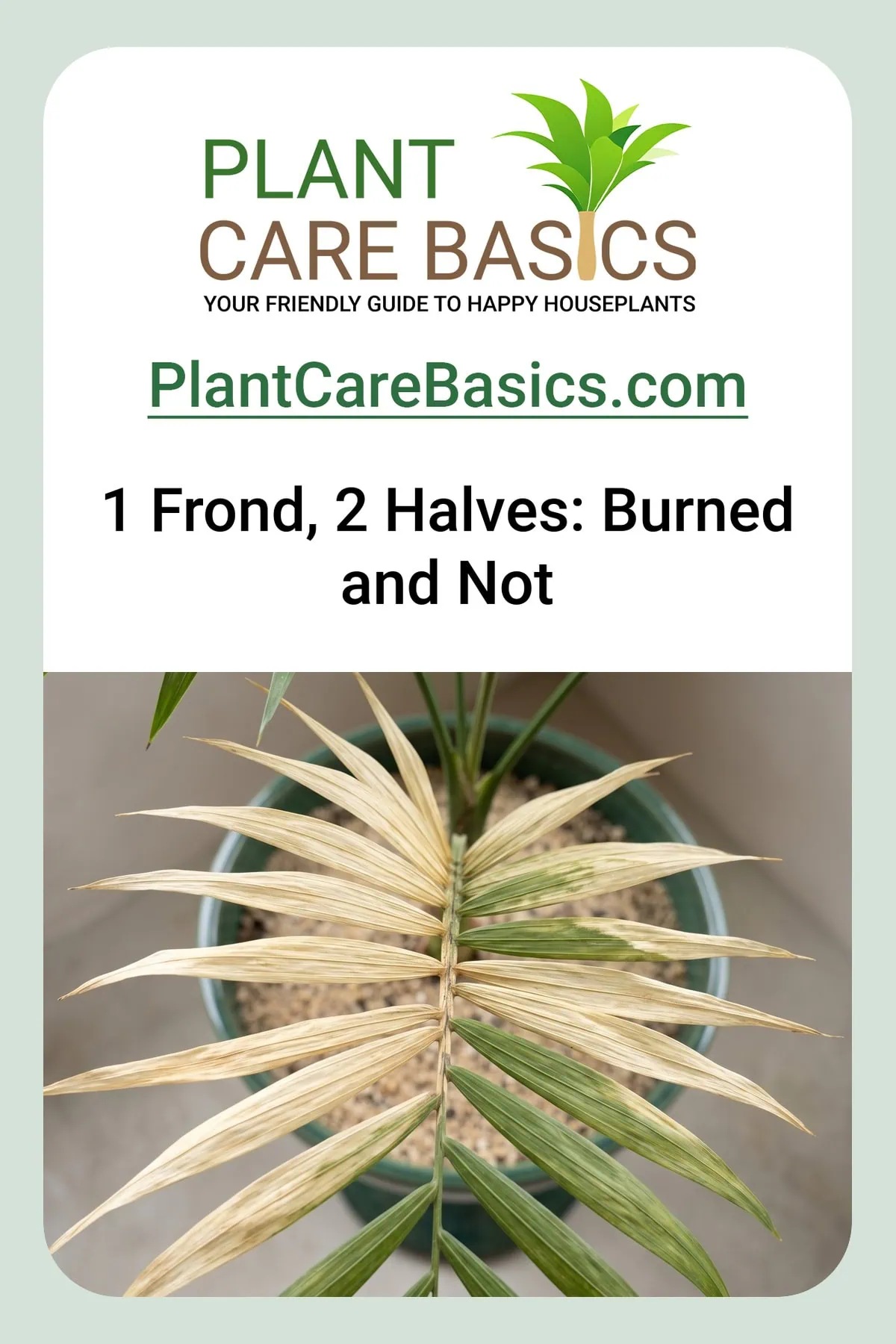
🎯 Quick Answer: light after sunburn
“How much light does a parlor palm need after sunburn” has a band answer: Chamaedorea elegans, an Arecaceae palm, plateaus at 75-500 FC of indirect light. Bleached leaflets never regreen. Read recovery from the spear that opens next, not from the damaged fronds.
- First move: pull the pot out of the direct beam today
- Filter, do not retreat: a sheer screen keeps a south window usable
- Read the new growth: long internodes and pale fronds mean too dark
- Skip the desk lamp: only a real grow fixture delivers usable intensity
- Fixture hours: run it 14-16 hours a day, never past 16
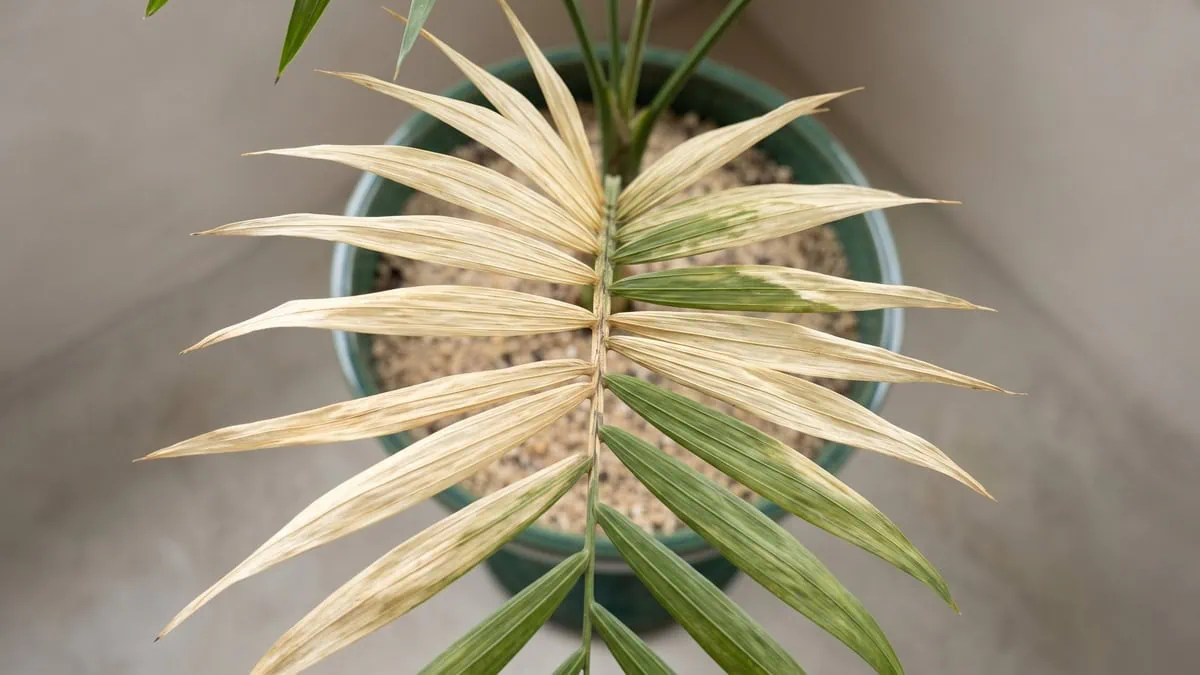
The leaflets that faced the window had bleached to the color of dry straw, while the ones the plant’s own body shaded stayed green. I misread that split four times running, blaming a pest rather than excessive light, and four parlor palms paid for it.
Let me rewind for a second… A shade-tolerant palm, I thought, could not possibly take in too much light intensity, and then a bleached frond showed me that Chamaedorea elegans runs its photosynthetic apparatus on a very low dark respiration rate (the palm family’s shade trick), and that an economy that tight has nothing spare to absorb photo-oxidative stress.
Let me level with you: the answer here is the 75-500 FC band, not a place. Placement is the whole fix, and the wider routine lives in how this species is looked after day to day.
If you are standing over a palm with two-tone fronds right now, the six numbers directly underneath decide where it goes next (I’ll explain in a sec).
How much light does a parlor palm need after sunburn: the numbers at a glance
| Parlor palm specs | Working value |
|---|---|
| Survival minimum light | 25-75 FC |
| Optimal band | 75-500 FC |
| Indirect-light ceiling | About 500 FC |
| Direct sun on the fronds? | No |
| Window aspect (Northern Hemisphere reference) | North, east or west; south only behind a sheer screen |
| Distance back from a south window (Northern Hemisphere reference) | 3-10 feet |
Tap the button below to get more plant fixes in your Google Search results

Table of Contents
How much light a parlor palm needs after scorch
A scorched parlor palm belongs back in the 75-500 FC band, inside the roughly 500 FC ceiling for indirect light, with no direct beam on the fronds at any hour. That band is a placement, not a procedure: Chamaedorea elegans uses the light it can and has no spare capacity for the rest.
Published guidance puts a band on where this palm grows, not a figure on where scorch begins. Take this with a grain of salt, then, whenever a page hands you a burn threshold (the numeric bands in circulation were written for a different species of the same genus).
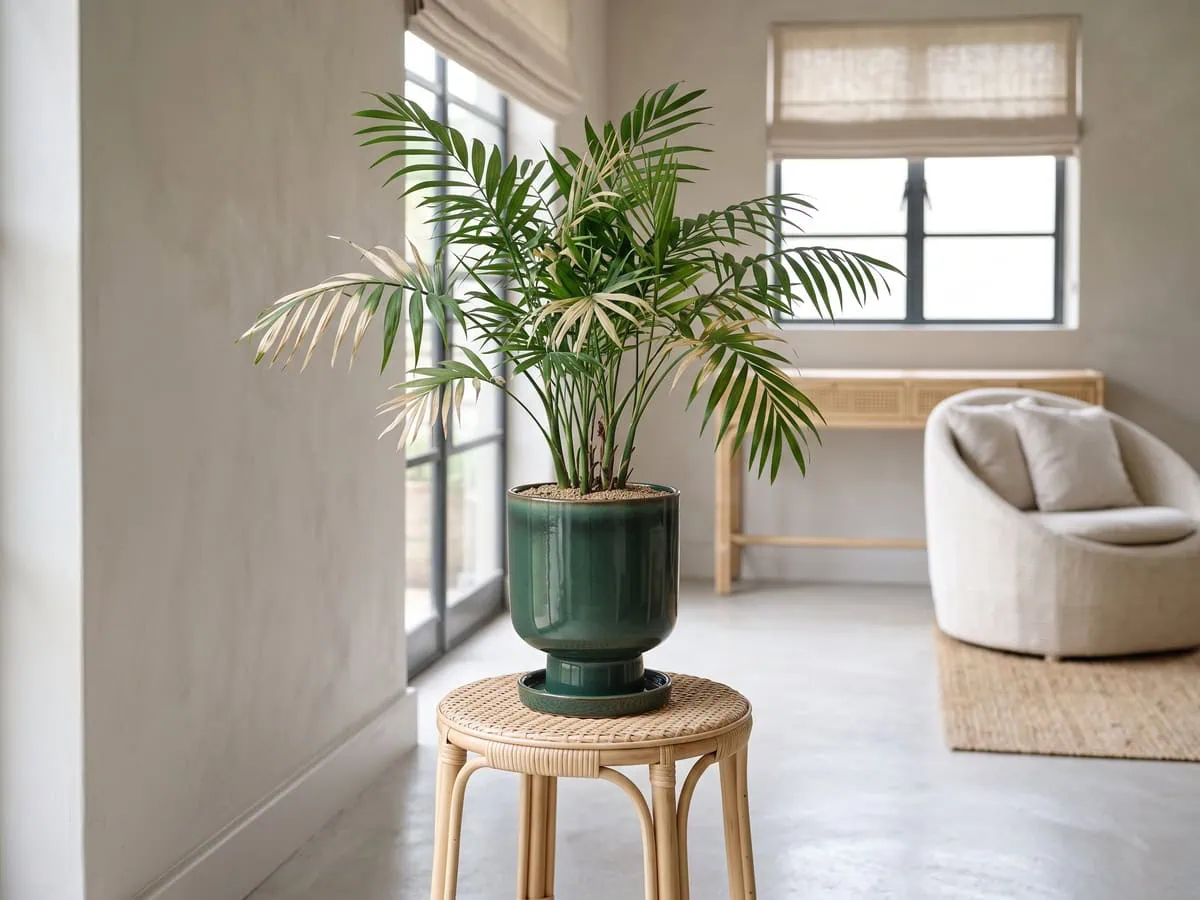
The understory record carries the ceiling instead. This palm evolved under roughly 2 mol of light per day on a rainforest floor, so bright indirect light is its upper end rather than its target.
In my testing the first honest signal was never the burnt frond but the spear: a new, still-rolled leaf pushing up from the growing point at a steeper angle than the scorched fronds around it. Marked leaflets stay marked.
The wait is long by design. Most palms grown as houseplants open only one or two new fronds a year, which means a single replacement frond can take most of a growing season to arrive on a plant graded slow for growth.
Bleached tissue is replaced, not repaired. Watch the growing point rather than the damaged frond, because a single-stemmed palm builds every new leaf at that one point.
The following sections give the band, the test for direct sun at the glass, and the two look-alikes.
The working band, in foot-candles
The numbers are 25-75 FC to survive, 75-500 FC to grow, and about 500 FC as the indirect ceiling. Most care guides answer this quantity question with adjectives only, so here are two checks that need no meter.
At midday you should be able to read printed text where the pot stands without switching on a lamp. From the plant’s own position, some open sky should be visible through the glass.
Two checks, one position. Together they rule out the back of a deep room while still keeping the fronds off the beam and the crown inside the roughly 500 FC ceiling this understory palm tolerates.
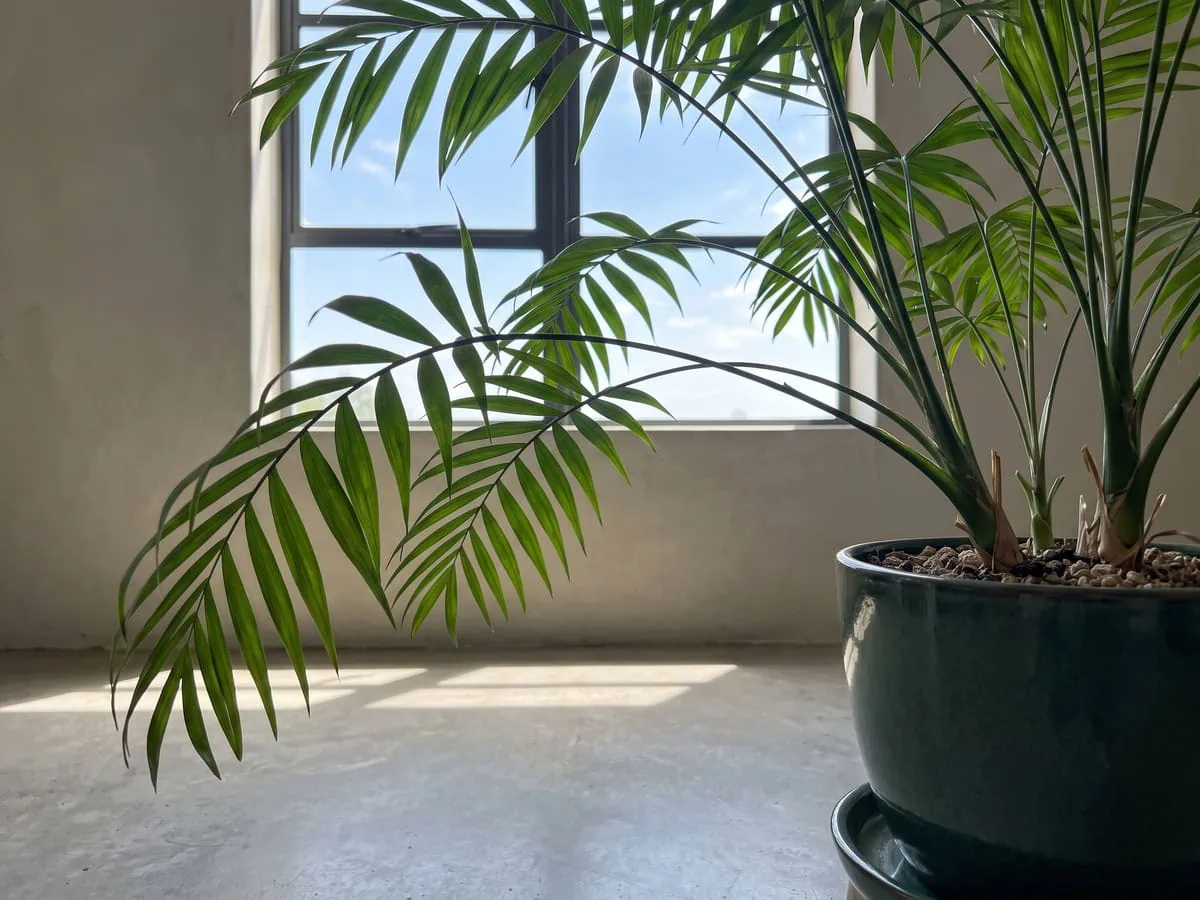
What counts as direct sun at the glass
Query “can a parlor palm take any direct sun” and both answers come back, sometimes on the same page. Follow the prohibition: no direct sun on the fronds.
Direct has a physical test, though (and it takes a second): if the beam throws a hard-edged shadow of a frond on the wall behind it, that is direct light and the plant is in the wrong place at that hour.
A soft, fuzzy shadow edge is filtered light and is fine. Run the check when the sun is actually on that side of the building.
Is it the light, or one of the two look-alikes?
Read the geography of the damage before you read its color. Light injury is positional: it lands on the leaflets that face the window and spares the ones the plant’s own body shaded, so the marks follow the light source.
A sap-feeding population is not positional that way and leaves physical traces on the underside, so turn a marked leaflet over before you reach for anything. A watering fault marks fronds on every side at once.
A widely copied claim assigns a faded, silvery frond to spider mites alone, which routes a scorched plant into a control routine that cannot reach it.
Tap the button below to get more plant fixes in your Google Search results

Where the pot goes, indoors and out
An east or west window with the pot a few feet back holds a parlor palm inside its 75-500 FC band and keeps direct beams off the fronds through the brightest middle hours of the day.
Aspect and distance are separate dials. Most placement advice welds them together (a distinction worth the extra second), and the weld is where readers lose the thread, because a north pane at zero distance and a south pane at ten feet hand the plant almost the same intensity. But they are not interchangeable.
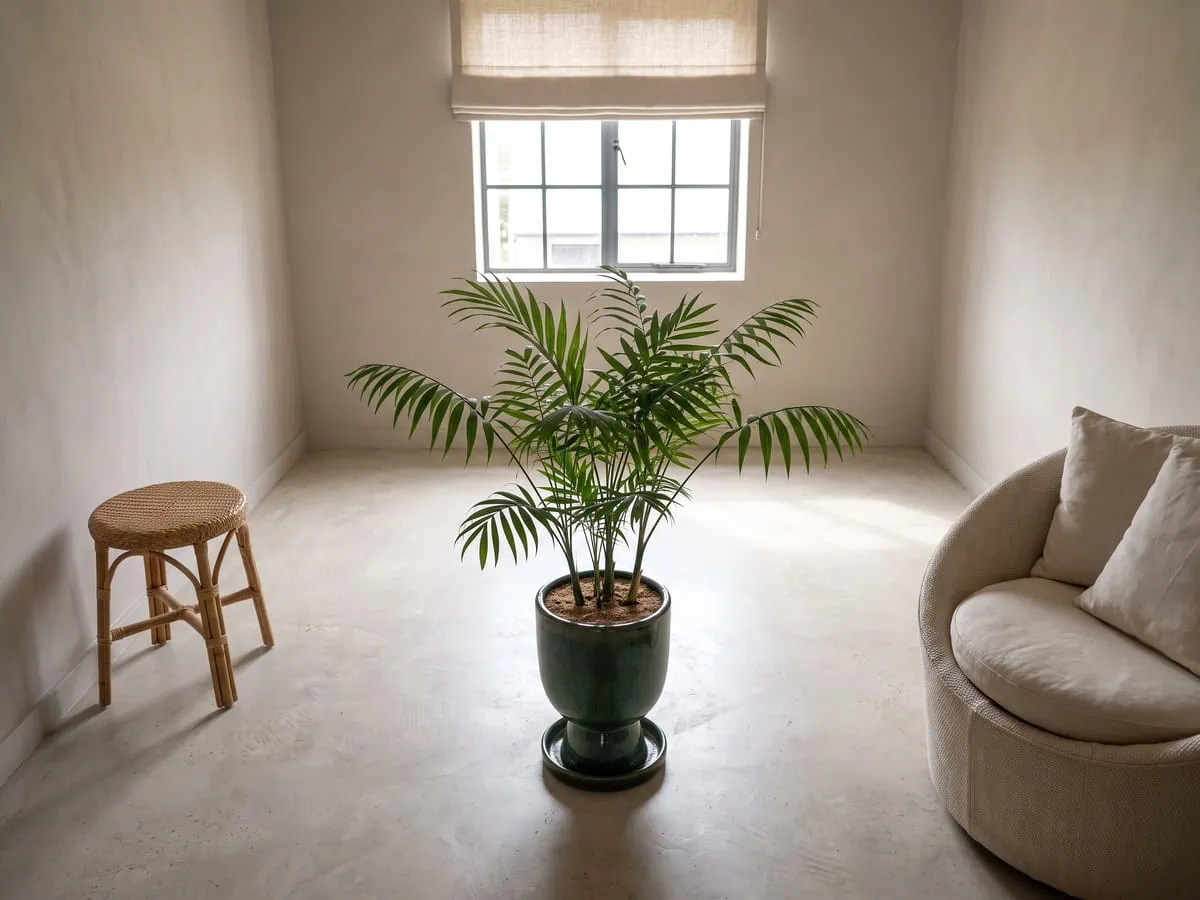
Below, the two dials come apart, the move happens in stages, and the outdoor season meets its end.
Aspect and distance are separate variables
Asked “how far from a window should a parlor palm sit”, most guides give a room, never a number. The map gives both. Directly in front of a north pane reads about 150 FC; a few feet back from that same pane drops to roughly 75 FC.
That lower figure is a survival floor, not a growing position. East and west are forgiving: a few feet back sits near 150 FC, the glass itself about 300 FC. South punishes carelessness.
Standing in a south window is direct light at roughly 1500 FC. Back it off to 3-10 feet, or hang a sheer. Tip damage that persists after a correct placement is usually not a light fault, and the tip scorch that light does not explain sorts those causes out.
Moving into brighter light in stages
Ask “how do I move a parlor palm into brighter light safely” and the honest answer is that you move it twice. The indoor schedule starts exposure at two hours a day and lengthens it gradually, and the species guidance names a bright window reached by acclimation rather than one lift.
Set the pot at a middle station first. Hold it there until one new spear has opened fully at the growing point. That event ends the stage, not a date.
Watch the shadow line creep across the floor toward the pot through an afternoon. When its edge sharpens as it reaches the leaflets, that station is bright enough to stop.
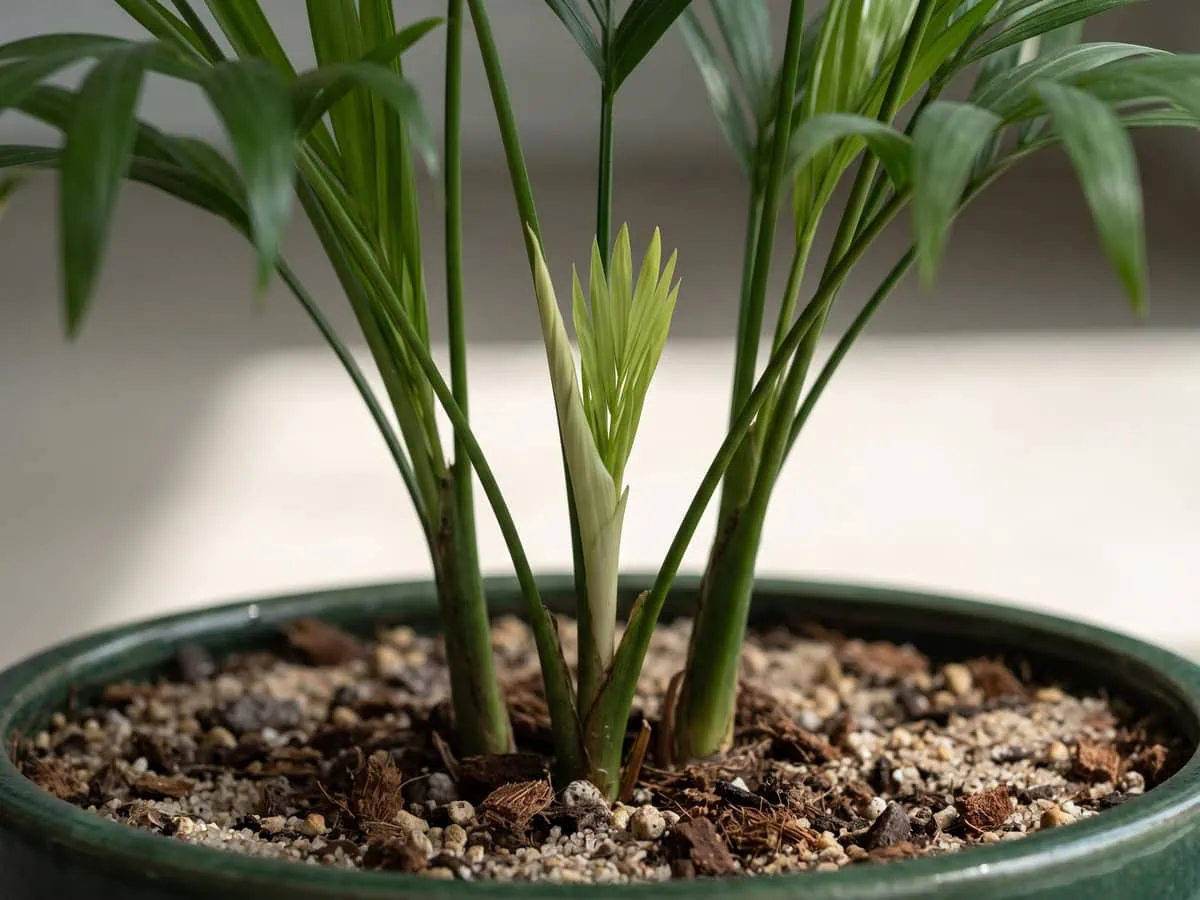
A move also resets how fast the pot dries. Read the mix, and the watering rhythm a change of position resets covers the rest.
The warm-month move, and what ends it
Readers searching “should I put my parlor palm outside for the summer” are told yes, in shade, with no end condition attached. The end condition is a temperature. For this species it is 61F, the winter night minimum.
Bring the pot in before night air reaches that floor. Below it the figures stop being species values and become palm-family damage bands, and chilling injury is documented across tropical palms above freezing and occasionally as high as 50F.
A single sudden night near 45F can necrose foliage on an unhardened palm. Frost sits at 32F. Outdoor shade is not indoor shade (open sky stays bright under a canopy), so stage the return exactly as you staged the move out.
Keep the returning pot clear of registers and radiators. A draft column striking the fronds can sit at the cold floor while the wall thermostat still reads comfortable.
Too little light: the opposite failure
Below roughly 25 FC a parlor palm stops building and starts stretching, and the damage arrives as slow thinning across the whole crown rather than as a mark you can point at on one frond.
This is the failure that hides. Scorch announces itself in an afternoon; inadequate light takes months, and because the species is graded Slow for growth and Low for maintenance, a stalled plant reads as a well-behaved one. I lost two more of those palms this way before I learned to date the fronds rather than admire them.
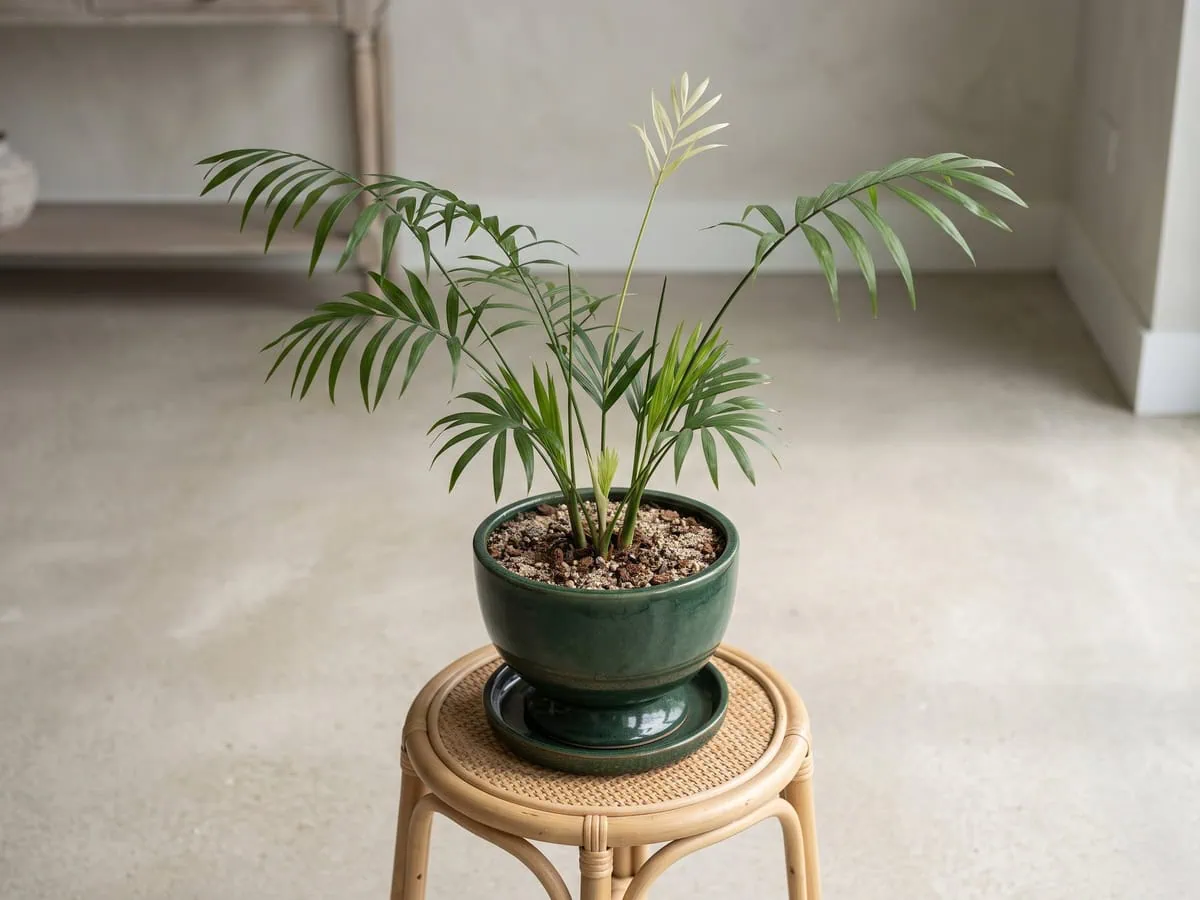
Symptoms in a dark corner, two free fixes, and the point where hardware becomes necessary.
What does a dark corner do over months?
Search “what happens to a parlor palm left in a dark corner” and the answer is a shape change, not a color change. New fronds emerge with longer internodes and longer petioles — the stretch gardeners call leggy — while each new leaf comes out smaller and paler than the one before it.
According to the University of California Statewide Integrated Pest Management Program, the published extension account of leggy growth caused by inadequate light names the stretched internodes and elongated petioles as a houseplant symptom, which is why a marked frond tells you nothing on its own here.
Lower leaves then yellow and drop. And the stem thins as it climbs. Watch a new spear over a fortnight: in adequate light it unrolls compactly, and in a dim corner it lengthens before it opens, reaching toward the window as it goes.
Compare that stretch against a speckled or stippled frond, because the two arrive by different routes and pale, speckled fronds and what else produces them separates them cleanly.
The stretch itself never shortens. Run a fingertip up the stem and the record is physical: on a single unbranched stem the elongated internodes are permanent, so the plant carries that record for as long as the stem stands.
A stretched plant already past saving as a shape is a different question again, answered in a stretched, thin-stemmed plant and what can be done with it.
Myth: this palm grows well in low light. Fact: tolerating a light level and growing at it are two different claims, and the sources that make the first one rarely make the second. The species tolerates deep shade; it fills out at 75-500 FC. A plant can hold its condition for a long time in a corner where it will never add a frond.
Turning and dusting when nothing is brighter
Two in-place fixes ask nothing of you and are almost never given a frequency. Give the pot a quarter turn once a week so growth stays even rather than one-sided. Nothing else belongs in that instruction.
The second is dust. Sponge the fronds with a soft cellulose sponge or a plain cotton cloth, or stand the plant in a lukewarm shower (yes, really) and let the water do the work.
A film you can lift with a fingertip is a film intercepting light intensity the plant has no spare capacity to lose. A rinse also discourages the sap-feeding organism this species loses most plants to, and handling a pest outbreak on the crown picks that up.
Neither fix adds light. Both stop you wasting what little arrives.
When a fixture is the honest answer
Sometimes no position in the room clears the survival floor (a windowless office is the usual case), and at that point hardware is the honest answer rather than a failure of patience. Cool white fluorescent bulbs work well for foliage plants, and an LED made for plant growth does the same job without the heat.
Run it 14-16 hours a day. Never past 16. An ordinary desk lamp is not a substitute at any duration, because the issue is delivered intensity and spectrum rather than hours on a timer.
Expect the response to be slow even when the fixture is right. One or two new fronds a year is all most palms grown as houseplants open — a figure published for palms as a group, not measured on this species — so a corrected position is judged over seasons, not weekends.
Frequently asked questions about light and scorch
Can parlor palms tolerate full sun?
No. Direct sun scorches the leaves, and the published guidance for this palm is bright but indirect light with direct exposure avoided outright.
The working ceiling is about 500 FC of indirect light. A south window at the glass puts the fronds near 1500 FC, which is direct light by definition. A sheer screen between the glass and the crown converts that position into a usable one, and setting the pot back several feet does the same job without hardware.
Does a Parlor Palm do well in low light?
It survives low light rather than doing well in it, and those are two separate claims that most guidance merges into one.
Survival runs from about 25 FC to 75 FC, while the band that actually builds foliage is 75-500 FC. A plant held at the floor keeps its existing fronds for a long time and adds almost nothing. Even in good light this species is graded a slow grower, and a dim corner takes an already unhurried plant down to a standstill.
Where is the best place to put a parlour palm?
A few feet back from an east or west window is the strongest everyday position, because that spot sits near the middle of the preferred band.
A north window works too, but the plant belongs right at the glass there, since a few feet back drops it to roughly 75 FC. A south window needs distance of 3-10 feet or a sheer. Keep the pot out of the airflow from registers, radiators and frequently opened doors, whichever aspect you choose.
Can potted palms survive outside in direct sunlight?
No. A parlor palm moved outdoors belongs in shade, and direct sun outdoors carries the same scorch risk it carries at a hot pane.
Outdoor shade is still far brighter than indoor shade, so the move out is staged in steps rather than made in one lift. The stay ends on temperature: this species requires a winter night minimum of 61F, and the pot comes back inside before night air reaches that floor. Watch the newest spear lean toward the brightest side over a week outdoors; that lean reports where the light arrives.
Prove it yourself: the shadow-edge test
Stand where the pot stands, at the brightest hour, and look at the shadow a frond throws on the wall behind it. Hard edge, wrong position. Fuzzy edge means filtered light and a right one.
Worth saying plainly. That one check settles more placement arguments than any meter, because it reads the beam rather than the room. Run it in the morning and again mid-afternoon, since the answer changes as the sun crosses the building, and a spot that passes at nine can fail badly at three.
Once the position holds, the next question is how fast the pot dries there, because a move resets that rhythm before it resets anything else. But the scorched leaflets will not come back. Let the growing point carry the verdict instead, and give the plant a season rather than a weekend to answer you.
That is the whole of how much light does a parlor palm need after sunburn: a band, a distance and a staged move, judged by new growth. Set this palm where the light stops short of the leaflets it already bleached, and judge the move by the spear that follows, never by the frond that cannot change.
Tap the button below to get more plant fixes in your Google Search results