🎯 Quick Answer: feeding a parlor palm without salt buildup
How to fertilize a parlor palm without salt buildup activates one lever on Chamaedorea elegans, an Arecaceae palm: 18-6-12 at part strength. This family grows from one tip. Feed monthly while fronds push, and stop while growth rests. Water first, then feed, and let a tenth of it drain.
- Crust check: white crust on the mix or rim signals salts
- Tip read: brown tips with crust mean excess, not a shortage
- Scrape: lift the crust off and top up with fresh mix
- Saucer: empty the saucer so roots never sit in runoff
- Rest: hold all feed until new fronds actually appear
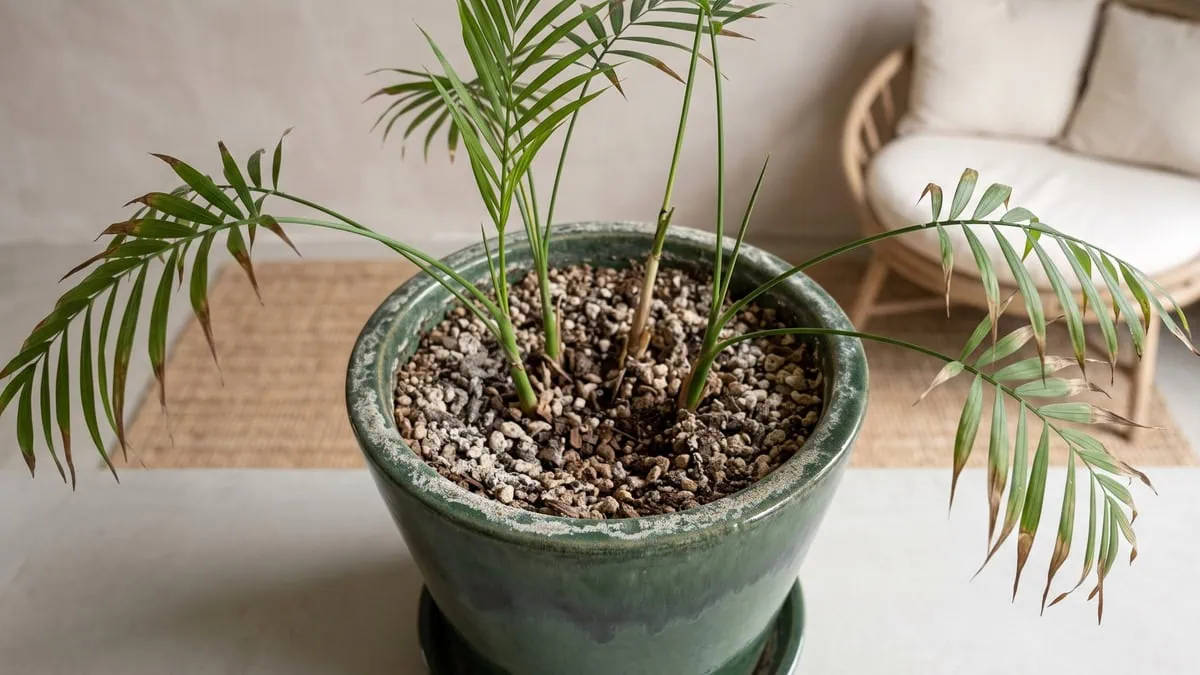
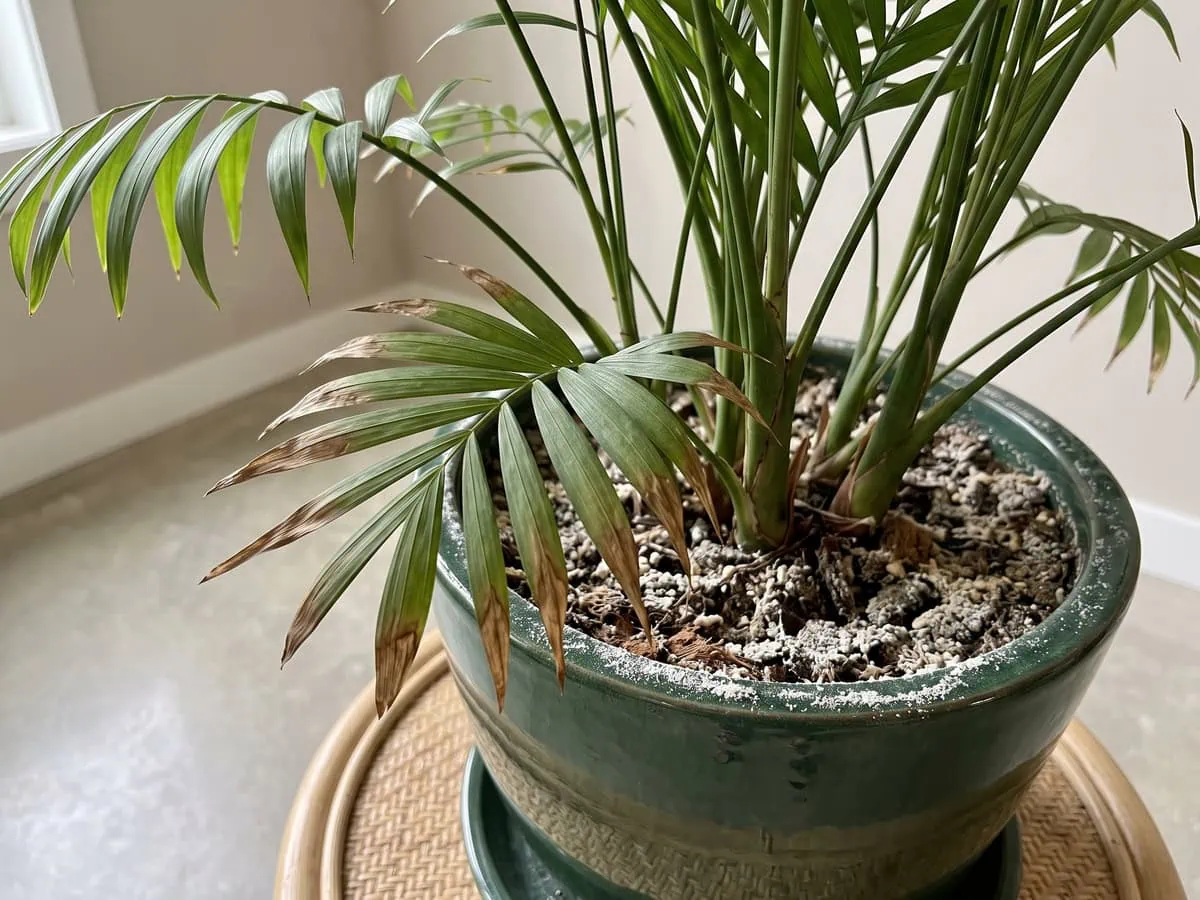
A white crust ringed the rim of my parlor palm’s pot. Fine and gritty. Two plants taught me what that ring takes: Chamaedorea elegans stores no water at all, so the soluble salts sit exactly where the fine roots must drink.
The brown frond tip is the visible problem. The actual problem is the salt buildup the mix has been holding since the last leaching (not joking). Honestly, that’s not quite right… the pot sheds some of it, but palm roots leave the stem at their final thickness and never widen, so they cannot grow past what stays behind.
Between you and me — the tell is weight, not color. A parlor palm in an 8-inch container flushed properly comes off the stool heavy and cool in both hands; the same pot after months of undrained feeding lifts light and dry-knuckled. Feeding is one lever inside the broader maintenance program it lives under.
You need no meter here. The table that follows collects the six numbers a parlor palm in an 8-inch container turns on, so you can act before you finish reading.
How to fertilize a parlor palm without salt buildup at a glance
| Parlor palm specs | Feeding value |
|---|---|
| Feed type | Complete water-soluble feed on a 3-1-2 analysis, about 18-6-12 |
| Feed strength | A fraction of the label rate, never the full label rate |
| Feed frequency | Monthly while the plant is in active growth |
| Feed onto dry medium? | No – water first, then feed |
| Routine leaching fraction | About 10% of the applied water drains out at every watering |
| Salt-load rescue | Leach at least 3 times with a container volume of fresh water |
Tap the button below to get more plant fixes in your Google Search results

Table of Contents
How often to feed a parlor palm, and how strong
Feed a parlor palm monthly while it is in active growth, at a fraction of the label rate, and not at all while growth rests. The species is a light feeder, and published guidance is blunt about which direction hurts it: too much, not too little.
Type “should a struggling parlor palm be fed or left alone” into a search bar and both answers come back. The split is readable: whole-plant pallor with growth still moving reads as a shortfall, while brown tips over a white crust (the two together, not either alone) read as a load already in the mix.
One hold is not a judgment call. After a container change the feed stops for a fixed stretch, and that figure belongs to the feeding hold after a container change rather than to this page. Every other figure here comes from a palm in a container, not from a field palm in the ground.
An 8-inch container gives you very little buffer. One part of this job is timed and the other is measured, and they are handled separately.
Reading the feeding window without a calendar
Anyone typing “when should I feed a parlor palm during the year” wants a month. But the plant does not keep one. Feeding starts again only when a stem actually pushes a new frond from its one tip bud, and it stops once short days and running heat have slowed growth to the point where a stem may open a single new frond in a whole year.
Three published cadences do the same work in an 8-inch container, and you pick by habit rather than by merit:
- A diluted liquid feed once a month through the growing stretch.
- The label rate every 2-3 months, and nothing in between.
- One-tenth of the label rate at every single watering.
How strong half strength really is
“How strong should liquid feed be for a parlor palm” is the wrong shape of question until you name the base it is a fraction of (the bottle, not the plant). Half strength means half of the rate printed on the bottle in your hand, and that printed rate is not the same from one complete feed to the next.
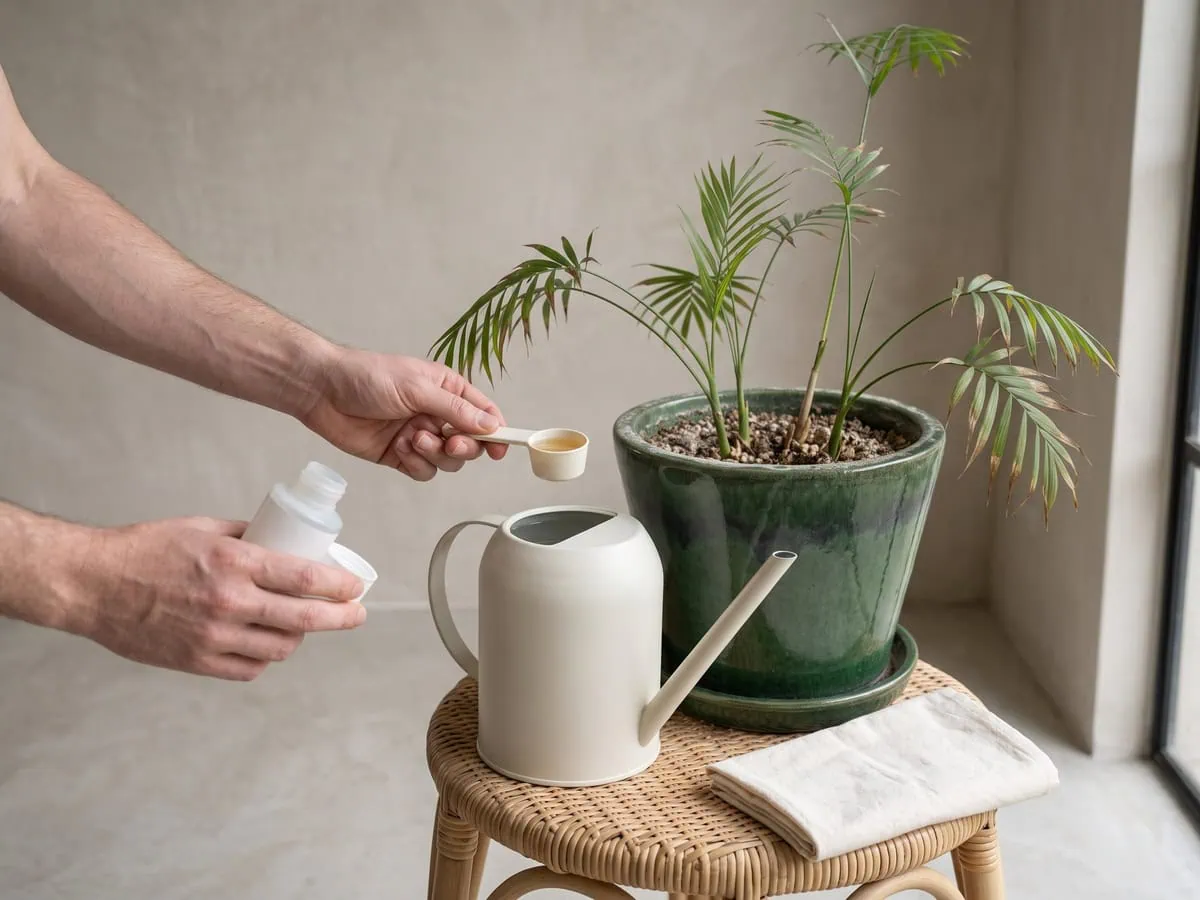
I stopped trusting the cap. A full 1-gallon watering can sits heavy and square in the wrist; the same can with a single measured scoop stirred through it weighs no differently, which is exactly why the dose doubles unnoticed on a light-feeding palm.
Tap the button below to get more plant fixes in your Google Search results

Getting feed into the container, and salts out of it
Two operations keep a container palm out of trouble: put the feed in diluted, and let water carry the surplus back out. A pot with drainage holes is a one-way street only if you water it that way (the holes only help if the water actually runs).
The palm cannot help you here. It holds no reserve of its own. Three parts follow: the pour, the flush, and the water you use.
Applying feed to a small container
Garden-scale instructions assume a bed. An 8-inch container is the whole root zone this palm ever gets, so a border dose lands far stronger than intended, and how fast it moves through depends on the growing medium behind the drainage a flush needs.
Water the mix first. Then pour the diluted feed over moist medium, off the fronds. A coarse palm mix of coir, bark fines and sand lets it through; a dense block holds it, and holds the salts with it.
Flushing mineral salts from the container
“How do I flush mineral salts out of a parlor palm pot” has a published quantity, and it is not a splash. According to the International Society for Horticultural Science, the leaching fractions — the share of applied water that drains away — decide how much salt stays in the drainage water rather than the mix.
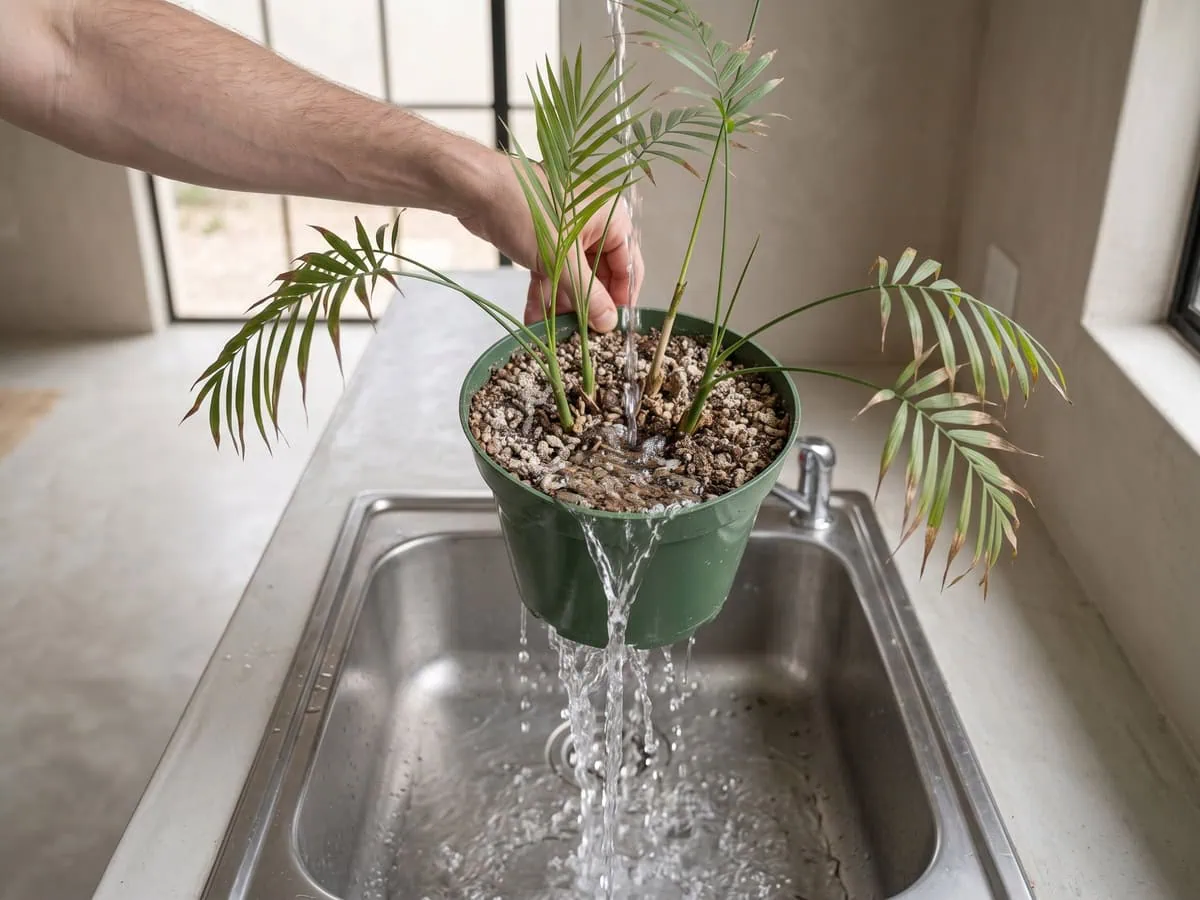
Take the 8-inch container to a sink and pass at least three container volumes of fresh water through it. Repeat the whole pass 2-3 hours later or the next day, and scrape the white crust off the surface before you start.
- A sink or tub deep enough to hold the container while it drains.
- Three container volumes of fresh low-mineral water.
- The saucer, emptied before you start and again when draining stops.
I lift the liner out before the second pass. A nursery liner that has just taken a container volume of water hangs dead-heavy off the fingertips; an hour later the same liner swings light enough to carry one-handed, and that swing is the salt leaving.
Whether hard tap water is the real load
“Is hard tap water bad for a parlor palm” is the right question aimed at the wrong remedy. Standing the water overnight releases free chlorine and nothing else — chloramine does not dissipate on standing, and neither does dissolved fluoride (nor boron, which this species is on record as sensitive to).
Rainwater, distilled or reverse-osmosis water removes the load at the source, and hard tap water also drags the medium up toward neutral, where a palm loses manganese first. The rest of that decision sits with the watering decision that sits just past this one.
Feeding mistakes and what they do to the fronds
Feeding mistakes on this palm show up on the fronds in two opposite patterns, and the medium surface tells you which one you have. Brown tips over a white crust is excess; uniform pallor with growth still moving is shortfall.
Four readings follow. Each one pairs a frond signal with a mix signal.
Brown tips read as hunger, not excess
A brown leaflet tip is the most misread signal on this plant. Half the shelf advice sends you to feed it; published guidance puts overfertilization and salt buildup at the top of the list for that exact symptom, ahead of any shortfall.
Dry air, a dried-out root zone and hard water all produce the same tip, which is why the moisture reading of a brown crispy frond is a separate check from this one. So read the crust first, then the frond.
Too little food, or too much
Whole-plant pallor with normal growth reads as a feeding shortfall rather than an organism, and owners reach that reading only after ruling out the water regime. The table below separates the two by what the mix is doing.
| Reading | Too little | Too much |
|---|---|---|
| Mix surface | Clean, no deposit | White crust on mix or rim |
| Frond pattern | Uniform pallor, smaller new leaves | Brown tips and margins first |
| Growth | Still moving, just slow | Slowed, lower fronds dropping |
Verdict: Read a clean mix surface with uniform pallor as a shortfall and feed; read any crust as a load and flush before you feed again.
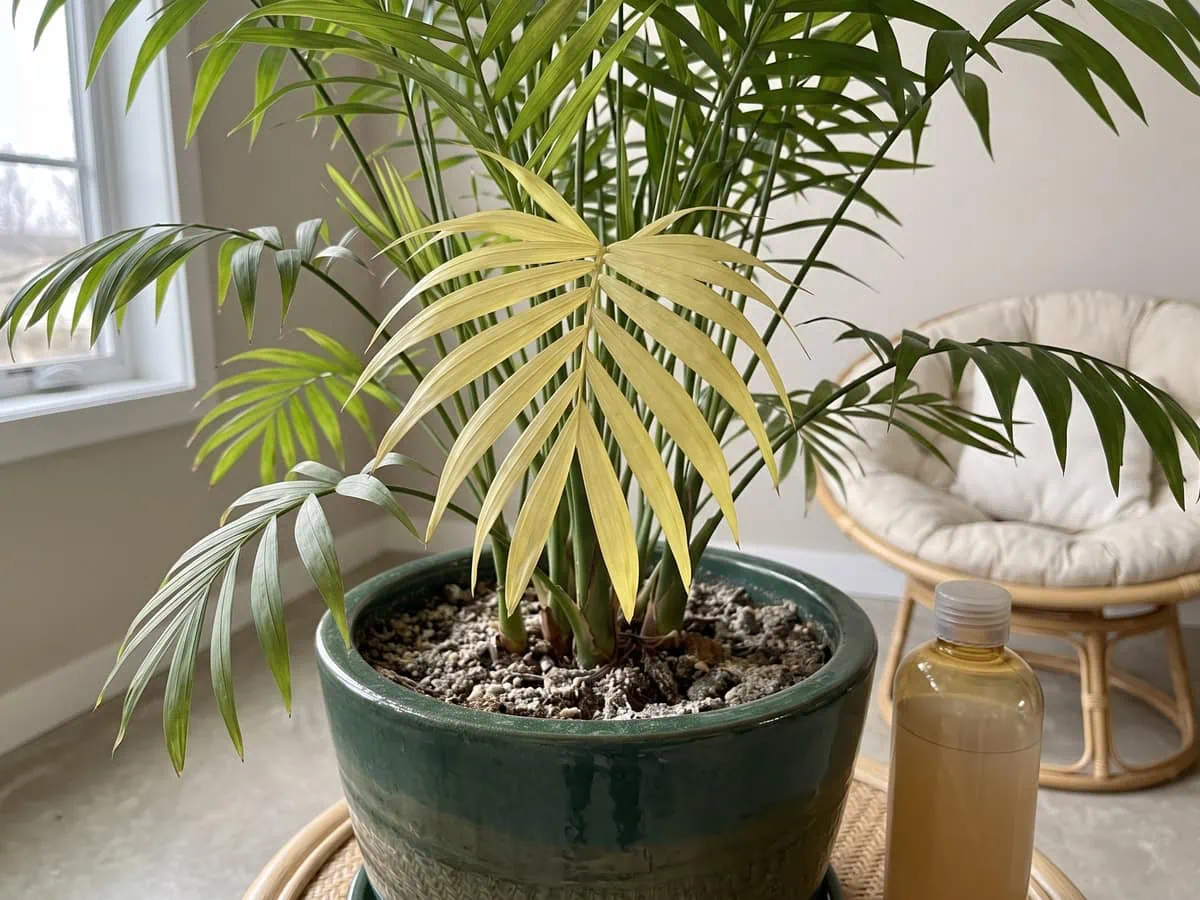
Nitrogen pallor is the one that reverses; yellowing from a shortage of anything else never does, so reading a pale or speckled frond matters before you reach for a bottle.
Magnesium salts and coffee grounds
One widely shared fix sends an owner with an overloaded container to add more of the element already piling up in it. Epsom salts are magnesium sulfate, and magnesium sulfate is a salt; on a pot already carrying a crust, that is the one thing not to add.
Magnesium does leach out of a container at every watering, and one teaspoon of Epsom salts per gallon is the published replacement dose. It earns its place only when the oldest fronds show broad yellow bands along the margins with the center still green (not before).
My working theory is that most owners reaching for it are reading a salt crust, not a magnesium band. Coffee grounds belong on the compost heap rather than on the medium surface.
What comes back after salt injury
Marked tissue does not come back. Once a leaflet tip turns tan it stays that way, and the palm swaps the whole frond out eventually, on its own unhurried timetable. What recovers is the root zone (and only once the load is out).
The saucer is the part I check first now. An empty saucer lifts like nothing at all; the same saucer twenty minutes after a flush comes up with a slopping weight in it, and that runoff is exactly what must not go back under the pot once it has drained.
Frequently asked questions about feeding a parlor palm
What is the best fertilizer for indoor palms?
A complete water-soluble feed on a 3-1-2-leaning analysis, about 18-6-12, is the published choice for a container palm. The three label numbers are the percentages of nitrogen, phosphorus and potassium by weight.
A balanced 20-20-20 foliage feed sits close enough to be defensible indoors. What matters more than the ratio is the strength: a small container cannot disperse surplus salts, so the feed goes in at a fraction of the label rate rather than at full strength.
How often should you fertilize a Parlor Palm?
Monthly, through the stretch when the plant is in active growth, and not at all while growth rests. That single cadence is the species-level instruction, and it sits alongside three interchangeable alternatives.
The alternatives are the label rate every 2-3 months, one-tenth of the label rate at every watering, or a feed at every seventh watering. None of them applies during the indoor rest period, when short days and running heat slow growth to the point that applied feed is not taken up and simply concentrates as salt.
Can you use Epsom salt to fertilize palm trees?
Epsom salt is magnesium sulfate, and it corrects a magnesium shortage rather than feeding the palm. The published indoor dose is one teaspoon per gallon of water, applied only when the symptom is actually present.
That symptom is specific: broad yellow bands along the margins of the oldest fronds, with the center of the leaf still distinctly green. Without those bands the application only adds salt to a container that cannot shed it, which is the opposite of what a crusted pot needs.
Is all-purpose plant food good for palms?
An all-purpose complete plant food is acceptable for an indoor palm, provided it carries nitrogen, phosphorus and potassium together and goes in dilute. A balanced 20-20-20 analysis is the standard indoor-foliage choice.
Two products are not suitable. The high-potassium palm maintenance analysis sold for outdoor palms is formulated for plants in the ground, and any product heavy in boron is a risk on this species, which has documented boron injury from irrigation water.
Are coffee grounds good fertilizer for palm trees?
Coffee grounds work as a compost ingredient rather than as a container feed, and a complete water-soluble product is what a feeding program calls for. They are not a substitute for a complete feed.
The practical objection is the one that governs every amendment here: a container cannot shed what is added to it. Organic matter laid on the medium surface also holds moisture there, which favors the medium-breeding flying insects and the surface fungal growth this palm already attracts.
What month do you fertilize palm trees?
No month governs it. The plant responds to growing conditions rather than to a calendar, so feeding resumes when a new frond pushes from the growing point and daylight is lengthening.
It stops when growth slows under short days and indoor heating, and it stays stopped until visible new growth returns. Tying the schedule to a date rather than to the plant is how a container ends up fed through a rest period in which it was never growing.
Troubleshoot, assess, fix — the two-surface test
Two surfaces settle almost every feeding question on this palm: the mix surface and the oldest fronds. A clean surface with pale, still-growing foliage says feed. A white crust says stop and flush.
The mix went unread while I studied the fronds. Two whole years.
And once you have read those two, the next question is how often the water itself goes in, because the flush and the ordinary watering share one route through the pot and one saucer underneath it. Getting how to fertilize a parlor palm without salt buildup right is mostly a matter of pouring less and draining more.
May the only white you ever find on that medium be the sand you top-dressed it with.
Tap the button below to get more plant fixes in your Google Search results