🎯 Quick Answer: salt injury on a fiddle leaf fig
How to fix fertilizer burn on a fiddle leaf fig (Ficus lyrata, a Moraceae fig): salt melts root tips, so flush at least 2 pot volumes. Lift the crust off first, or the water carries it back down. New growth returns once the salt leaves the pot.
- Plain water only: never flush with a fertilizer solution, only clean tap water
- Empty the sleeve: the inner pot never stands in the runoff it shed
- Skip bottom watering: it concentrates salt in the mix instead of carrying it out
- Patch-test any spray: try it on one lower leaf a day ahead
- Time the marks: contact injury from a spray shows within about 24 hours
Get the one-page care card for this guide, plus a printable A4 copy
We condense this guide into one card for your phone and a print version for the pot shelf. Enter your email and we send both to your inbox. Subscribe once, then request the card of any guide you read.
By subscribing you agree to get emails from Plant Care Basics about plant care guides, about once a week at most. Unsubscribe in one click. Privacy policy
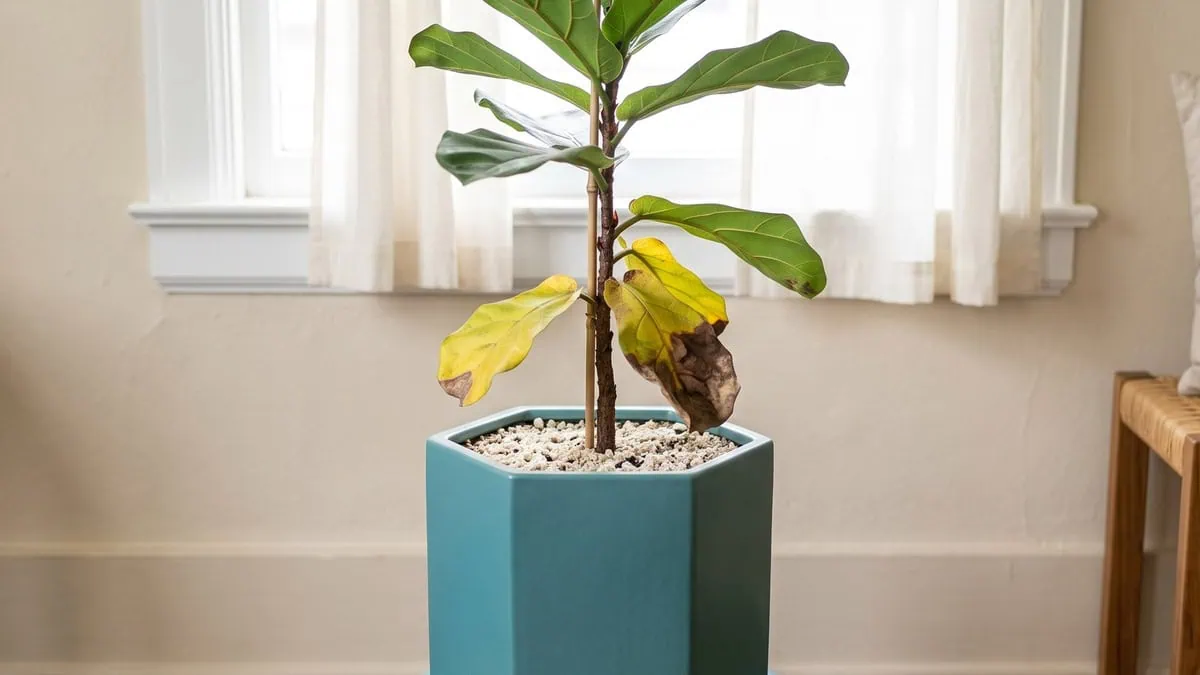
The crust came up like sugar under the spoon, pale and gritty against the dark mix. Off to one side — The fiddle leaf figs I lost were the ones I fed hardest. On both, the oldest leaves went yellow, then brown, then necrotic.
What looked like a watering fault turned out to be a feeding one (paid for that lesson myself): soluble salt from every feed had banked up in the mix, and that salt buildup is what drives tip burn. Scattered dead patches, not only along the margin.
I am running ahead of the order here. Ficus lyrata stores no water in trunk or root, so salt scorches leaf margins while the soil is still damp.
Read the crust before you flush. A mature fiddle leaf fig is too heavy to carry to a sink, so the flush happens where it stands. That order decides whether leaching carries the salt out or drives it deeper into the rootball, and it is the same order that sets the feeding and watering regime the flush restores.
No lab is needed to read this. The comparison under this line sets crust, blade and roots side by side, in the order you check them.
Fixing it: how to fix fertilizer burn on a fiddle leaf fig
| What to check | What it means, and what to do |
|---|---|
| Is there a pale crust on the mix surface, the rim or the drainage hole? | Yes points to salt injury; no crust and no recent feeding points elsewhere |
| What it looks like on the blade | Brown dry tips and margins, plus dead patches scattered across the blade, oldest leaves first |
| What it looks like below the surface | Dead root tips, wilting and slowed growth while the mix is still moist |
| The corrective flush | Lift the crust off, then pour twice the container’s volume of plain water through |
| Flush interval as routine maintenance | Every 3-4 months |
| Feeding once new growth appears | Monthly at label strength through the long-daylight season, nothing through the short-daylight rest |
You are subscribed
Press the button and we prepare this guide's one-page care card and its A4 print copy and email both to you within a few minutes.
Tap the button below to get more plant fixes in your Google Search results

Table of Contents
Confirm it is salt injury before you pour anything
Salt injury announces itself at the container rather than on the leaf: a pale crust on the mix surface, the rim or the drainage hole, on a plant that has been fed recently. The three checks below run in that order.
The crust on the mix, the rim and the drainage hole
White crust means salt. Slide a spoon edge under one flake and it lifts pale and gritty, with the mix beneath showing dark as wet bark. That break in color is the confirmation you are after, and on this fig it is the one sign that separates salt injury from every other cause of a brown margin.
- The mix surface, thickest where the top layer dries fastest between waterings
- The planter rim, showing as a chalky ring at the lip
- The drainage hole, where run-off sits and evaporates
No crust anywhere, and no feed in recent memory, sends you elsewhere. But “my fiddle leaf fig shed leaves after I changed its feed” is a different case, because the timing itself is evidence. On the ones I lost, that chalky ring reached the rim before the oldest leaves gave anything away.

Where the marks sit, and when they appeared
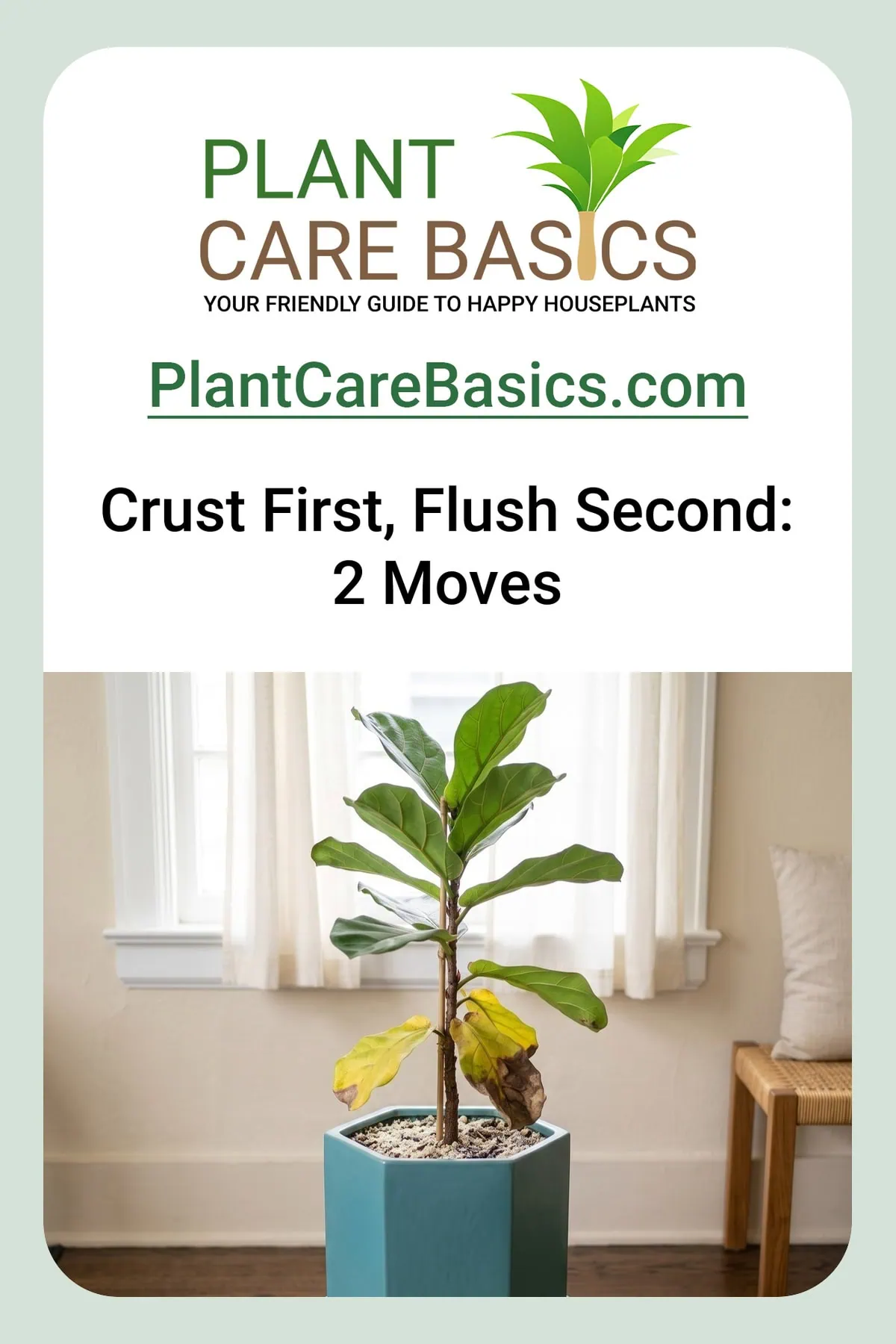
Salt-injured leaves brown at the tip and along the margin, and they also carry dead patches scattered across the blade. Drought marks the margin only. Oldest leaves go first, since they have moved the most water.
So a reader searching “what do salt damaged fiddle leaf fig leaves look like” should check the middle of the blade, not only its edge, because that is where the two readings separate, margin-only marks being edge browning traced to the watering pattern.
When the damage came from a spray, not the feed
Contact injury shows within about 24 hours, only on tissue the liquid actually touched, so the timing of the marks tells you as much as their shape when you are working out what caused them. It follows a run-off line down the blade, pools in the notch where blade meets stalk, and stops at a hard edge.
- Rubbing alcohol at 70 percent belongs on the insect, never on the leaf surface
- Patch-test one lower leaf 1 to 2 days before spraying a whole plant
- Rinse both leaf surfaces with plain water, then keep the plant out of direct sun
That answers “why did rubbing alcohol damage my fiddle leaf fig leaves”: the burn sits on the surface, so no amount of flushing at the roots reaches it.
Get the one-page care card for this guide, plus a printable A4 copy
We condense this guide into one card for your phone and a print version for the pot shelf. Enter your email and we send both to your inbox. Subscribe once, then request the card of any guide you read.
By subscribing you agree to get emails from Plant Care Basics about plant care guides, about once a week at most. Unsubscribe in one click. Privacy policy
Tap the button below to get more plant fixes in your Google Search results

The corrective flush, and how to know it worked
A corrective flush pours at least twice the container’s volume of plain water through the mix and lets every drop drain away. Scrape the crust off first. Water poured onto an untouched crust dissolves it downward and lands the salt among the fine roots, which is the opposite of what you want.
The three steps below run in order.
The order decides the outcome. Crust off, then water on, then drain and empty the sleeve. A flush run in any other order moves salt deeper into the rootball rather than out of the pot.
Lift the crust off before any water goes on
Work dry. Slide a small stainless steel trowel under the pale layer and lift it away in flakes, taking the top inch of mix with it if the crust has bonded to the surface. The pot returns to the watering rhythm the flush returns you to only after it has finished draining.
- Scrape the mix surface, then the inside of the rim, then the drainage hole
- Discard what comes off rather than working it back into the pot
- Top the pot back up with fresh mix once the flush has drained
How much water, and where it has to end up
The “how to flush built up salts out of a fiddle leaf fig pot” question comes down to volume and exit. Twice the container’s volume of plain water, poured slowly enough that it soaks rather than channels, and every drop of it has to leave the pot.
According to the University of California Agriculture and Natural Resources, whose houseplant guidance covers fertilizer residue in the medium, soluble salt in a houseplant pot moves out only with water that drains clear through the medium, which is why you tip the runoff out rather than back into the pot.
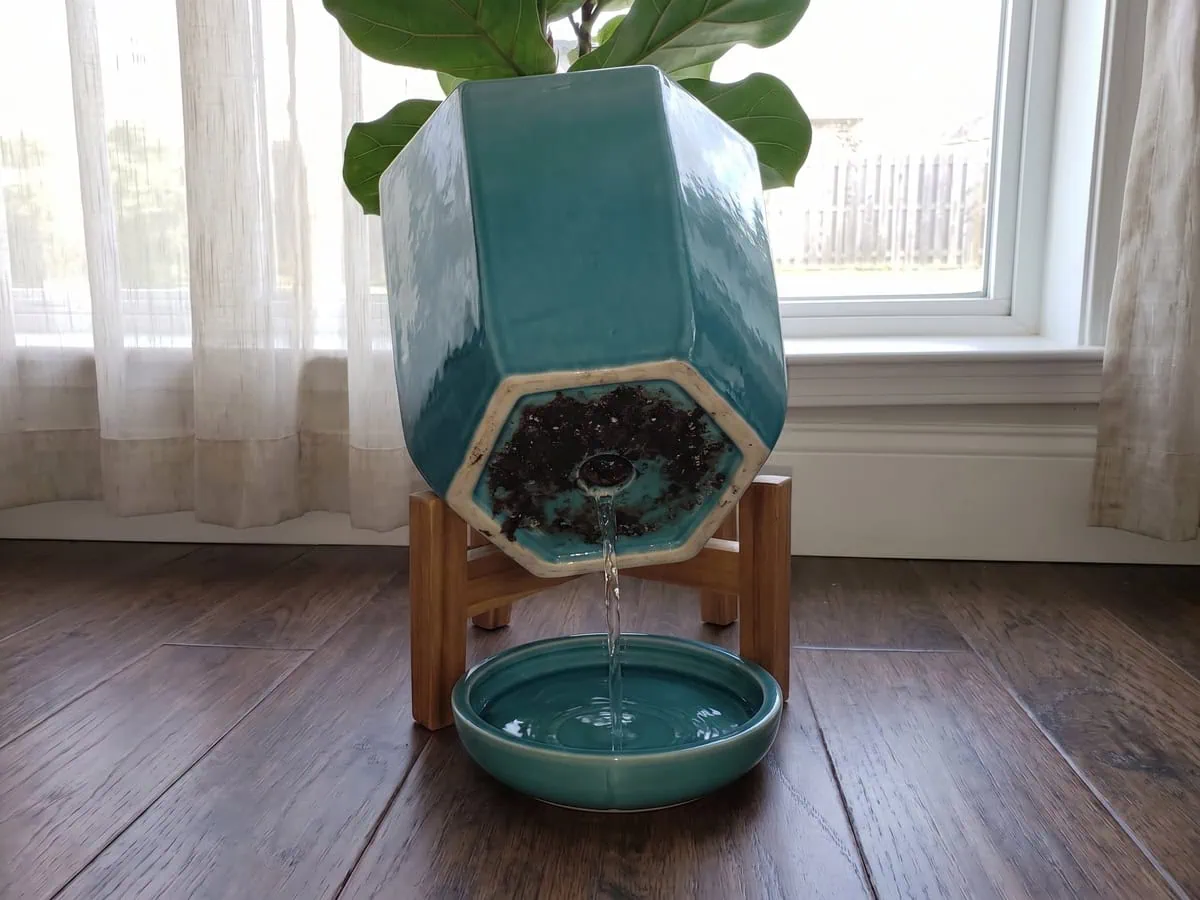
Catch the first runoff in a clear glass measuring cup and hold it to the light. It comes off the color of weak tea on the first pass, straw on the second, and near-clear by the third; that fade is the flush doing its work.
- Plain tap water only, never a feed solution and never softened water
- Set the inner nursery pot on a rack until it stops dripping, then empty the sleeve
- Repeat as routine maintenance every 3 to 4 months
What the roots say about whether to carry on
Tip the plant out if the leaves keep going while the mix stays damp. Healthy root tips are firm and silvery white. Salt-injured tips are dead: brown, soft, and stopping short in the mix where the growing point should be, and a rootball that has lost most of them will drink sluggishly for weeks after the salt is gone.
There is room for me to be off here, but the volume and the interval are the documented figures, and the finish line is one the plant shows you. So read the plant: a new leaf says the roots work again, while sour mix and a foul smell say something else entirely.
Feeding again without repeating the injury
No feed goes back on until the plant has pushed a new leaf, and it returns at label strength once a month while the days stay long. Nothing goes on through the short-daylight rest. The three rules below keep the salt from banking up again.
Wait for a new leaf before any feed goes on
A flushed pot holds a root system that is still rebuilding, and fertilizer analysis printed on any bottle assumes roots that can take it up. Feed follows the water and light corrections; it never leads them, and a sour pot is decay at the root rather than salt at the leaf. One unfurled leaf is the signal.
I fed one of them too early, three weeks after its flush, because the crust was gone and the plant looked steady. It dropped two more leaves inside a fortnight and took the rest of that year to put out anything new.

How often, and how strong, once growth resumes
So one answer covers “how strong should fiddle leaf fig plant food be” on this species: exactly what the label says, no stronger, and no more often than monthly (yes, this sounds unhelpfully plain — bear with me).
- Monthly at label strength through the long-daylight months
- Nothing at all through the short-daylight rest, however green the plant looks
- Water first, then feed, so the mix is damp before the solution goes on
Mix it in a plain white bowl and look at it. A correctly diluted water-soluble fertilizer sits pale straw against the white glaze; anything closer to amber is stronger than this fig will take, and the micronutrients it carries, iron and manganese among them, do not soften that.
Two feeding shortcuts that cause this injury
Two habits put the salt back faster than any watering can.
- Feeding through the foliage. A spray on the leaf surface does not feed a fig; it wets the blade with a salt solution and leaves it there to dry, which is contact injury by another name.
- Kitchen scraps as a measured feed. Coffee grounds and the like carry no stated nitrogen figure, so nothing about the dose can be read off them, and they sit on the surface where the crust forms.
A slow-release pellet acts like a doubled dose on a pot that has not been flushed, and a repot into the substrate recipe this species is repotted with resets the pot only if the salt leaves with the old mix. Then feed the plant that is actually growing, not the one you hoped for.

Frequently asked questions
Can a plant recover from fertilizer burn?
Recovery follows once the roots still hold live tips and the salt comes out of the pot. Marked leaves never turn green again, so recovery is measured in new growth rather than in repaired tissue.
Flush at twice the container’s volume, hold off feeding, and watch for one unfurled leaf. A rootball that has lost most of its tips will drink slowly for weeks before that leaf appears.
How can I fix fertilizer burn?
The crust comes off the mix first, rim and drainage hole included, and then a flush of at least twice the container’s volume of plain water drains away completely.
Empty the outer sleeve so the pot never stands in its own runoff. Then leave the plant unfed until it pushes a new leaf, and resume at label strength once a month.
How often should I fertilize my fiddle leaf fig?
At label strength once a month while daylight is long, and nothing at all once it shortens. That cadence is the one this species tolerates without banking salt in the mix.
Water first so the mix is damp, then apply the diluted feed. Skip the month entirely if the plant has not put out new growth, because unused salt simply stays in the pot.
What is the best fertilizer for a fiddle leaf fig tree?
A balanced water-soluble houseplant fertilizer used at the strength its own label states, applied to damp mix, is what this fig needs.
Read the analysis on the bottle rather than the marketing on the front. Slow-release pellets work only on a pot that has been flushed; on a salted one they behave like a doubled dose. A pellet also commits the pot to its whole stated release period, which is a long time to be wrong.
How long does it take for fertilizer burns to recover?
Expect a decision point about a month after the flush: by then the plant either holds its remaining leaves or keeps shedding them.
Full appearance takes far longer, because the marked leaves stay marked and only new growth changes the look of the plant. Published guidance fixes the flush volume and the feeding cadence; the timetable comes from the plant. Read the plant instead of the calendar: one unfurled leaf is the evidence that the roots are working again.
How to recover a plant from too much fertilizer?
Stop feeding, remove the visible crust, and leach the pot with plain water at twice its volume, draining every drop away.
Repeat that flush every three to four months as routine maintenance rather than as a rescue. Softened water is the one liquid to keep out of the pot, since it adds sodium of its own. The inner nursery pot drains outside the sleeve, and the sleeve is emptied before it goes back.
What does fertilizer burn look like?
Brown dry tips and margins on the oldest leaves first, with dead patches also scattered across the blade, and a pale crust on the mix surface, the rim or the drainage hole.
Below the surface the root tips are dead and the plant wilts while the mix is still damp. That combination separates salt injury from a rootball that simply dried too far.
How to fix nutrient burn on plants?
The correction is the same on any potted plant: clear the surface deposit, flush the medium with plain water at twice the container’s volume, and withhold feed until new growth appears.
Then resume at the strength the label states rather than at the strength the plant seems to want. Foliar sprays and unmeasured kitchen amendments are what put the salt there in the first place.
Lesson locked. Take the crust off first.
Blunt truth. The hard part of this is not the flush. It is trusting a pale gritty film to tell you what the leaves cannot: that the salt sitting in the mix, not the watering can, is what burned those margins.
So the sequence stays short. Crust off, twice the container’s volume of plain water through, sleeve emptied, then nothing until a new leaf opens. After that, label strength once a month.
Fixing fertilizer burn on a fiddle leaf fig comes to that. The whole method fits in one line. The crust is the sign, the flush is the fix, and a fiddle leaf fig fed at label strength never has to meet either one again.
Get the one-page care card for this guide, plus a printable A4 copy
We condense this guide into one card for your phone and a print version for the pot shelf. Enter your email and we send both to your inbox. Subscribe once, then request the card of any guide you read.
By subscribing you agree to get emails from Plant Care Basics about plant care guides, about once a week at most. Unsubscribe in one click. Privacy policy
Tap the button below to get more plant fixes in your Google Search results