🚨 Emergency 30-Second Answer: why are my peace lily leaves turning yellow
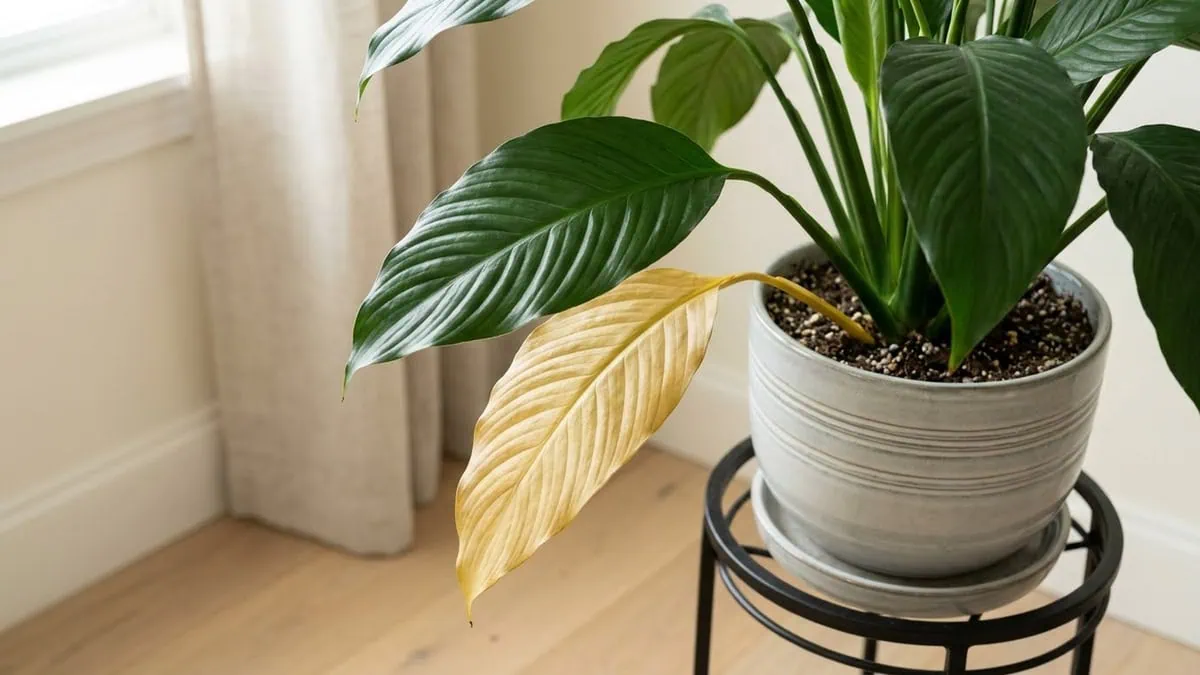
Stop watering and lift the pot — Spathiphyllum wallisii, an Araceae aroid, sheds its oldest leaves when the mix stays wet at two inches deep. One or two yellow blades low on the clump is ordinary turnover. Several at once, or any yellow on the newest leaf, is a fault.
Dry at two inches with a light pot means the plant is thirsty, not drowning. Wet mix under a heavy pot means the roots are suffocating. The blade and the pot together settle it; neither one settles it alone.
- Lift the pot: heavy and wet means stop watering right now
- Push a finger in: dry at two inches means it is time to water
- Count the yellow blades: one or two lowest leaves at a time is turnover
- Watch the newest leaf: yellow on the newest blade means act now, not wait
- Check the window: bright filtered light only, never a direct sun window
The lowest leaf on my clump went the color of weak tea while the blade right above it stayed glossy dark green. One gone, one untouched.
Two years of failure forced me to learn what this plant does when it drops a leaf. With no water-storing organ anywhere in its rhizome, it cannot ration a reserve, so the oldest blade is always the first thing it gives up. That orderly hand-off is senescence; chlorosis from root injury is the one that skips the queue.
Pull a yellowed blade from a wet pot and it tears with a soft, wet sound, nothing like the dry paper snap of one that dried out. So check the pot before you change anything (dry at two inches means thirst, wet means the roots are drowning). It matters.
Separating the two takes minutes once you know the standing routine behind a stable clump, and the check asks for nothing but a hand on the pot.
No need to rush this. The table below lines up the numbers I check first — turnover pattern, moisture depth, light — before the watering can ever comes out.
Why are my peace lily leaves turning yellow? The numbers at a glance
| Peace lily specs | What to look for |
|---|---|
| Normal yellowing pattern | One or two lowest leaves at a time, roughly one leaf every 1-2 months |
| Yellowing that is NOT normal | Several leaves together, or any yellowing that reaches the newest leaf |
| Substrate check before watering | Dry at 2 inches, cross-checked by lifting the pot for weight |
| Growing medium | A peat-and-pine-bark foliage mix, 2 parts peat moss to 1 part pine bark, opened up with coarse aeration so it drains and resists compaction |
| Light band for good leaf color | 150-500 FC optimal, 50-100 FC survival floor |
| Can a yellowed leaf turn green again? | No – the plant is emptying that blade, not repairing it |
Tap the button below to get more plant fixes in your Google Search results

Table of Contents
Start here: the first three checks when leaves go yellow
Check the substrate first, then the water you use, then the light, before you go looking for a disease. That is the order. The following sections count the leaves and take apart the remedies that make it worse.
Do not discard the plant on yellow leaves alone. Only visible gray or black growth on the tissue moves this question out of watering and into pathology. A soft, sour base is a rot question instead.
In my own testing I lift the pot before anything else, because weight settles the wet-versus-dry question faster than any leaf does (a pot that still feels heavy days after watering is holding water the roots cannot use). Then read the yellow.

Which leaves are yellow, and how many at once?
One or two of the lowest leaves at a time, at roughly one leaf every 1-2 months, is ordinary turnover. Typing “peace lily bottom leaves turning yellow one by one” into a search bar describes exactly that pattern, and the plant is redirecting resources from its oldest blades into new growth. Several at once is different.
A group of yellow leaves arriving several days after a wilt episode is the signature of a dry-out that already happened, not one happening now. Set that beside leaves that hang over the rim instead of changing color, which is a different question.
Myths that make yellowing worse
“Can yellow peace lily leaves turn green again” is the most-searched form of this question, and the answer is no. The pigment does not rebuild. Recovery shows up in the next leaf, not in the damaged one (the newest blade is the one to watch).
Sugar water is not a remedy; feeding a plant that is already carrying salt build-up only adds to the load, and the fertilizer question belongs with the wider care routine. One more sound test: a yellowed blade from a soggy pot tears with a wet, stringy give, while an air-dry one snaps like paper.

Where you find dark mush at the base instead of a color change, the plant needs a rescue rather than a color read.
Tap the button below to get more plant fixes in your Google Search results
Overwatering or underwatering? Read the blade, then the pot
Both faults yellow the leaves, so the blade alone cannot settle which one you have. A wet mix under a heavy pot points to roots with no air left, while a dry mix under a light pot points to plain thirst. The following sections read each sign set in turn.
| Wet-side signs | Dry-side signs |
|---|---|
| Whole blade yellows at once, sometimes swollen or puffy | Yellowing starts at the tips and edges |
| Water-soaked spots on the blade | Margins go crispy and the blade curls |
| Lowest and inner leaves go first | Yellowing follows a wilt by several days |
| Pot still heavy days after watering | Pot light, mix shrunk back from the sides |
Verdict: Take the wet-side reading whenever the pot stays heavy, because a mix that never drains keeps air away from the roots and the clump gives up its lowest leaves from the base outward.

Wet-side signs on the blade
Excess moisture shows first on the lower and inner leaves (the ones this clump gives up soonest), and the blade often looks swollen rather than dried out. That puffy, water-soaked look is easy to miss, so read it beside the weight of the pot rather than on its own. And a pot still heavy days after watering is the confirmation.
Dry-side signs on the blade
Thirst writes itself at the edges first. Tips first, then the margins. Typing “peace lily yellow leaves from overwatering or underwatering” into a search bar reveals how tangled the two look, yet the dry side is the one that goes crispy at the rim and curls before the entire blade fails.
But dry brown tips and margins rather than a whole yellow blade point somewhere else entirely.
The soak-and-clock test
Water until it runs from the drainage hole, then tip the saucer out. Now leave it alone (this is the part everyone skips) and push a finger to two inches each day, because the interval between soakings is the reading, not the calendar.
I settle the question with a knuckle instead of a meter: rap the pot wall, and a saturated mix answers with a dull thud while a dry one rings hollow enough to hear across the room. Keep that reading honest by pairing it with the schedule that keeps the root zone from staying wet.

Pale, curling, and yellow new leaves: three different signals
A pale blade, a curled blade and a yellow newest leaf are three different signals. Each points at a separate lever. The following sections take them one at a time.
Washed-out pale blades
A blade that fades to soft yellow-green without going crispy is reading you the light, not the watering can. Typing “why does my peace lily have pale washed out leaves” into a search bar returns three causes at once (and no separator), so read where the pale sits.
- Too little light: the entire clump dulls; hold 150-500 FC
- Too much sun: the window-facing half bleaches; keep direct sun off the blades
- Self-shading: only the inner fans pale, shaded by their own crown
Look closer. Where the tissue between the veins yellows while the veins themselves stay green, the reading changes again: according to Illinois Extension, that interveinal pattern belongs to chlorosis and the nutrients behind it – iron, manganese and zinc, whose availability in a peat mix moves with pH.

Curling and wrinkling with the color change
Search “why are my peace lily leaves curling and wrinkling” and you get half an answer, because most care guides write about curl and stops there. A sound blade is flat and glossy; a puckered one keeps its texture after you smooth it out.
Curl with a color change arrives with moving air. Cold injury runs inward from the tip and edge (necrosis first, then blackened tissue) below about 52F, while a heated room at 10-20% humidity against the 40-50% this plant wants only turns the margins papery. Step the pot back from cold glass.
When the newest leaf is the yellow one
Yellow on the newest blade is the reading that changes what you do. Turnover works bottom-up, so a fault reaching the top of the clump has moved past age. Check that leaf first, because the newest blade is the one to read the plant by.
Press a finger into the mix and listen (I never skip this one): saturated peat answers with a wet squish at the fingertip. A squish at two inches deep means the roots are holding water the newest leaf cannot use.
Frequently asked questions about yellow peace lily leaves
How do I fix yellow leaves on a peace lily?
Work the checks in order: substrate first, then water quality, then light, and only then look for a disease. Lift the pot and push a finger to two inches; a wet mix under a heavy pot means stop watering and let the mix dry back before anything else. Visible gray or black growth on the tissue is the only sign that moves this question out of watering.
Can a yellow leaf turn green again?
No. Chlorophyll does not come back, so the plant is emptying that blade rather than repairing it, and the leaf goes whatever you do next to the pot. Judge the correction by the next leaf instead: recovery shows up as new growth that emerges and stays green, which is the clearest signal this plant will ever give you that the change actually worked.
How do I make my peace lily healthy again?
Fix the root zone first, because nothing else holds while the mix sits either wet or bone-dry. Water thoroughly until it runs from the drainage hole, empty the saucer, then wait for the top two inches to dry before the next drink. Steady indirect light finishes the job, and the wider watering and feeding routine belongs with the full care guide.
Should I cut yellow leaves off lily?
Only for looks. A blade that has yellowed through is already spent, and the plant has taken back what it could, so removing it changes nothing the plant is doing. Leave any leaf that is still part green where it is, and handle the grooming routine itself as part of the wider care guide rather than a fix for yellowing.
What does a thirsty peace lily look like?
It droops, hanging over the rim within a day of the mix drying through, then stands back up within hours of a thorough soak. That recovery time is the test: a plant still down the next morning has a root problem rather than a thirst problem. Dry-side yellowing follows several days later, starting at the tips and edges rather than across the whole blade at once.
Is sugar water good for peace lily?
No. Sugar is not a nutrient the roots can take up, and a peat mix already carries a salt load that feeding adds to, so more dissolved solids is the last thing a struggling root zone needs. Water it plainly, hold the fertilizer until new leaves are pushing again, and read any white crust on the surface as salt rather than shortage.
Win your next yellow-leaf battle
One yellow leaf low on the clump is housekeeping; several at once, or one at the top, is a request for change. You now have the three readings that separate them: the count and position of the yellow, the pot’s weight against a two-inch moisture check, and the color of the newest blade. No meter needed.
The interval question sits with the watering guide. So the next time you type “why are my peace lily leaves turning yellow” into a search bar, read the newest blade first. Count the yellow leaves before you change anything, and let the newest blade tell you whether this is ordinary turnover or a fault to fix.
Tap the button below to get more plant fixes in your Google Search results