🎯 Quick Answer: telling three Ficus trees apart
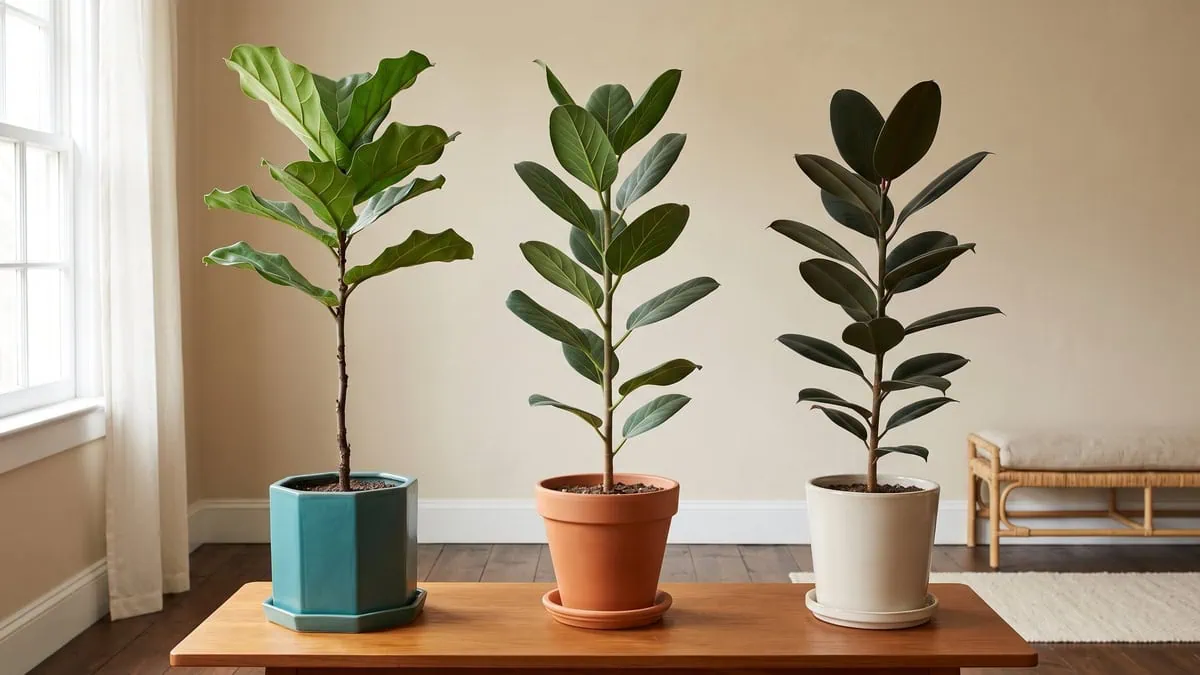
Fiddle leaf fig vs Ficus Audrey vs rubber plant fails on gloss: Ficus lyrata, a Moraceae family member, spans 8-15 inches. Ficus Audrey holds a smaller oval blade with a pale midrib. A rubber plant blade is oval and unlobed, never fiddle-shaped.
- Look 1: hold the blade flat and read its outline first
- Look 2: tilt it to the light and judge the surface
- Look 3: turn it over and check whether veins sit sunken
- Order: outline splits all three before surface or veins do
- Stop point: one look rarely settles it; two agreeing looks do
Get the one-page care card for this guide, plus a printable A4 copy
We condense this guide into one card for your phone and a print version for the pot shelf. Enter your email and we send both to your inbox. Subscribe once, then request the card of any guide you read.
By subscribing you agree to get emails from Plant Care Basics about plant care guides, about once a week at most. Unsubscribe in one click. Privacy policy
The tag said fiddleleaf; the blade in my hand was a glossy oval barely half that size. Every misread since then began the same way. One side note: a blade left against a cold pane reads stiff and cool under the thumb, which tells you about the window rather than the species.
Gloss is the visible problem. Strike that. The actual problem is blade outline, because gloss shifts with the room and the cloth you last wiped with, while outline holds steady from the first unfurled leaf (TBH — Ficus lyrata carries 8-15 inch blades, the largest of any interiorscape Ficus).
Three looks settle the question, and they run in a fixed order because outline – the fiddle shape that named this fig – splits all three before surface or veins can. Once the name is settled, how any of these three is actually kept at home becomes the question that matters.
You do not need every feature at once. Underneath, four rows carry the fiddle outline, the 8-15 inch blade, the care answer and the watering trigger.
Fiddle leaf fig vs Ficus Audrey vs rubber plant at a glance
| Fiddle leaf fig specs | Reading for this plant |
|---|---|
| Blade outline of Ficus lyrata | Fiddle-shaped, broadest above the middle, carried on one upright woody stem |
| Mature blade length of Ficus lyrata | 8-15 inches, with upper records to 18 inches |
| Do a fiddle leaf fig and a rubber plant take the same care? | No – the direction of the requirements is shared, the tolerance of variation is not |
| Water when | The top 2 inches of mix are dry; never let the rootball dry until the soil pulls away from the pot wall |
You are subscribed
Press the button and we prepare this guide's one-page care card and its A4 print copy and email both to you within a few minutes.
Tap the button below to get more plant fixes in your Google Search results

Table of Contents
Three looks that separate these three Ficus trees
Three checks in a fixed order settle which fig you own: blade outline first, leaf surface second, vein color last. Most comparison guides hand you the same features as a flat pile of adjectives, and none says which one to read first. The sections below take each check in turn, starting with the one that does most of the work.
Run the checks in order and stop as soon as two agree. Outline eliminates two species in one look; surface splits the pair that outline leaves standing; veins are the confirmation, not the opening move.
Look 1: blade outline, the check that splits all three
A fiddle leaf fig blade is exactly what its name says: broadest above the middle, waisted below, with a wavy edge carrying no teeth (the violin outline that named the plant). It measures 8-15 inches long, with records to 18 inches, which makes it the largest blade of any Ficus kept indoors.
So hold a spread hand against the leaf. A blade longer than your hand belongs either to this fig or to a rubber plant, while a blade that fits inside your hand is Ficus Audrey, whose oval runs about three inches across. I have misread that shelf more than once, always by trusting gloss before outline.

Look 2: leaf surface, and what it tells you
Surface separates the two large blades that outline leaves standing. Ficus Audrey reads matte. Its blade is faintly velvety under the fingers, while a rubber plant blade is glossy enough to throw the window back at you.
The fiddle leaf fig sits between those two, and its own record is split (one university fact sheet records a dull green upper surface, a horticultural society records glossy dark green). Both were written from real plants, and dust alone will pull a blade toward the duller reading, so read surface as the second vote rather than the verdict.
Look 3: vein color, the confirming check
Veins settle what the first two checks proposed. On this fig the veins are impressed into the upper surface, so the back of a finger drawn across the blade dips into each one, and on a leaf that has stood against a cold pane overnight those grooves read cooler than the tissue between them.
Ficus Audrey does the reverse. Pale, near-white veins stand raised against a darker blade. A rubber plant carries a plain glossy unlobed blade and little else worth noticing, while this fig holds one upright woody stem that stays bare between leaves until turning one bare leader into branches becomes the goal.
Get the one-page care card for this guide, plus a printable A4 copy
We condense this guide into one card for your phone and a print version for the pot shelf. Enter your email and we send both to your inbox. Subscribe once, then request the card of any guide you read.
By subscribing you agree to get emails from Plant Care Basics about plant care guides, about once a week at most. Unsubscribe in one click. Privacy policy
Tap the button below to get more plant fixes in your Google Search results

Leaf size and outline compared, species by species
Blade length is the one feature on this page you can measure rather than judge, and it separates all three species on its own. Most comparison write-ups give a number for one species and adjectives for the rest. The three sections below take the pairings one at a time.
| Species | What the blade shows |
|---|---|
| Fiddle leaf fig (Ficus lyrata) | 8-15 inches, violin outline broadest above the middle, veins sunken |
| Rubber plant (Ficus elastica) | 6-12 inches, plain oval, glossy, unlobed and never fiddle-shaped |
| Ficus Audrey (Ficus benghalensis) | Oval, about three inches across, matte surface, pale veins |
Verdict: measure first, judge gloss second. Blade length alone puts Ficus Audrey in a different class from the other two, every time.

Fiddle leaf fig or a rubber plant
Adjectives are what “what shape are fiddle leaf fig leaves compared to a rubber plant” returns. The shape answer is simple. This fig is waisted and broadest above the middle, while the rubber plant blade is a plain oval that tapers evenly at both ends.
Size overlaps enough to be useless on its own (the two ranges share several inches), so outline carries the decision here. The University of Florida Institute of Food and Agricultural Sciences publishes a species sheet for the rubber tree and describes it as a house plant undone mainly by overwatering, warning that its soil should dry between waterings.
Fiddle leaf fig or Ficus Audrey
Anyone asking “how to tell a fiddle leaf fig from a ficus audrey” can stop at size. Audrey blades run about three inches across against 8-15 inches here, so the two are barely the same order of leaf (yes, this sounds too easy — bear with me).
Surface and veins confirm it. Audrey reads matte and velvety with pale, near-white veins standing proud of the blade, where this fig has a coarser surface and veins pressed down into it.
Fiddle leaf fig or a young Ficus altissima
Harder is “is my plant a fiddle leaf fig or a young ficus altissima”, because juvenile foliage of the look-alike group has not yet taken its adult outline. Three features do the work at that stage. Look at blade thickness, the shape of the leaf tip, and how much light the surface throws back.
Apply them against what this fig always shows. A violin outline broadest above the middle, a wavy edge without teeth, and a blade running past 8 inches on an established plant – a young altissima matches none of those three at once.

Same genus, same care? What is shared and what is not
Half yes is the honest reply to “do a fiddle leaf fig and a rubber plant need the same care”. The direction of the requirements is shared across all three: bright indirect light, steady moderate watering, warm stable rooms.
What differs is how much drift each one forgives. Below, the naming question comes first, then the care question, then the claims that get both wrong.
Is each of these a Ficus, and do all Ficus make figs
Yes to the first question. All three are Ficus: Ficus lyrata here, Ficus elastica for the rubber plant, Ficus benghalensis for Ficus Audrey, and all three sit in the Moraceae family alongside the edible fig.
Figs are a separate matter. Fruit in this genus depends on a specific pollinating wasp, so where that insect is absent the tree bears none, and indoors this species rarely flowers at all. All three are foliage plants indoors, which is why the pet-safety record for this species turns on leaves and sap, with the ASPCA Animal Poison Control Center (888-426-4435) as the primary line and the Pet Poison Helpline (855-764-7661) as the secondary one.
What is shared, what is not, and how the fuss ranking works
Under “which indoor ficus is the least fussy to keep” the same ranking meets you nine times over, never once with a figure attached to it. The rankings agree on direction and publish nothing you can check.
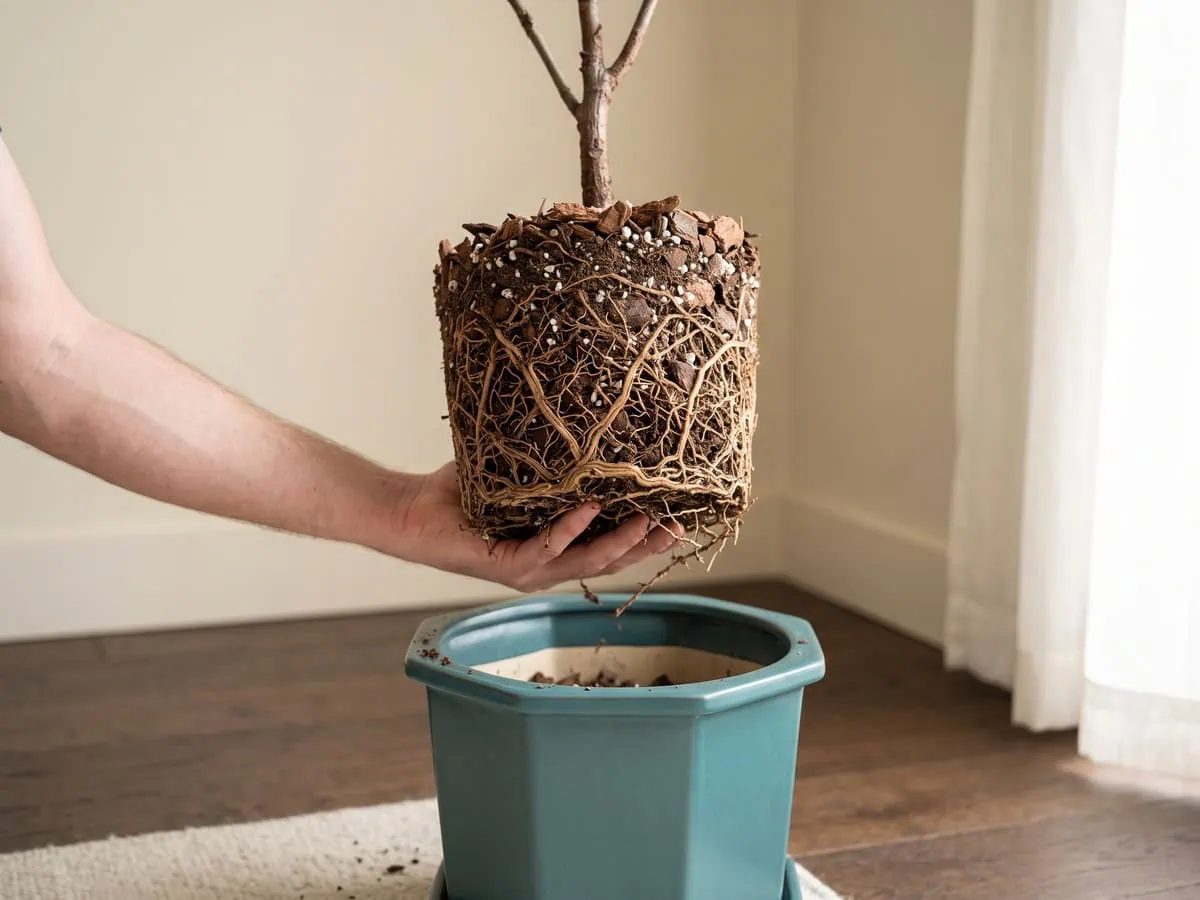
So use the trigger instead. The pour goes in once the top 2 inches of mix read dry, and the rootball never waits long enough for the soil to pull from the pot wall (lift it: a dry rootball reads light and cool against the forearm). That is what reading the mix instead of the calendar means.
Tolerance is the axis that differs (the rankings point at it without measuring it). Published care references call this species finicky, and it grows slowly indoors. I cannot account for why this holds, only that it does: the plants I leave in one bright spot hold their leaves better than the ones I keep adjusting.
What the mix-up write-ups get wrong
Myth: the fiddle leaf fig is a short, multi-stemmed plant with mottled, variegated foliage. Fact: it is an upright tree on one woody stem carrying large violin-shaped leaves in plain green. The variegated foliage in those photographs belongs to rubber plant cultivars, not to this species.
The second error is quieter. Comparison pages hand out watering intervals in days for these species, which looks like precision and is not: the same page will print a different figure for the same plant depending on which sibling it is being measured against.
Both mistakes share a root. They describe the plants from other articles rather than from a leaf in the hand, which is also how sap gets left out of the picture entirely, when skin contact with the white exudate is the one handling fact all three species share.
If a severe skin reaction develops (blistering or intense burning), seek medical attention immediately. For chemical exposure, you can also contact Poison Control (1-800-222-1222 in the US).
Frequently asked questions about telling these three figs apart
How do I tell what kind of Ficus I have?
Read three features in a fixed order: blade outline first, then leaf surface, then vein color.
Outline separates all three at once, because only this species carries the waisted violin blade. Surface splits the pair that outline leaves standing, and veins confirm the call. Start with a leaf held flat so the outline shows true, and stop as soon as two checks agree.
What are the main differences between Ficus Audrey and fiddle leaf figs?
Size settles it first: Ficus Audrey blades run about three inches across, against 8-15 inches here.
Audrey is matte and velvety where this fig is coarser, and its veins are pale, almost white, raised clear of the blade. On a fiddle leaf fig the veins press down into the upper surface instead. Outline differs too, since Audrey is a plain oval and this one is waisted.
Is a fiddle leaf fig and a Ficus the same thing?
They name the same plant at different widths. Ficus is the genus; the fiddle leaf fig is one species in it.
That genus sits in the Moraceae family beside the mulberries and the edible fig, which is why every Ficus bleeds milky latex from a cut stem. Calling the plant a Ficus is correct but imprecise, because Ficus Audrey and the rubber plant answer to the same word.
Is a Ficus and a rubber plant the same thing?
No. The rubber plant is one Ficus among many, carried under the binomial Ficus elastica.
Ficus names the whole genus, so a rubber plant is a Ficus in the same way a fiddle leaf fig is. A shop label reading only Ficus tells you the genus and nothing about the species in the pot. Check the blade: a plain glossy oval with no fiddle waist means elastica.
How can I identify a Ficus tree?
Cut or snap a stem and a Ficus bleeds milky white latex, which is the genus-level tell.
Leaves sit alternately along the stem, and a papery ring wraps each growing tip, leaving a scar behind when it drops. Those two features place a plant in Ficus before any argument about species begins. Wear gloves for the sap check, because the latex irritates skin.
What does an indoor Ficus look like?
Indoors a Ficus is usually a floor-standing tree between 2 and 10 feet tall.
This species holds one upright woody stem with leaves set alternately up its length, so the trunk shows bare between them while the crown gathers at the top. Height is owner-set rather than fixed, capped by pruning and by pot volume, which is why two plants of the same age can differ by feet.
Are Ficus and fig tree the same?
Botanically they are the same, loosely they are not. Every Ficus is a fig in the botanical sense.
In a shop, fig tree usually names the edible fig grown for fruit, while the three trees on this page are grown for foliage. All of them belong to the same fig family, and all release the same milky latex when cut. The phrase is doing two jobs at once.
Do all Ficus produce figs?
Every Ficus bears the fig structure, and few of them ever bear fruit indoors.
Fruiting in this genus depends on a specific pollinating wasp, so where that insect is absent the tree grows without setting figs. This species rarely flowers indoors at all, and container-grown plants of these three stay foliage plants in practice. Expect leaves rather than fruit, which is normal.
From guesswork to a named fig in three looks
Three looks, in order, and the argument is over. Outline first, because only this fig is waisted and broadest above the middle. Then surface, then veins.
Bluntly stated. Most write-ups turn this into a memory test. It is three checks in one order, and the waisted violin outline settles two of them before the veins are read.
So next time you stand in front of one, hold the blade flat until it warms against your palm, feel whether the veins sit sunken or raised, and let shape decide before the label does.
Getting the name right is what makes every care instruction you read afterwards land on the correct plant, which is the whole point of asking fiddle leaf fig vs Ficus Audrey vs rubber plant at all.
Turn one blade over and the argument ends: outline, surface and veins name this fig long before any tag does.
Get the one-page care card for this guide, plus a printable A4 copy
We condense this guide into one card for your phone and a print version for the pot shelf. Enter your email and we send both to your inbox. Subscribe once, then request the card of any guide you read.
By subscribing you agree to get emails from Plant Care Basics about plant care guides, about once a week at most. Unsubscribe in one click. Privacy policy
Tap the button below to get more plant fixes in your Google Search results