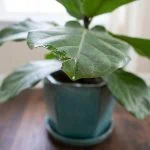

🎯 Quick Answer: scale and mealybugs on a fiddle leaf fig
How to get rid of scale and mealybugs on a fiddle leaf fig races the juveniles: Ficus lyrata, a Moraceae family tree, takes 70 percent alcohol. Alcohol goes on the insect, never on the leaf. Patch test one leaf 1 to 2 days first.
- Juveniles hide: translucent young mealybugs slip past a first swab pass
- Egg math: one female lays 100 to 200 eggs over 20 days
- Sticky film: honeydew and black sooty mold mark an active feeding population
- Crawler window: scale crawlers sit under the mother cover for several days
- No residual: soap works only where the spray actually lands, nowhere else
Get the one-page care card for this guide, plus a printable A4 copy
We condense this guide into one card for your phone and a print version for the pot shelf. Enter your email and we send both to your inbox. Subscribe once, then request the card of any guide you read.
By subscribing you agree to get emails from Plant Care Basics about plant care guides, about once a week at most. Unsubscribe in one click. Privacy policy
Quick story: the first white specks I found on a fiddle leaf fig sat in the axil where a leaf stalk meets the stem, and a cotton swab of isopropyl took them off in one pass. But years later, that first pass is still the easy half: this tree stacks its axils up one bare woody stem.
I assumed a clean swab pass meant a clean plant, until the honeydew and its black sooty mold came back in a week and taught me the juveniles are translucent enough to vanish against a blade this size (that part I did check twice). Backtrack: they were never on the blade.
So this is a calendar problem. On Ficus lyrata, whose leaves shade every joint they sit above, the second pass against mealybugs falls due in 2 to 3 days, long before the next hatch is visible. Get that spacing right and every condition this tree needs under a roof has something to hold.
You are two joints in and unsure which insect you have. The following rows pair each insect with the joint it hides in and what closes the job.
How to get rid of scale and mealybugs on a fiddle leaf fig at a glance
| What to check | The read and the action |
|---|---|
| Where mealybugs sit | White cottony insects in leaf joints, on leaf undersides, and on the pot outside |
| Where scale sits | Small bumps along stems and leaf veins, undersides; brown soft scale to 1/8 inch |
| What goes on the swab | Isopropyl rubbing alcohol at 70 percent or less, applied to the insect |
| Patch test before you start? | Yes – try it on a small part 1-2 days ahead |
| Repeat spacing | Mealybugs 2-3 days; contact soap 4-7 days, per label |
| While the episode runs | Keep the affected plant apart from the rest of the collection until solved |
You are subscribed
Press the button and we prepare this guide's one-page care card and its A4 print copy and email both to you within a few minutes.
Tap the button below to get more plant fixes in your Google Search results

Table of Contents
Mealybug or scale: which insect is on your fiddle leaf fig
Mealybugs are white cottony insects in the leaf joints, while scale are immobile bumps lined along stems and leaf veins. That single split decides how you work, because a shell-like covering is a lid and a contact spray cannot get under it. The following sections give the sitting places, the sizes and the residue.
| Point | Mealybug | Scale |
|---|---|---|
| Where it sits | Leaf joints, undersides, the pot outside | Along stems and veins, mostly underside |
| What you see | White waxy covering, oval body under 1/8 inch | Oval bumps 1/8 to 3/16 inch, often flat |
| Does it move | Adults crawl slowly between sites | Adults immobile; only crawlers move |
Verdict: Swab mealybugs with alcohol, and lift scale by hand first, because the covering blocks what a spray reaches.

Where each insect sits and what it looks like there
Search results for “what do mealybugs look like on fiddle leaf fig leaf joints” rarely show the joint itself. Point a light there, and on a heavy infestation you can count five cottony joints on one stem. On this tree the blade meets the stalk at a deep V, and the white mass packs into it in this order:
- Leaf joints, where stalk meets stem
- Leaf undersides, lowest leaves first
- Stems and veins, in short lines
The white you see is a covering, not the animal: a pinkish-white oval body sits under it. But scale reads differently. Run a fingernail along this bare woody stem and the bumps pop off dry, which is how I told the two apart after weeks of working the wrong one.
Sticky leaves and the black film that follows
The query “why are my fiddle leaf fig leaves sticky underneath” has one answer: honeydew. Both insects feed on sap and excrete the surplus onto whatever sits below them, which on leaves that run to eighteen inches long means the leaf beneath and the pot rim:
- A sticky film on the floor below
- Black sooty mold on the leaf beneath
- Ants, gnats and flies at the residue
Black sooty mold grows on the honeydew rather than on the blade, so it is not an infection, and plain water on a microfiber cloth takes the film off with it. Plain water only. On this tree it returns within days, because the axils hold what the cloth never reached.

Get the one-page care card for this guide, plus a printable A4 copy
We condense this guide into one card for your phone and a print version for the pot shelf. Enter your email and we send both to your inbox. Subscribe once, then request the card of any guide you read.
By subscribing you agree to get emails from Plant Care Basics about plant care guides, about once a week at most. Unsubscribe in one click. Privacy policy
Tap the button below to get more plant fixes in your Google Search results

The removal pass: what to put on the swab and how to wipe
Load a cotton swab with 70 percent isopropyl alcohol, touch it to each insect, and reload before the swab dries. The alcohol goes on the animal, never dragged across a blade this size. Strength, the two-hand wipe and where to stand each get a section.
Alcohol strength, and why it goes on the insect
Alcohol at 70 percent or less is the only strength any authority publishes for this job, and on leaves this broad more is not better. It wets and collapses the white waxy covering on contact. A dab that does not visibly darken and flatten the insect never reached it, so reload and go again.
- Cotton swabs, one loaded per joint
- The alcohol bottle, at 70 percent or less
- Nitrile gloves, because every cut bleeds latex
Work the joints first, then the undersides, then the bare stem between them, because anything you can see goes in one pass while what has not hatched does not, and that gap is why there is a schedule at all. One pass is never the job.

Supporting a large leaf while you work
Search “how to wipe scale off a fiddle leaf fig stem safely” and no result mentions the other hand (yes, this sounds fussy — bear with me). Lay a flat palm under the blade and take its weight before the swab touches the stem.
The tear that follows an unsupported wipe happens where the blade meets the stalk, and it does not grow back. I tore one blade that way. Two hands, every time.
Where to do the job, and the patch test first
Carry the plant to the shower. The runoff needs somewhere to go, and the label needs reading before any spray leaves the bottle. According to University of Maryland Extension, insecticidal soap for tropical plants brought indoors is the labeled option for a plant this size, and its own directions set the strength and the spacing.
Wear nitrile or thick gardening gloves for the whole pass, because any cut or torn blade on this tree releases milky latex. If sap reaches skin, rinse it under room-temperature running water for at least 15 minutes.
If a severe skin reaction develops (blistering or intense burning), seek medical attention immediately. For chemical exposure, you can also contact Poison Control (1-800-222-1222 in the US).
- Somewhere the runoff drains
- A label that names this plant
- One test leaf, checked after two days
Test it on one of the lowest blades, the ones this tree sheds first anyway, 1 to 2 days ahead and confirm no burn.
Wear gloves as well: every cut on this tree bleeds milky latex, and handling the milky sap that any broken stem releases is its own job.

Why they come back, and the schedule that ends it
Readers ask “why do sap feeding insects keep coming back on a fiddle leaf fig”, and the answer is usually the plant standing next to it. Turn the neighbors over before you repeat anything on those axils. The sections below cover the stage a pass misses, the spacing and one myth.
The crawler stage, and what a single pass cannot reach
Adult scale do not move. Only the crawler stage travels, and it sits under the mother covering for several days before it disperses, which is why an insect you removed today cannot walk back and anything on those broad leaves next week hatched after your last pass.
The one published figure for that mobile window was written for a plant living outdoors on an annual cycle, so indoors I read it as a rough guide. Caveat: this might be wrong. Work the calendar rather than the count, because three things sit outside the reach of any single pass on this tree:
- Eggs still inside the cottony sac
- Crawlers under the mother covering
- Insects on the plant beside this one
Repeat spacing, and the two checks that close the job
Repeat spacing under “how often to repeat a pest wipe down on a fiddle leaf fig” splits three ways, one per material:
- Mealybugs: a second pass at 2 to 3 days
- Contact soap: 4 to 7 days, following the label
- Horticultural oil: two weeks between applications, never sooner
Two checks close the episode on this tree. Run a gloved thumb over the joints, the undersides and the pot rim twice, two weeks apart, and feel nothing gritty both times, with the plant still standing away from its neighbors. Until then it stays where it is.

Plan for a horizon of weeks, and read a fresh insect after a clean week as the ordinary shape of this job. If the flies you see rise from the pot rather than sit on the blades, you are looking at the insects that breed in the mix surface rather than on the leaves.
Myth: releasing ladybugs indoors finishes the problem
Four guides recommend releasing predatory beetles indoors. The household that reported back found the beetles scattered through the rooms rather than staying on the plant, drew flies and wasps to their mass, and lost the colony once the pests were eaten. Nothing in that sequence ends on your fiddle leaf fig.
Frequently asked questions about scale and mealybugs on a fiddle leaf fig
What clears mealybugs immediately?
A swab of 70 percent isopropyl alcohol, touched to each visible insect, works on contact. It wets and flattens the waxy covering, so what you can see is gone in that pass.
Nothing else is that fast. What the swab does not reach is anything unhatched in those deep axils, which is why a second pass falls due at 2 to 3 days rather than whenever the blades look clean.
Can you use dish soap to get rid of mealybugs?
No – not as a substitute for the formulated product, which is the only soap the extension record backs for this pest. One extension source does publish a mild soap-and-water wipe for scale, a different substance against a different insect.
Detergent is built to strip grease, and on a leaf it strips the waxy cuticle the same way. If you have already used one at an unknown strength, leaf injury from a product applied at the wrong strength is the next thing to read.
How do I get rid of mealy bugs on my fig tree?
Work the ladder in order: swab each insect with alcohol, dislodge what remains with a strong jet of water, and stand the plant apart from the others.
That sequence needs no product on hand. A colony held to two or three leaf joints is the swab job, while insects on both surfaces of several leaves is the whole-plant job, and the rung you are on decides whether a spray is worth mixing.
How can I get rid of scale insects on my fig tree?
Take them off by hand first, because the shell-like covering is a lid and a contact spray cannot reach what sits under it.
Lift each bump with an alcohol-loaded swab, then keep watching. A soap spray is the second route rather than the first, and on a plant this size the joints and the leaf undersides are where the survivors sit.
Will mealy bugs ever go away?
Yes, once nothing in the room is still feeding them. One household reported the episode ending only when the untreated plant standing beside the fig left the room.
The calendar does not close this by itself. Your own inspections date the end of it. Two inspections two weeks apart that find nothing, with the plant still standing apart, is the finish line worth using.
What are some homemade sprays I can use to get rid of mealybugs?
The extension record stops at formulated products for this pest, and inventing a mix-at-home recipe is how leaves get marked.
What published guidance does support goes in a bottle only after a patch test: plain water for a forceful rinse, and a formulated soap used at its label strength. The alcohol route is not sprayed at all, but applied point by point on a swab, joint by joint up the bare stem.
Can vinegar get rid of mealybugs?
No – the one vinegar passage in the extension record is bait in a dish for a soil-dwelling insect, a different animal in a different place.
Pouring an acid at an unmeasured strength onto a blade is a leaf-injury question rather than a pest question. Skip it. For a fiddle leaf fig the swab and the rinse are the two household routes that are actually documented.
Should I throw out a plant with mealy bugs?
Not while this tree’s stem is firm and the insects are still confined to the joints and undersides. That is the state in which persisting is reasonable.
The call changes when the plant has become a reservoir for the rest of the room: insects on every surface, neighbors reinfested after each pass, and no clean inspection in weeks. One authority is blunt that a heavily infested plant is often better discarded than worked on.
Skip the ladybugs, use the calendar
No softening it. The swab is the easy part on this tree. What ends an episode is the return visit you booked before you put the swab down, and the neighbor you turned over on the way past.
Hold the plant apart from the rest of the collection, run a dry fingertip along the joints on a fixed date, and stop only after two clean inspections two weeks apart. That is what how to get rid of scale and mealybugs on a fiddle leaf fig comes down to in practice. Book it now.
On a fiddle leaf fig the calendar ends this, not the bottle – set the date of the next pass before you put the swab down.

Get the one-page care card for this guide, plus a printable A4 copy
We condense this guide into one card for your phone and a print version for the pot shelf. Enter your email and we send both to your inbox. Subscribe once, then request the card of any guide you read.
By subscribing you agree to get emails from Plant Care Basics about plant care guides, about once a week at most. Unsubscribe in one click. Privacy policy
Tap the button below to get more plant fixes in your Google Search results