🎯 Quick Answer: reading the pot instead of the calendar
How often to water a peace lily drops to one cue: Spathiphyllum wallisii, a member of the Araceae family, drinks at 2 inches dry. Push a finger in; damp means wait. Lift the pot too: light means water, heavy means the roots are already drowning.
- How much: pour until it runs from the drainage hole
- Saucer: tip out standing water after every watering, without exception
- Missed a week: blades droop, then recover after a good drink
- Salt flush: an occasional heavy soak carries built-up salts back out
- No fixed day count: the pot decides the interval, not the calendar
A peace lily tells you it is thirsty by folding over the pot rim, the midrib still dark while the blade edge has already gone matte. That collapse is turgor draining out of thin leaves that bank nothing (note to self: there is no backup tank on this plant, just whatever is in the pot). Several pots went that way before I stopped blaming the schedule.
Fine roots draw the water. They need soil oxygen to do it.
I assumed a weekly rhythm was kindness, until I pushed a finger in and found the mix under the surface still dark and wet two inches down on every one of those pours. Hmm, on reflection, the calendar was never the fault. The pot was.
Waterlogging leads the owner reports: 7 of 16 that reached a cause landed on a root zone held wet, ahead of dry-out at 5. Same droop, both times. Two checks separate them, and the wider routine sits in my guide to keeping a peace lily alive indoors.
Confession time: I still lift the pot before I trust my own eyes. The table below sets out the numbers this routine turns on.
How often to water a peace lily: the numbers at a glance
| Peace lily specs | Value or reading |
|---|---|
| Watering trigger | Top 2 inches of the mix dry to the touch |
| Cross-check | Container noticeably lighter than it is straight after a soak |
| Water preference | Rainwater or distilled water preferred, plain tap water acceptable, softened water avoided |
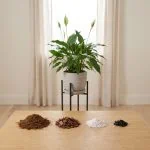
| Growing medium | A peat-and-pine-bark foliage mix, 2 parts peat moss to 1 part pine bark, top-dressed with a thin layer of the same coarse pine bark |
| Drainage hole required? | Yes |
| Standing water emptied from the saucer after every watering? | Yes |
Tap the button below to get more plant fixes in your Google Search results

Table of Contents
Reading the pot: when the water is actually due
Water is due when the top 2 inches of mix read dry to a pushed finger and the pot has gone light in the hand. It takes two checks, not one. The following sections take them in order, then the two cues that mislead people.
The dry-down depth check
Push a finger straight down at the pot edge, past the bark top-dressing, to the second knuckle. Damp below the crust says wait. Dry to that depth says pour.
The surface lies. The coarse bark on top can read pale and powdery while the peat a knuckle down still shows dark and slick on the fingertip, so a test that stops at the crust reports the opposite of what the roots are sitting in. That is how to tell when a peace lily needs water.
The pot-weight cross-check
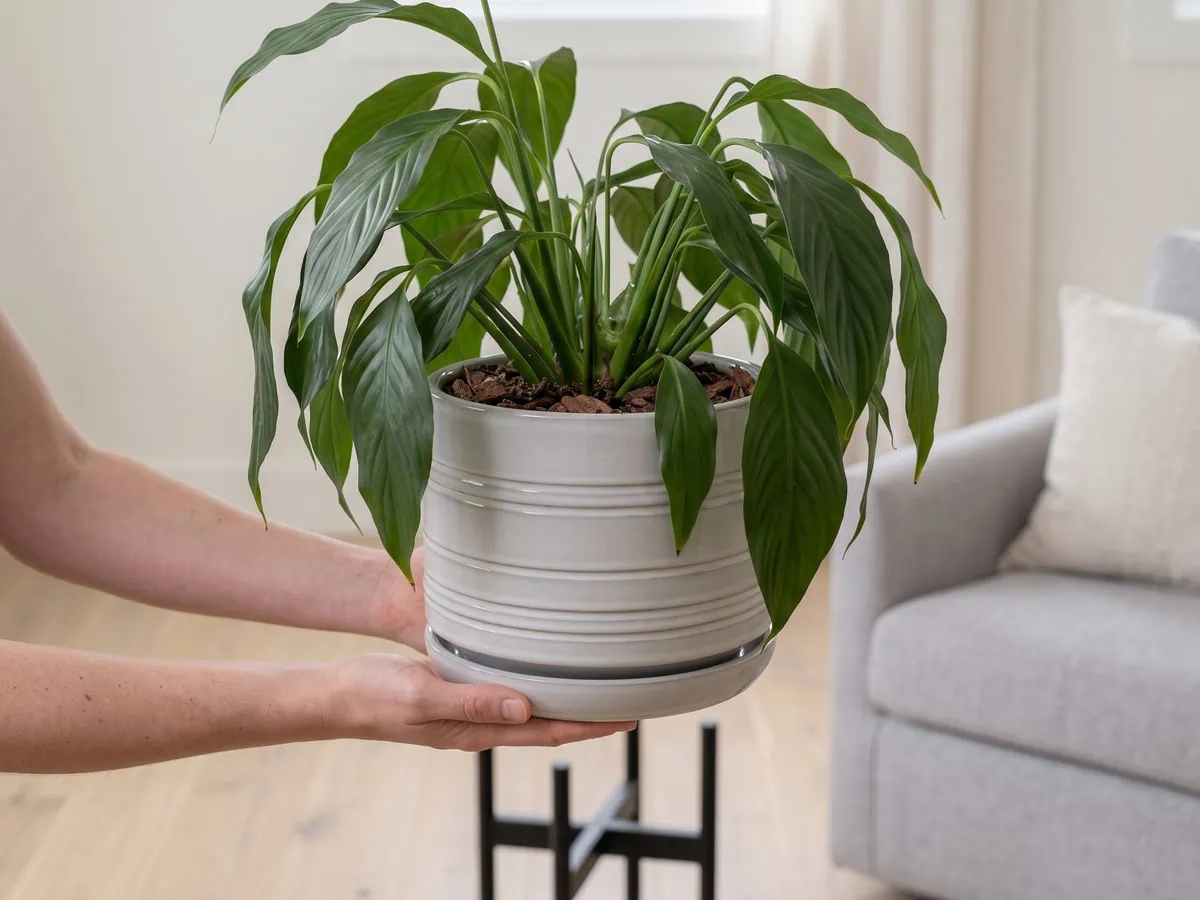
Lift the container the moment you finish watering, then again three days later. A drenched pot is noticeably heavier. A dry one feels hollow.
Weight catches what the finger misses. A rootball that has shrunk from the wall leaves a gap the water runs straight down, so the middle stays bone-dry while the top reads damp. And it needs no gear.
The droop is a late signal, not the trigger
The collapse is a real trigger, but it is the last one the plant gives you. Spathiphyllum wallisii banks no water anywhere, so turgor drains out of thin blades within hours of the substrate running dry.
And every droop takes something. Owner reports tie repeated wilting to leaves that yellow and tips that crisp days later, and yellowing never reverses. Water on the check instead, and read leaves that go limp before the next watering as proof the interval is a day too long.
What moves the interval: light, container, room air
Light moves the interval further than anything else in the room. Brighter placement drives transpiration and evaporation up together, so the same pot dries faster; a north or east window is this plant’s band, never a bare south pane.
Container and mix set the rest. A wide pot holds more wet soil than the roots can drink, which is why the mix that holds moisture without holding water shifts a schedule more than any calendar edit does.
Room air is the quiet third. Vent draft is where I stop being certain: I have a hunch about this but no peer-reviewed source. What is documented is that moving air across the blades pushes transpiration past what the roots refill.
Run both checks in one motion. Finger in at the edge, then hands under the rim and lift. Damp finger and a heavy pot together mean walk away and look again in two days.
Tap the button below to get more plant fixes in your Google Search results

How much water each time, and what to pour
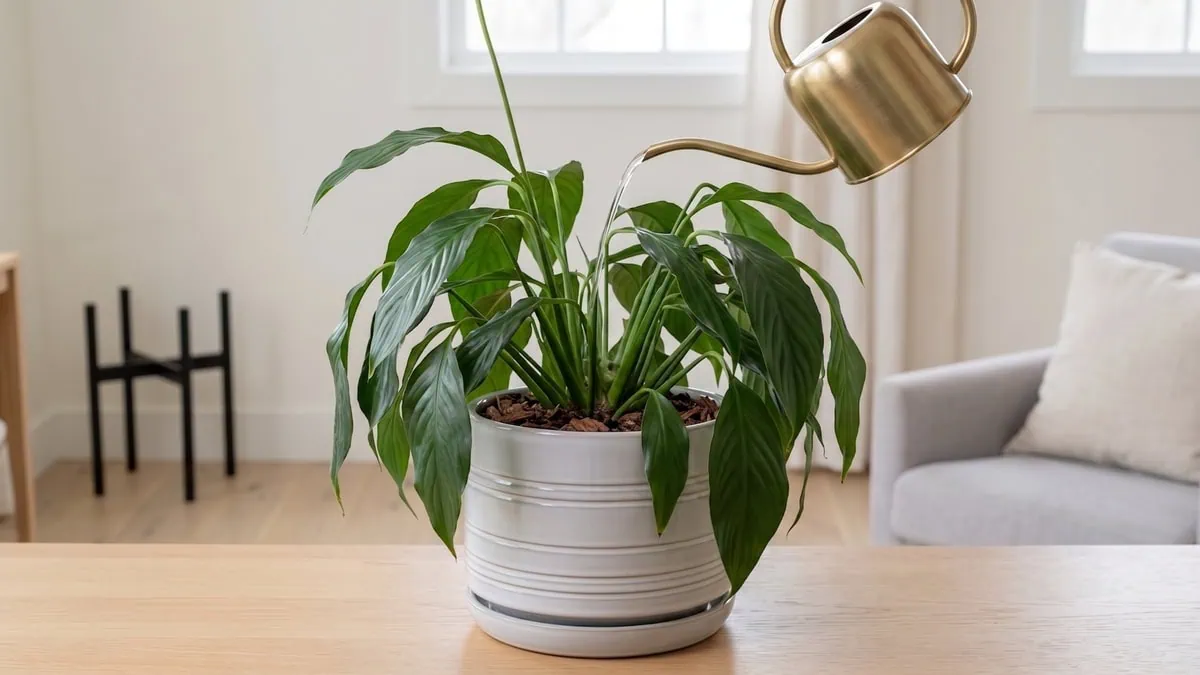
Pour until water runs from the drainage hole, then stop. The answer to how much water does a peace lily need is an endpoint you can watch for, not a volume you measure out. The following sections take the pour, the water itself, its temperature and the missed week.
Water until it runs from the drainage hole
Drench the surface evenly and keep pouring until the base leaks. Roughly a tenth to a fifth of what went in should come back out.
The run-through does two jobs. It proves the whole rootball wetted rather than one channel down the side, and it carries built-up salts out of the medium. Watch for the first bead at the saucer rim, a shade darker than the dry clay around it.
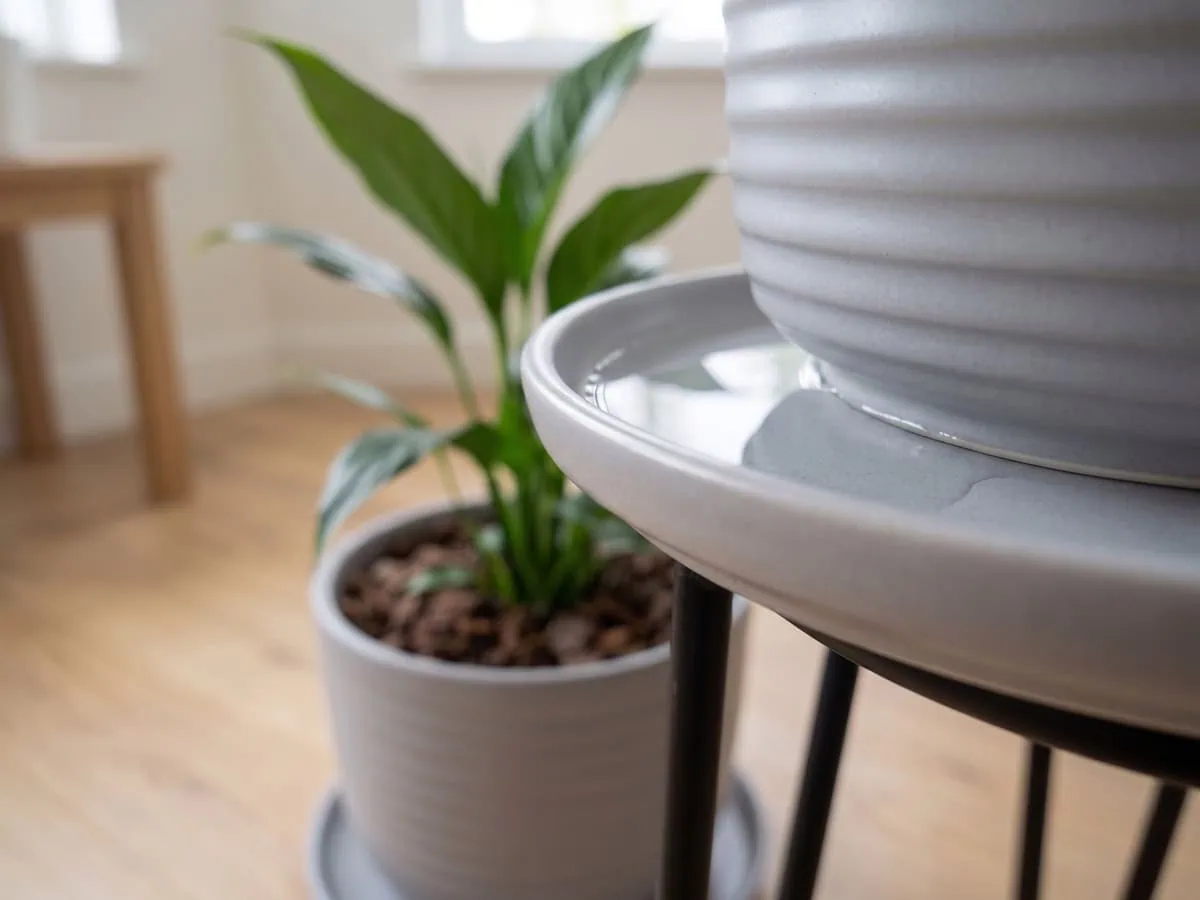
Rainwater, distilled water and tap water
Rainwater is the cleanest option, distilled is next, and ordinary tap water is acceptable. Softened water is the one to refuse outright, because the sodium a domestic softener adds does not leave with the run-through and simply builds up in the medium around the fine roots.
Standing a can overnight is half a fix. It off-gasses free chlorine and does nothing to chloramine, which many suppliers dose precisely because it stays stable for weeks. On a chloraminated supply, collect rain rather than rigging a filter train, and read brown, crisp leaf edges as the salt-load tell.
Water temperature
Pour at room temperature. Straight from the cold tap, water chills the root zone. That is when the fine roots are working hardest.
The fix is a container, not a thermometer. Draw the water, leave it standing in the room until it no longer feels cold against the back of your hand, then pour. But do not count that wait as a chloramine remedy, because it is not doing that job.
How long it can go without water
One missed week is recoverable. That is the honest boundary on how long can a peace lily go without water, and recovery shows within hours to a day of a proper soak.
Past that the picture changes. A fully dried rootball turns water-repellent and sheds a top pour straight down the inside wall, so the repair is a bottom soak rather than a second drink. Stand the pot in an inch of water, let it draw up, then drain it completely.
Not twice.
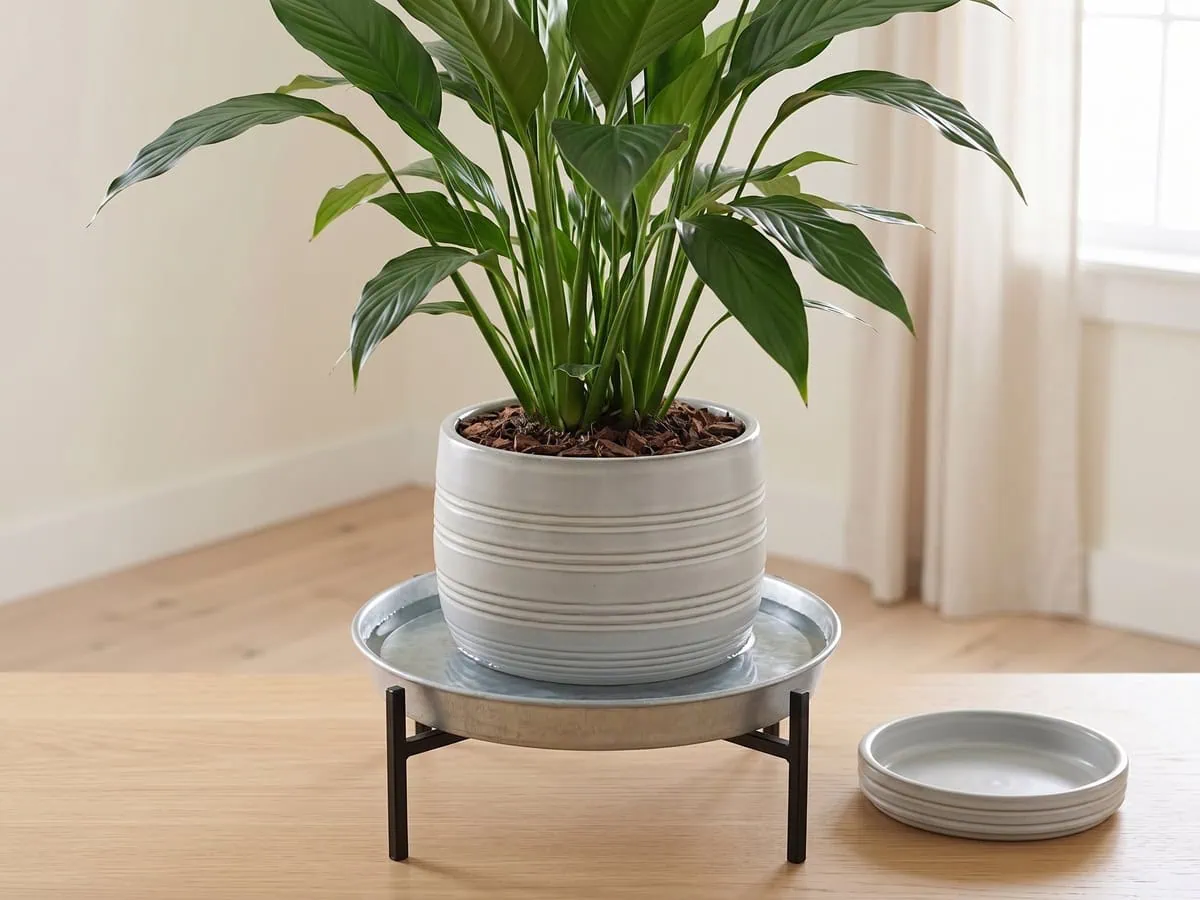
Top watering, bottom soaking and the saucer
Pour from above until the base drips, then empty whatever collects underneath. Bottom soaking is the repair, not the routine. The following sections take the soak, the saucer, and what a wet root zone actually does.
When a bottom soak is the right call
Water sits on the surface and runs to the edge instead of soaking in. That is the signal to soak from below. Not before.
Set the pot in an inch of water for 15 to 30 minutes, then lift it out and let it drain completely.
The narrow answer to “is it better to bottom water a peace lily” is this: only when the mix has stopped accepting water from above and a top pour runs straight down the inside wall. Alternate back afterwards. A soak leaves behind what a run-through flushes out.
| Method or step | What it does |
|---|---|
| Top watering | Wets the whole rootball and washes built-up salts out of the base |
| Bottom soaking | Rewets a mix that has stopped accepting water from above |
| Soak time | 15 to 30 minutes in an inch of water, then drain |
| After either one | Empty the saucer within half an hour of the drip stopping |
Verdict: Choose top watering for the routine because it flushes salts, and keep the bottom soak for a rootball that has gone water-repellent.
Emptying the saucer and the decorative outer pot
Standing water under the pot is the failure itself, not a detail. Empty it within half an hour of the run-through finishing.
Lift the inner nursery pot out of the decorative sleeve and look at the sleeve floor — the sleeve tells on the pot every time. A dark tide line a finger’s width up the inside wall points to one thing. The pot has been standing in its own runoff.
Never leave the pot standing in its own runoff. A decorative sleeve hides the water a saucer would show you, and a root zone held wet is the leading route to loss for this plant indoors.
What over-frequent watering does to the root zone
Fine roots stop working before anything above the mix looks wrong. That is what happens if you overwater a peace lily. By the time the blades go soft, roots that have already broken down take up nothing at all.
Seven of sixteen indoor cases that reached a cause landed here, ahead of dry-out at five. In my testing the tell never changed: a pot still heavy three days after a thorough watering, long before a single blade said anything about it.
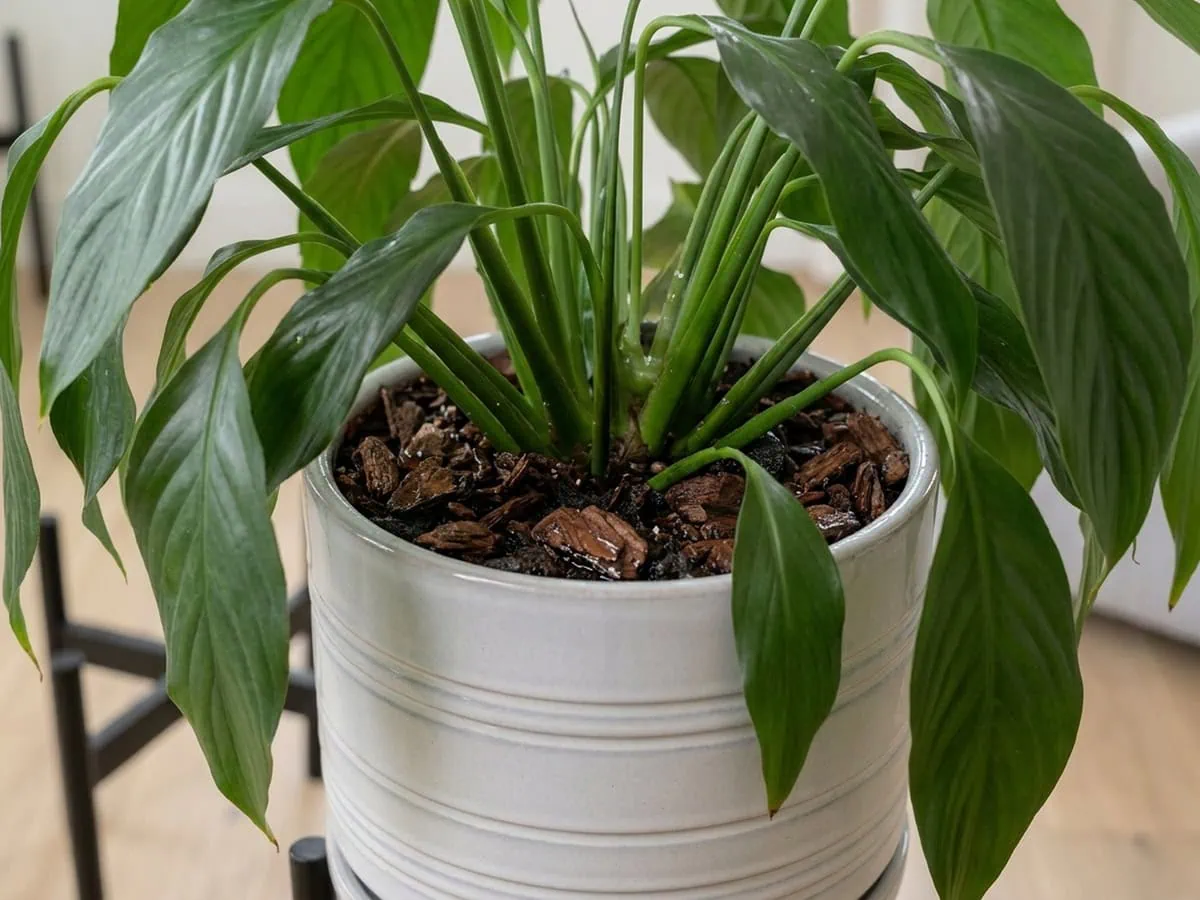
Extension research names the actual displacement at work: excess water pushes the air out of the medium first, and that drop in soil oxygen is what leaves the fine absorbing roots with nothing to work with. Crown rot follows at the base.
Frequently asked questions about peace lily watering
Do you water a peace lily from the top or bottom?
Water from the top as the routine. Pour over the surface until water runs from the drainage hole, because that run-through wets the whole rootball and carries accumulated salts out with it.
Reserve the bottom soak for the exception. Use it when the mix has gone water-repellent and a top pour runs straight down the inside wall instead of soaking in, then return to top watering next time.
Does peace lily need daily water?
No. Daily watering is wrong for this plant, because the mix is its only reservoir and a root zone held wet every day never gets its air back.
Check the pot instead. Push a finger down two inches; if the mix is still damp at that depth, skip the pour and look again in two days. Twice a week is the shortest sensible interval, and only in warm rooms.
What is the best thing to water a peace lily with?
Collected rainwater is the best option here, with distilled next and ordinary tap water acceptable. Refuse softened water: the sodium a domestic softener adds never leaves with the run-through.
Leaving a can out overnight only off-gasses free chlorine. It does nothing to chloramine, which many suppliers dose precisely because it stays stable, so collecting rain beats rigging a filter train at home.
Are coffee grounds good for a peace lily?
No. Keep the watering water plain, because this plant draws through fine roots that are already vulnerable to a mix held wet and airless.
Grounds add a damp organic layer to the surface rather than nutrition the roots can use, and that layer holds moisture exactly where fungus gnats breed. Handle feeding separately from watering, and the pour itself remains plain.
From anxious to confident in two watering cycles
Two checks decide this, and neither is a date. The mix two inches down, and the pot’s weight in your hand.
The calendar was never measuring your plant, and once you swap it for the finger and the lift, the guesswork that made watering feel risky stops.
Run the check for two cycles and note the gap. That number is yours, and it moves when the light does.
Knowing how often to water a peace lily comes down to reading the pot, and a second knuckle coming up dark says more than a date. Let the pot answer you before the calendar does, and every pour you make will land on a plant that actually asked for it.
Tap the button below to get more plant fixes in your Google Search results