
🎯 Quick Answer: cats, dogs and this fig
Yes, and “is a fiddle leaf fig toxic to cats and dogs” has one settled answer. Ficus lyrata, of the Moraceae family, is listed as mildly toxic to dogs and cats. Chewed leaves bring mild stomach upset; the milky sap irritates skin.
- First move: move the animal away and clear the fallen leaves
- Call: the ASPCA Animal Poison Control hotline on (888) 426-4435
- Do not: reach for a home remedy before you call
- Handle sap: gloves on, and wipe dripped latex off the floor
- Placement: beyond a cat’s leap and a dog’s reach
Get the one-page care card for this guide, plus a printable A4 copy
We condense this guide into one card for your phone and a print version for the pot shelf. Enter your email and we send both to your inbox. Subscribe once, then request the card of any guide you read.
By subscribing you agree to get emails from Plant Care Basics about plant care guides, about once a week at most. Unsubscribe in one click. Privacy policy
A chewed fiddle leaf fig leaf on the floor looks harmless until you turn it over and find the break still wet with milky sap — the tissue the ASPCA names as a skin irritant. That bead of latex is no wider than a pinhead and already skinning over.
Sidebar — across the fiddle leaf figs I have kept with cats, the order never changes. Owners find the leaf, then the sap, then the search bar, and only then think about ingestion.
That failure, repeated, forced me to learn that the nickname, not the irritant, is what misleads people. Wait — I’m getting ahead of myself… (FYI — the shortened English name is registered in the animal poison-control database to a different plant, one in another family.)
The poison-control record for this fig is short and specific, it names the animals and the signs and the tissue that carries the trouble, and it pairs badly with the guesswork that fills most of the pages above it. Read it once. Then set it beside the household routine behind these safety calls.
Memorizing is not the job here. The following table sets out the six lines a worried owner actually reaches for, and it fits on one screen.
Is a fiddle leaf fig toxic to cats and dogs? The safety card at a glance.
| Fiddle leaf fig specs | The safety record |
|---|---|
| Pet safe? | No – toxic to cats and dogs; mild gastrointestinal signs from the plant material and skin irritation from the sap (ASPCA). ASPCA Animal Poison Control: (888) 426-4435 |
| Which part carries the hazard | Leaves and stems, plus the milky latex any break releases |
| Signs after a small ingestion | Mild gastrointestinal irritation, most commonly vomiting and diarrhea |
| The nickname trap | The short nickname is registered to Philodendron bipennifolium, family Araceae |
| Human and infant exposure | Contact and allergic skin irritation; people call Poison Control, 1-800-222-1222 |
| Gloves before you cut? | Yes – every cut releases milky latex, and sap contact irritates skin |
You are subscribed
Press the button and we prepare this guide's one-page care card and its A4 print copy and email both to you within a few minutes.
Tap the button below to get more plant fixes in your Google Search results

Table of Contents
What the animal poison-control record says about pets and this fig
The animal poison-control record puts Ficus lyrata on the toxic side for both cats and dogs. It is a low-severity listing — mild stomach upset from chewed plant material, and skin irritation from the sap.
The following sections split that record into the tissue that carries it and the myth attached to it.

Which part carries the hazard: leaves, stems and the latex
Most people want one guilty organ named when they ask which part of a fiddle leaf fig is irritating to pets. There is none.
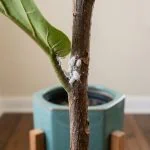
Every above-ground part a pet can reach — leaf blade, petiole, woody stem — runs the same milky latex, and a broken edge beads it within seconds, a white dot no wider than a pinhead that dulls to a skin as it dries.
I once wiped a fresh bead with a dry sleeve. That spread it further than the break ever would have. Sap is sticky, not watery, so a damp cloth lifts it off and a dry one drags it wider.
If it lands on skin rather than a floorboard, handling the same sap safely on your own skin is the fuller answer.
Why the calcium-oxalate answer belongs to another plant
Search the shortened nickname in a pet-safety database and you land on Philodendron bipennifolium, an Araceae plant whose toxic principle is insoluble calcium oxalate. So the calcium-oxalate claim about this fig starts as a name collision. Not a chemistry finding.
According to the ASPCA Animal Poison Control Center, the genus record that does carry named compounds is the animal poison-control database entry for the weeping fig — a different species again. I could be wrong here, but the listing for this fig stops at irritant sap and mild stomach signs, and that is the line worth quoting.
Myth: a fiddle leaf fig burns a pet’s mouth with calcium oxalate crystals. Fact: that compound belongs to an Araceae plant registered under the same short nickname. The fig’s own record lists mild gastrointestinal irritation and irritant sap, and names no compound at all.
Get the one-page care card for this guide, plus a printable A4 copy
We condense this guide into one card for your phone and a print version for the pot shelf. Enter your email and we send both to your inbox. Subscribe once, then request the card of any guide you read.
By subscribing you agree to get emails from Plant Care Basics about plant care guides, about once a week at most. Unsubscribe in one click. Privacy policy
Tap the button below to get more plant fixes in your Google Search results

What to do in the first minutes after a pet bites a leaf
Ask what should I do right after my dog bites a fiddle leaf fig and the honest answer is a sequence, not a remedy.
Stop the exposure, then make contact. The following sections cover the dish to skip, the coat to check, and the watching that follows.

Why the milk-and-yogurt step is the one to skip
One widely copied page tells owners to offer water, milk or plain yogurt after a bite. Three other care guides I compared tell the owner to put nothing in the animal’s mouth until a veterinarian says so. Skip the dish.
Nothing by mouth. The disagreement is not really about dairy — it is about who acts first, and the sequence only works in one order, so let the instruction to give or withhold anything come from the person on the phone.
This information is for educational purposes only and is not a substitute for professional veterinary advice. If your pet ingests any part of this plant, seek immediate veterinary intervention or contact the ASPCA Animal Poison Control Center (888-426-4435) or the Pet Poison Helpline (855-764-7661) immediately.
Sap on the coat: the step to take before grooming
The care guides I compared state that sap reaches fur and skin, and only one guide gives a rinsing instruction — written for the veterinarian, after arrival. (pedantic, I know, but it decides the call)
I left a smear on a cat’s shoulder once and only noticed it after it had dried. Wipe the residue off the coat with a damp cloth before the animal settles down to groom.
What you can actually see is a leaf on the floor mat and a stem above it still beading — a white dome no bigger than a match head, holding its shape while the animal circles back for a second look.
The leaf has its own story; why leaves reach the floor in the first place is worth reading once the animal is settled.

How long to watch after a bite
Owners search what happens if a cat chews a fiddle leaf fig leaf and want a clock issued with the answer. The published record for this species carries no onset or duration window, and the only timing in those guides is written for fig trees as a genus.
But the trigger is the event. Make contact when you see the bite rather than when the vomiting starts, and let the person on the phone tell you how long the watching should run.
Do not induce vomiting unless a veterinarian instructs you to. Call the ASPCA Animal Poison Control Center on (888) 426-4435 or your own veterinarian, and let them set the next step.
Keeping a fiddle leaf fig and a pet in the same home
A fiddle leaf fig and a cat can share a home. The arrangement holds on placement rather than on goodwill, and placement is where most advice goes soft.
Reach, deterrents and the substitute question are what the following sections cover.
Why height is not the same as out of reach
Owners look up how to place a fiddle leaf fig out of reach of a cat and land on shelf heights. Cats climb. A dog on its back legs clears most shelves, so the only placement that reliably holds is a room the animals do not enter.
This is a floor-standing specimen, two to ten feet indoors, capped by pruning and pot volume, so a hanging basket is not an option for a mature one. Sweep dropped leaves: a fallen blade curls at the margin once dry, and pets chew it.
Scented deterrents: assessed for the plant, not the pet
Citrus and essential-oil deterrents are the standard recommendation, and across the twelve care guides I reviewed, every warning attached to them is a warning about the plant — chemical burn on roots, oils kept off the soil. Not one assesses the substance against the animal.
So the safer instruction is the physical one. No bottle required. A closed door, a barrier, or a stand the animal cannot use as a step needs no substance at all.

Pet-safe substitutes, sorted by the floor space you fill
Ask is there a pet friendly alternative to a fiddle leaf fig and the lists that come back are inventories rather than replacements. Sort them by what you are actually replacing: the floor position, or simply something green the animal will leave alone.
Most named substitutes are small plants, and the guides I reviewed attach a size term to exactly one of them. If it is the corner you are filling rather than a shelf, telling this tree apart from the two figs sold beside it is the more useful comparison.
One worry you can drop: this fig rarely flowers indoors, so there is no pollen falling onto a carpet for a cat to walk through, and the fruit that bears the seeds is not seen on container-grown plants either.
- Pebble top-dressing: a layer of river stone over the mix surface — discourages digging and soil-flinging.
- Dried citrus peel: at the pot base — a commonly suggested pet-safe option, with efficacy varying by animal.
- A closed room: the plant and its stand behind a door the animals do not open — the placement that holds for a climber.
Frequently asked questions about fiddle leaf figs and pets
What happens if a cat eats a fiddle leaf fig?
Mild gastrointestinal irritation is the documented outcome, most commonly vomiting and diarrhea. Poison-control listings grade that exposure as low severity rather than as a systemic poisoning, and the chewed plant material is the vehicle.
Sap on the lips or gums adds skin irritation to that picture. Call the hotline or your veterinarian rather than waiting to see how bad it gets, because the record covers what happens and not how long it runs.
Can I have a fiddle leaf fig if I have a cat?
Yes, if placement does the work. The plant stays toxic whatever room it stands in, so the arrangement depends on the cat not reaching it rather than on the fig becoming safe.
A room the cat does not enter is the placement that holds, and a shelf is not, because cats climb. Sweep fallen leaves promptly, since a dropped piece on the floor is what most animals actually chew.
My dog ate a fiddle leaf fig leaf. What should I do?
Take the plant material away, then call the ASPCA Animal Poison Control Center on (888) 426-4435 or your own veterinarian. Never make the dog vomit unless one of them instructs you to.
Give nothing by mouth on your own initiative, milk and yogurt included. If sap reached the coat, wipe it off with a damp cloth before the dog grooms, and tell the clinic what was chewed and roughly how much.
Is fiddle leaf cat friendly?
No. The species is listed as mildly toxic to cats, and the sap irritates skin on contact.
Be careful with the nickname, though. The shortened form is registered in the animal poison-control plant database to Philodendron bipennifolium, an Araceae plant with a different toxic principle entirely, so searching by nickname returns the wrong plant. Look the safety record up under the binomial Ficus lyrata instead.
What plants are toxic to cats?
Too many to list here, and the answer that matters is the one for the plant standing in your room. For this fig the record is clear: toxic to cats and dogs, with mild gastrointestinal signs and irritant sap.
Look each plant up by its binomial rather than its nickname in an animal poison-control database, because common names collide across plant families. That single habit removes most of the confusion this question runs into.
How do I stop my cat from eating plants?
Physical separation is the measure the sources back without caveat. A closed door beats a high shelf, since a cat uses a shelf as a step.
Pebble top-dressing over the mix discourages digging, and dried citrus peel at the pot base is a commonly suggested option whose efficacy varies by animal. Note that the published advice on scented deterrents assesses them only for damage to the plant, never for effect on the cat.
What do I do if my cat ate a toxic plant?
Remove the plant material first, then make contact: the ASPCA Animal Poison Control Center on (888) 426-4435, or your veterinarian. The event triggers contact, not the appearance of symptoms.
Bring or name the plant, ideally by its binomial, and say what part was chewed. Withhold home remedies until you are told otherwise, because the published record for this species stops at the signs themselves, and waiting to see is not a plan.
Lesson locked. Take the placement decision today.
Put bluntly. The toxicity was never the hard part. Mild, documented, six lines long.
The part that decides outcomes is where the pot stands and what you do in the first two minutes — stop the exposure, make the call, put nothing in the animal’s mouth.
Choosing a room the pets do not enter beats any shelf you can reach, and it beats the white smear you will otherwise find dried on a floorboard the next morning.
The sap question on your own skin is a different record. The short version of is a fiddle leaf fig toxic to cats and dogs is yes, mildly, and manageable — so move the pot today rather than after the next chewed leaf.
Every break on this fig bleeds the same white, so glove the hand that cuts and sweep up the leaf that falls before a curious nose finds it.

Get the one-page care card for this guide, plus a printable A4 copy
We condense this guide into one card for your phone and a print version for the pot shelf. Enter your email and we send both to your inbox. Subscribe once, then request the card of any guide you read.
By subscribing you agree to get emails from Plant Care Basics about plant care guides, about once a week at most. Unsubscribe in one click. Privacy policy
Tap the button below to get more plant fixes in your Google Search results